
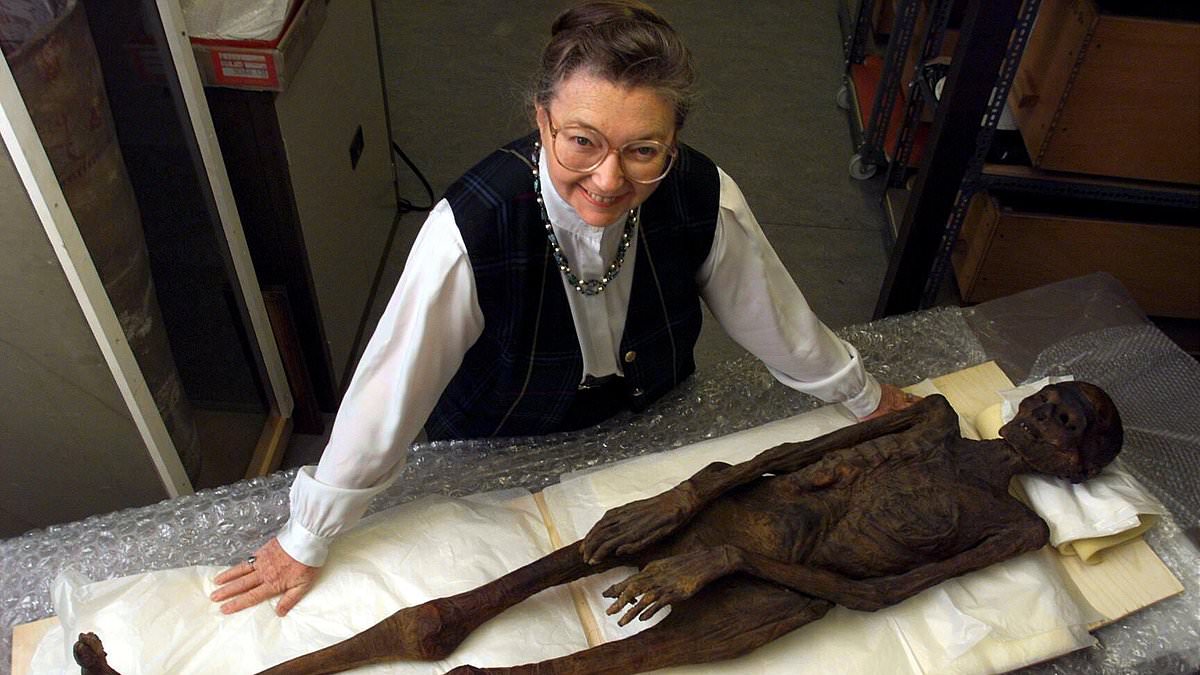
Manchester Museum has removed an Egyptian mummy on display for over 200 years to 'respect her wishes'. Curators said they decided to stop showing the 2,700-year-old remains of a woman named Asru in a decision they said 'aligns most closely with what we understand about her own wishes'. Asru's mummified body was donated to the Manchester Natural History Society in 1825, then carefully unwrapped and displayed in the Oxford Road museum's Egypt and Sudan gallery. 'Before making this change, we consulted with Egyptian colleagues, members of the Egyptian diaspora and visitors to the museum, helping us to understand people's feelings about care for mummified people,' a spokesperson for the museum told the BBC. Ultimately, however, the decision to 'remove Asru from display aligns most closely with what we understand about her own wishes,' they added as 'elite Egyptians of [Asru's] time expected their mummified bodies would remain...invisible to the living'.The daughter of 'Pa-Kush', meaning a black Sudanese man, Asru is believed to have been 60 when she died in 650 BC. Inscriptions on her coffin suggest she was a temple musician. Dr Rosalie David, keeper of etymology at Manchester Museum, pictured with the mummified remains of Asru Asru's remains were dug up in Luxor, the site of the ancient city of Thebes, before they ended up in the possession of Manchester traders, William and Robert Garnett, sometime in the early 1800s.Last year, the museum asked visitors whether they 'should continue to display the body of Asru' when they added a plaque that revealed her body was 'unwrapped' at the Manchester Natural History Society in April 1825. 'She has regularly been on display for the two centuries since. In that time, we have also changed as a museum and are thinking more about how we care for people,' the plaque read. For now, Asru's coffin and body have been kept in storage at Manchester Museum before officials decide whether they will be returned to Egypt. It comes amid a debate on whether the display of mummified bodies is ethical as the Manchester Museum spokesperson said 'elite Egyptians of [Asru's] time expected that their mummified bodies would remain wrapped in their coffins, invisible to the living'. Mummification was an ancient Egyptian practice of preserving a dead body before wrapping it in hundreds of strips of linen. Asru, believed to have been a chantress at the ancient Temple of Amun in Karnak, was the last mummy on display at Manchester Museum. A spokesperson said the decision 'reflects changes in how we think about our responsibility towards ancestors, museum collections and the communities they represent'. The daughter of 'Pa-Kush', meaning a black Sudanese man, Asru is believed to have been 60 when she died in 650 BC. Inscriptions on her coffin suggest she was a temple musicianIn 2020, the famed Pitt Rivers Museum removed mummies as well as shrunken heads made by an Amazon headhunting tribe after bosses said exhibiting human remains 'reinforces racist and stereotypical thinking'.The removal was part of a three-year internal review at the Oxford museum to 'deeply engage with its colonial legacy' and 'inform a plan for decolonisation'. Last year, the all-party Parliamentary Group for Afrikan Reparations branded the continued display of human remains 'unethical' and said mummies had been 'looted' from Egypt and subject to 'racist pseudo-scientific research'.Led by Labour MP Bell Ribeiro-Addy, the group of 16 parliamentarians have called for the return of all human remains held by British institutions to their country of origin.Returning human remains would assist the African diaspora in 'healing from the traumas of enslavement and colonial violence', a report titled Laying the Ancestors to Rest said.The report stated mummified bodies and other remains were 'looted' before being brought to the UK, 'often as trophies and as commodities to be traded and displayed as curiosities'.It cites the British Museum, Natural History Museum and several universities among the offenders, and claims they represent 'continuous acts of displacement and objectification of human beings.''In the UK, the mummified person has been excavated and brought back to the UK as an object of racist pseudoscientific research, including in efforts to evidence that Egyptians were white Europeans,' they wrote.It comes after the British Museum said it would stop using the word 'mummy' to describe the remains of ancient Egyptians out of 'respect'. The institution, which is home to over 100 mummies, in 2023 said it would use the phrase 'mummified remains' to reiterate that visitors were looking at people who once lived. The Great North Museum: Hancock in Newcastle said that it has also adopted new terms including 'mummified person' to acknowledge the history of colonial exploitation and to give her the respect she deserves.National Museums Scotland in Edinburgh has also removed the word 'mummy' from labels on its human remains.A spokeswoman said: 'Where we know the name of an individual, we use that, otherwise, we use "mummified man, woman, boy, girl or person" because we are referring to people, not objects.'The word "mummy" is not incorrect, but it is dehumanising, whereas using the term "mummified person" encourages our visitors to think of the individual.'Museums are also concerned that the word has become linked to terrifying monsters, thanks to countless horror B-movies such as 1932's The Mummy.
Museum removes Egyptian mummy from display after 200 years 'to respect her wishes'
Full Article
Original Source
Read the full article at Dailymail →KhanList aggregates and links to publicly available news content. We do not host full articles from third-party sources. Always verify important information with original sources.