
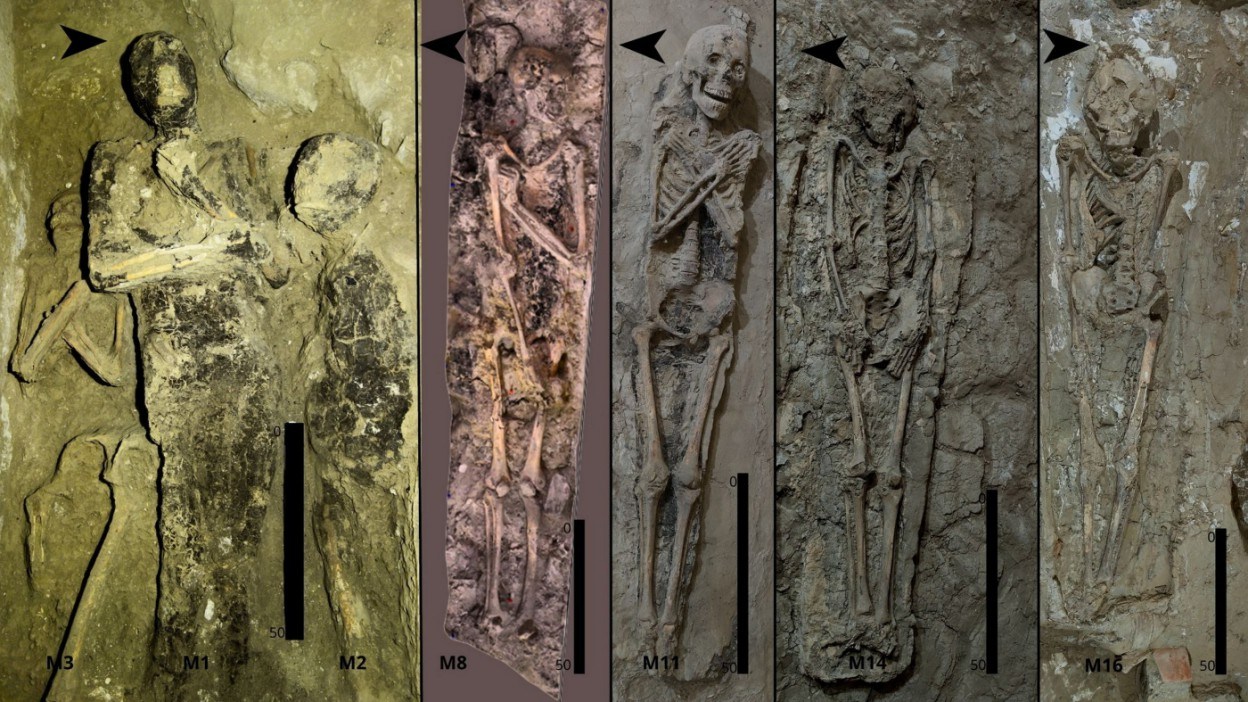
Credit: Jared Carballo-P¿rez / SWNS ARCHEOLOGISTS have discovered a mummified dog resting on top of the remains of a man and woman in an ancient Egyptian chamber. The chamber is just one of hundreds of burial sites in the Theban Necropolis, an ancient cemetery across the Nile from Luxor. Outside of Chamber TT 209 in the Theban Necropolis Credit: Jos¿ Miguel Barrios Mufrege/SWN Mummified individuals found inside the burial site Credit: Jared Carballo-P¿rez / SWNS Researchers found bodies stacked on top of one another, and over the centuries, later burials were squeezed into the remaining space. The cemetery was reused by mourners for more than 700 years. Sign up for the Tech newsletter Thank you! The most striking discovery was a mummified dog resting on top of the remains of a man and woman. The researchers say the arrangement could suggest the animal had a special relationship with the pair or been intended as a guide to the afterlife. First author Dr Jared Carballo-Pérez, a researcher at the University of La Laguna, in Spain, said: “Anthropologically, placing an animal so close to human burials can suggest some kind of meaningful relationship.” “I find it moving because these human-animal connections are something we can still recognize today, but I try to keep that personal reaction separate from the scientific interpretation.” A sketch of the dog buried on top of the man and woman Credit: Jared Carballo-P¿rez / SWNS A sketch of the tomb layout Credit: Jared Carballo-P¿rez / SWNS Around 680-404 BC, towards the end of the 25th dynasty and the Persian period, bodies were inserted into any space available. This led to burial changes, such as arms folded in, instead of the previous custom of arms stretched out. Most read in Tech They also started to stack bodies on top of each other to make the most of the space. Despite the cramped conditions, experts say the tomb was not an unorganised mass grave. Instead, each new burial adapted to those already inside. The team excavated the chamber, recording their findings through photographs, sketches and written notes of the mummies’ position and orientation. The study, published in the journal Frontiers in Environmental Archaeology, reads: “Overall, the chamber can be understood as a funerary space with an accumulative biography, in which reuse did not simply involve the addition of burials, but the progressive transformation of the organization, materiality, and meaning of the space itself.” In some of the earliest deposits, dating back 2,500 years, researchers found spaced out burials where bodies were placed in coffins. Senior author Dr Molinero Polo said: “The earliest individuals buried here appear to have been of high social standing, as they were interred in coffins, with funerary nets and amulets, and with an assemblage containing costly items.” Experts have warned that the growing global trade of mummies could release “a real mummy’s curse” of ancient fungal spores on the world. They say there are risks of dormant microorganisms and toxic preservation materials being released when mummies are moved or disturbed. Some of the severe health risks include severe poisoning, brain damage, cancer, liver and kidney issues, skin lesions and lung irritation. Comment now
Mummified DOG found on top of man and woman in creepy ancient Egyptian tomb stuffed with 14 other skeletons
Full Article
Original Source
Read the full article at Thesun →KhanList aggregates and links to publicly available news content. We do not host full articles from third-party sources. Always verify important information with original sources.