
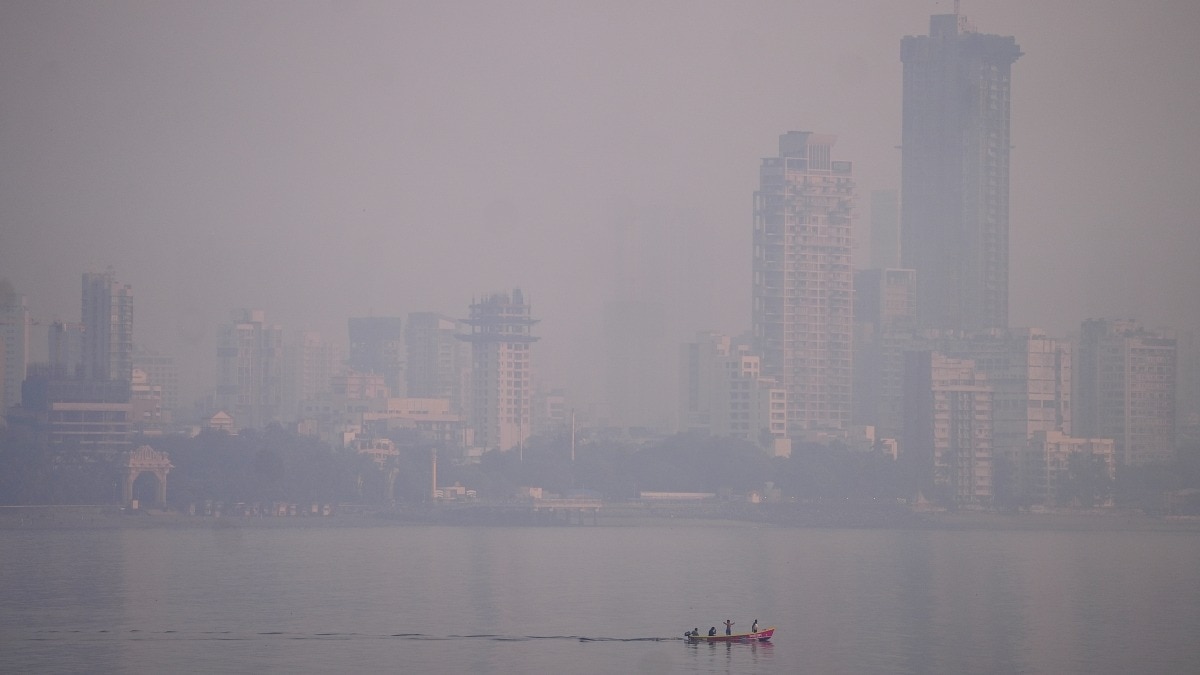
Mumbai's air quality worsened sharply in early October, with the AQI touching 197 and PM2.5 levels rising across several neighbourhoods. The spike has renewed concern over post-monsoon pollution and its health risks, though the exact drivers need deeper analysis.Mumbai: A boat moves in the Arabian Sea as haze covers the city skyline, in Mumbai. (Photo: PTI)New Delhi,Oct 9, 2026 13:22 ISTMumbai’s air quality has deteriorated sharply in early October, with rising levels of fine particulate matter pushing pollution into the poor and unhealthy categories across several parts of the city. The AQI jumped to 197 on Thursday night.The worsening air comes as the city transitions out of the monsoon, raising concerns about the return of pollution that often accompanies the cooler, drier months.According to live air quality data updated on October 9, Mumbai recorded an Air Quality Index (AQI) of 137 on the US scale, placing it in the poor category. The concentration of PM2.5 stood at 51 micrograms per cubic metre, while PM10 levels reached 62 micrograms per cubic metre.Historical data show that PM2.5 pollution has climbed significantly since the end of September. Concentrations that were largely below 60 micrograms per cubic metre during much of September rose sharply around October 1, when levels approached 140 micrograms per cubic metre. Photo: AQI.in After fluctuating over the following days, PM2.5 reached a reported peak of 150 micrograms per cubic metre on October 8.The data also shows that Mumbai’s daily PM2.5 exposure exceeded the World Health Organization’s recommended 24-hour guideline of 15 micrograms per cubic metre on 28 of the 30 days monitored.WHY IS AIR POLLUTION RISING IN MUMBAI? One important factor is the seasonal transition following the monsoon. Rainfall helps wash suspended particles out of the atmosphere, while stronger winds can disperse pollutants. As rainfall decreases and weather conditions change, pollutants can accumulate more easily, particularly when atmospheric mixing is limited.Construction activity, road dust and vehicular emissions are other potential contributors. Mumbai’s dense traffic generates exhaust emissions, while construction sites and roads can release dust into the air. Industrial activity and emissions from other urban sources may add to the pollution burden. The Siddhivinayak Temple in Prabhadevi illuminated on the occasion of Angarki Sankashti Chaturthi, as dark clouds gather over the city skyline, in Mumbai, Tuesday, Sept. 29, 2026. (PTI Photo) Weather conditions also influence how long pollutants remain suspended. High humidity, weak winds and atmospheric stability can affect the dispersion of particulate matter, although the relative contribution of each factor requires detailed meteorological and emissions data.The latest readings show pollution across multiple neighbourhoods.Anushakti Nagar recorded an AQI of 153, classified as unhealthy on the displayed scale, while Ambivali registered 139 and Andheri East 134. Bandra East recorded 141, highlighting that poor air quality is not confined to a single pocket of the city.WHAT DOES THIS MEAN FOR RESIDENTS?PM2.5 particles are small enough to penetrate deep into the lungs and can enter the bloodstream. Exposure can aggravate asthma and other respiratory conditions and increase cardiovascular risks, particularly among children, older people and those with existing health problems.With pollution rising ahead of the winter season, sustained monitoring of construction dust, traffic emissions and industrial sources will be important. Photo: AQI.in Residents can reduce exposure by limiting strenuous outdoor activity during high-pollution periods and following local air-quality advisories.The early-October rise is a warning that Mumbai’s post-monsoon pollution season may be gathering pace. However, identifying the precise causes of the latest spike will require source-specific measurements and meteorological analysis rather than AQI readings alone.- Ends
Mumbai's AQI jumps to 197: What's behind the rising air pollution?
Full Article
Original Source
Read the full article at Indiatoday →KhanList aggregates and links to publicly available news content. We do not host full articles from third-party sources. Always verify important information with original sources.