
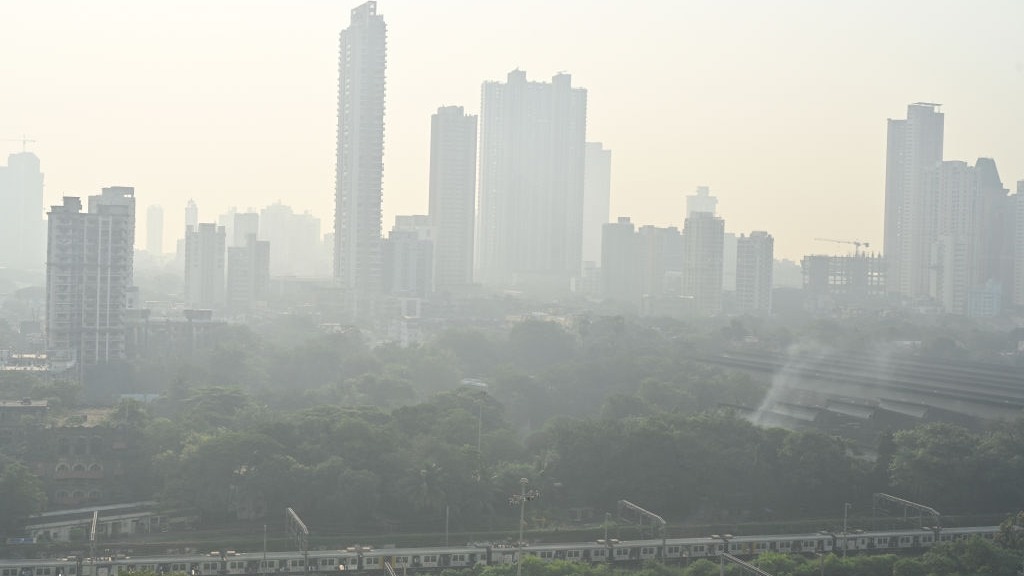
Mumbai, as writers have often put it, was "stolen from the sea". The Arabian Sea has long been the city's natural shield against pollution, with its winds helping disperse the kind of toxic air that engulfs northern India, especially Delhi, every winter. But the sea breeze is failing to protect it this time.This is the second time in 2026 that Mumbai's air quality index (AQI) has been worse than Delhi's. Last week, Mumbai topped India's pollution rankings and stood fifth globally on iQAir's list, recording an AQI of 152 on October 15. This comes amid unusually hot and humid weather, following a rain-deficient monsoon. Earlier this year, in January and February, Mumbai's AQI had reached around 400.The familiar suspects — construction dust and vehicular emissions — are only part of the picture.Experts India Today Digital spoke to suggest sluggish winds are allowing pollutants to accumulate, while agricultural fires inland, garbage burning in rural areas around Mumbai, and festival-season firecrackers are adding to the toxic mix. Atmospheric scientist Gufran Beig said changing weather patterns might be worsening the situation, in this case, a Super El Nino, while environmental activist Sumaira Abdulali warned that the cumulative impact of pollution sources is being compounded by weak enforcement.The deterioration of the air quality has again drawn scrutiny from the Bombay High Court, which has questioned the authorities over Mumbai's worsening air and sought details of the steps being taken to enforce pollution-control measures. The High Court described the situation as an emergency and questioned how Mumbai could be more polluted than Delhi. On October 21, the court directed the police, the Brihanmumbai Municipal Corporation (BMC) and the Maharashtra Pollution Control Board (MPCB) to explain the steps taken to enforce its orders on pollution and firecracker use. The authorities have been asked to present their enforcement measures at the October 26 hearing.Delhi's toxic winter air has become an annual fixture. It's driven by a familiar combination of stubble burning in Punjab and Haryana, vehicular emissions, construction dust and weather conditions that trap pollutants close to the ground. Low wind speeds and high moisture levels worsen the problem, while shifts in paddy sowing and harvesting schedules have pushed more farm fires into November. Delhi's winter smog has become so routine that it is not even surprising any more.But when a coastal city like Mumbai, long believed to have nature on its side, begins to record similarly poor air quality, it becomes news. Mumbai's skyline is shrouded in dense smog amid deteriorating air quality. (Image: Getty Images) SLOWER WINDS TRAPPING POLLUTANTS OVER MUMBAIGufran Beig, chair professor at the National Institute of Advanced Studies on the IISc campus, said Mumbai's coastal location usually helps disperse pollutants. But that advantage weakens when winds slow down."The overall wind speed is becoming slower. In a city like Mumbai, where winds are usually stronger, even a slight stagnation can lead to an accumulation of pollutants. This is one of the reasons why pollution levels are rising right now," he told India Today Digital.In simpler terms, when air moves slowly, pollution from vehicles, construction and other sources does not disperse as quickly. It can accumulate close to the ground, worsening the air people breathe.Beig said El Nino is expected to bring a relatively mild winter this year, with temperatures potentially remaining higher than usual. He explained that warmer air near the surface can carry pollutants upwards, but cooler air above can restrict their further movement and affect how they disperse."When surface temperatures are higher, pollutants emitted near the ground can rise more quickly because warmer air promotes vertical movement," Beig said. He added that when this warmer air meets cooler air above, it can limit further movement and affect the dispersion of pollutants.Beig also flagged a potential gap between visible pollution and official readings. Mumbai's coastal meteorology, he said, can make it difficult for measurements taken at a particular height to capture the haze and pollution people experience closer to the ground. "The real concern is that a common person can see pollution clouds or haze with the naked eye, yet the ambient air quality readings reported by authorities may not appear as bad," he said.The distinction matters because AQI readings depend on the monitoring station, the pollutants measured, and the index being used. For instance, iQAir's October 15 reading of 152 used the US AQI scale, while the Central Pollution Control Board's (CPCB) citywide reading that day was 98 on India's National AQI scale. The two figures are not directly comparable.CAN STUBBLE BURNING IN MADHYA PRADESH, JHARKHAND AFFECT MUMBAI?Beig's latest assessment pointed to agricultural fires as a possible contributor, although he cautioned that their impact depends on wind direction, speed and how long pollutants remain in the atmosphere."During this period (October-November), winds generally come from north-east of Mumbai. They can carry emissions from areas such as Madhya Pradesh and Jharkhand towards Mumbai, where stubble burning also takes place," he said.However, he stressed that the distance between the states is considerable and winds might weaken before reaching Mumbai."There is no likelihood of stubble-burning pollution from Delhi, Punjab and Haryana reaching Mumbai through the winds. Madhya Pradesh and Jharkhand are a more relevant source to examine because of the prevailing wind patterns during this period," he said.Beig told India Today Digital in February that east-to-west winds during the season could carry pollutants from stubble-burning fires inland towards Mumbai. Eight months later, his assessment had shifted with the changing wind patterns.Notably, a 2018 report by Down To Earth magazine, citing a study by Indian and US scientists, found that pollutants from stubble burning in Punjab, Haryana and western Uttar Pradesh could travel as far as Maharashtra and Madhya Pradesh, with prevailing winds carrying emissions beyond northern India. Mumbai rarely experienced such smog because sea breezes helped disperse pollutants, carrying them inland towards the Western Ghats. (Image: Getty Images) FARM FIRES, GARBAGE BURNING ALSO AFFECT MUMBAI'S AQIFarm fires and garbage burning in and around Mumbai are adding to the city's pollution burden, with their impact depending on wind patterns and changing climatic conditions. These sources were also examined by India Today Digital in February this year, when Mumbai's air quality was worse than Delhi's.Atmospheric scientist Gufran Beig had pointed to changing climatic conditions making the effects of agricultural burning in Maharashtra more noticeable, even though the stubble burning in the state has continued for decades. In Maharashtra, crop-residue burning mainly occurs during February-May and October-November, with the exact months varying by crop and region.Sumaira Abdulali, founder of the Awaaz Foundation, has also flagged crop-residue burning and garbage fires in rural areas around Mumbai as contributors to pollution."Just south of Mumbai, even in the Alibaug area and in rural belts around the city, garbage is being burnt in the open," Abdulali said, pointing out that many villages lack formal waste-collection and disposal systems. Residents often resort to burning waste along roadsides and on open grounds.She highlighted the collective impact of these sources, saying, "The cumulative impact of both these factors could be significant depending on wind patterns."Waste burning in areas including Bhiwandi in Thane district and Alibaug in neighbouring Raigad district is a big concern for Mumbai's worsening air quality. Abdulali's sensor-based readings recorded PM2.5 levels exceeding 1,000 near roadside garbage fires, while readings in parts of Alibaug ranged between 300 and 400. The lack of official air-quality monitoring stations in many rural areas makes it difficult to track the full extent of the problem.FIRECRACKERS ADDING TO THE POLLUTION BURDENAbdulali told India Today Digital, "Tests had found toxic heavy metals in firecrackers, including those marketed as green crackers." She warned that the label offered no guarantee of safety, particularly when regulations were not properly enforced.She said Mumbai had little time to recover between successive celebrations, with Diwali, Christmas and New Year still ahead.Abdulali called for a ban on all firecrackers, arguing that children, older people and those with breathing difficulties would be among the first to suffer if pollution continued to worsen.Her concerns also extend to enforcement. Abdulali wrote to Maharashtra Chief Minister Devendra Fadnavis dated October 21, a copy of which India Today Digital accessed. The letter to the CM documented the usage of firecrackers despite the ban, mentioning that the Bombay High Court had prohibited firecrackers in public spaces, including roads and footpaths, during festivals in 2026 and directed the police to measure decibel levels and take appropriate action.She urged the state government to ensure the directions were followed during the remainder of the festival season.The court's latest intervention follows its earlier criticism of civic authorities over the city's pollution. In January, the Bombay High Court had expressed displeasure over the failure to bring down pollution levels in Mumbai and Navi Mumbai, warned the BMC and Navi Mumbai civic commissioners that his salary could be withheld and criticised the implementation of pollution-control measures.Mumbai's pollution problem, therefore, extends beyond a single source or season.For a city whose coastal winds have long helped disperse pollution, the current spell is a reminder that geography alone cannot guarantee clean air when weather conditions and multiple emission sources work against it.- Ends
Mumbai has the sea, so why is its air now worse than gas chamber Delhi's?
Full Article
Original Source
Read the full article at Indiatoday →KhanList aggregates and links to publicly available news content. We do not host full articles from third-party sources. Always verify important information with original sources.