
Jensen Huang’s return to the CEO position at Nvidia, just 11 days after his departure, does not mean that the crisis at the artificial intelligence (AI) chip giant is over. The market rewarded the stock on Monday with a 31% surge, adding to its market capitalization of $952 billion — the largest single-day gain in history. The rebound was a lifeline for Huang, the largest private shareholder with nearly 3.5% of the company’s equity, but the stock price is still far from stabilizing. On Tuesday, at times, it fell by more than 6%.In general terms, as The Wall Street Journal points out, the company must address the risks associated with its business model and the AI ecosystem — of which Nvidia is one of the major funders — with an exposure of more than $110 billion invested in dozens of companies, including startups such as OpenAI and Nscale, as well as publicly traded firms like Anthropic, SpaceX, CoreWeave, Nebius, Intel, Marvell, Synopsys, Nokia, Coherent, Lumentum, and Corning, among others.Concerns have resurfaced in the market about what could amount to circular financing. In this regard, Huang’s return does not resolve structural concerns about an AI bubble or the interconnected business model among the industry’s major players, in which Nvidia provides loans, investments, and financial guarantees to help customers purchase its own chips. As its stock price plummeted — at its worst, falling nearly 50% from its all-time high recorded on October 6 — Nvidia dragged down CoreWeave and Nebius, both of which are closely monitored by rating agencies. Nscale also fueled doubts about AI by acknowledging that it will need new funding, after its losses multiplied and uncertainty arose regarding its initial public offering.All of this is on the external front. Internally, the key issue Nvidia must resolve relates to corporate governance and Huang’s succession. Various investors and columnists in the specialized press have criticized the company’s lack of a clear succession plan, its heavy reliance on Huang’s personal agreements, and the weak governance of the board of directors. This governing body has also been left in a weakened position after reversing its own decision to oust Huang in less than two weeks — even after its chairman, Harvey C. Jones, had categorically ruled out the co-founder’s return, insisting that the company was seeking the most suitable person to replace him. Resignations on the board are being anticipated by the market and analysts. And among those who may leave, there is speculation that interim CEO Colette Kress could be one of them.Once again facing outside scrutiny, and during the announcement of Huang’s return, Nvidia noted that its board of directors had recently created a National Security and Export Control Oversight Committee, composed of independent directors, to oversee compliance with trade regulations and national security risks. According to the company, this committee is consulting with legal advisors with expertise in national security, who in turn will engage other advisors with expertise in the field.In addition, Nvidia announced that it had begun a recruitment process to fill a new position of chief compliance officer, whose role will be to oversee operations company-wide and report to the Nominating and Corporate Governance Committee. It was surprising that a company like this did not yet have such a role in its organizational chart.Nvidia concluded its statements on Monday by assuring that it will continue to cooperate with ongoing government investigations and inquiries. This is hardly surprising, given that Huang faces serious allegations that could even affect national security — even though U.S. President Donald Trump has downplayed the matter. In light of this, lawmakers from both parties have criticized Huang’s return, viewing it as a risk to national security.Currently, U.S. authorities are conducting an investigation into the extramarital affair that Jensen Huang admitted to having with Alice Huang, a woman whom U.S. officials suspected might be a Chinese intelligence agent. The investigation aims to determine whether corporate or national security secrets were compromised.According to Bloomberg Intelligence, Huang’s return reduces uncertainty about leadership and the roadmap, but U.S. lawmakers continue to demand stricter controls on AI chip exports and a more thorough review of Nvidia’s sales in China.As part of this process of analyzing Huang’s legacy, the special committee of the board of directors — composed of independent members — must continue to investigate the circumstances surrounding his initial dismissal and his conduct in the workplace, including allegations of an extramarital affair with a direct subordinate. Huang had an intimate relationship with Nvidia Vice President Kimberly Powell, who is part of the company’s core leadership team. There is also reportedly a third relationship with another employee of the tech giant, whose identity has not been disclosed.Finally, there is the entire spectrum of institutional scrutiny. The Securities and Exchange Commission (SEC) is investigating to determine whether Nvidia’s corporate disclosures may have misled investors, in parallel with other investigations by organizations such as the FBI, the U.S. Department of Justice, and the California Department of Justice.Barring any changes, Huang will appear on December 1 at a behind-closed-doors hearing of the House Foreign Affairs Committee, and two days later before the Senate Banking Committee, which is reviewing policies on export controls for sensitive technological equipment.The reinstated CEO is still likely to face severe criticism in congressional circles. “We’re going to have to put stronger guardrails. We might even have to put a babysitter on Jensen Huang, for crying out loud,” Republican Senator Kevin Cramer said yesterday on CNBC, insisting that someone should be by his side, just to make sure he doesn’t do anything that puts the United States at risk.Sign up for our weekly newsletter to get more English-language news coverage from EL PAÍS USA Edition
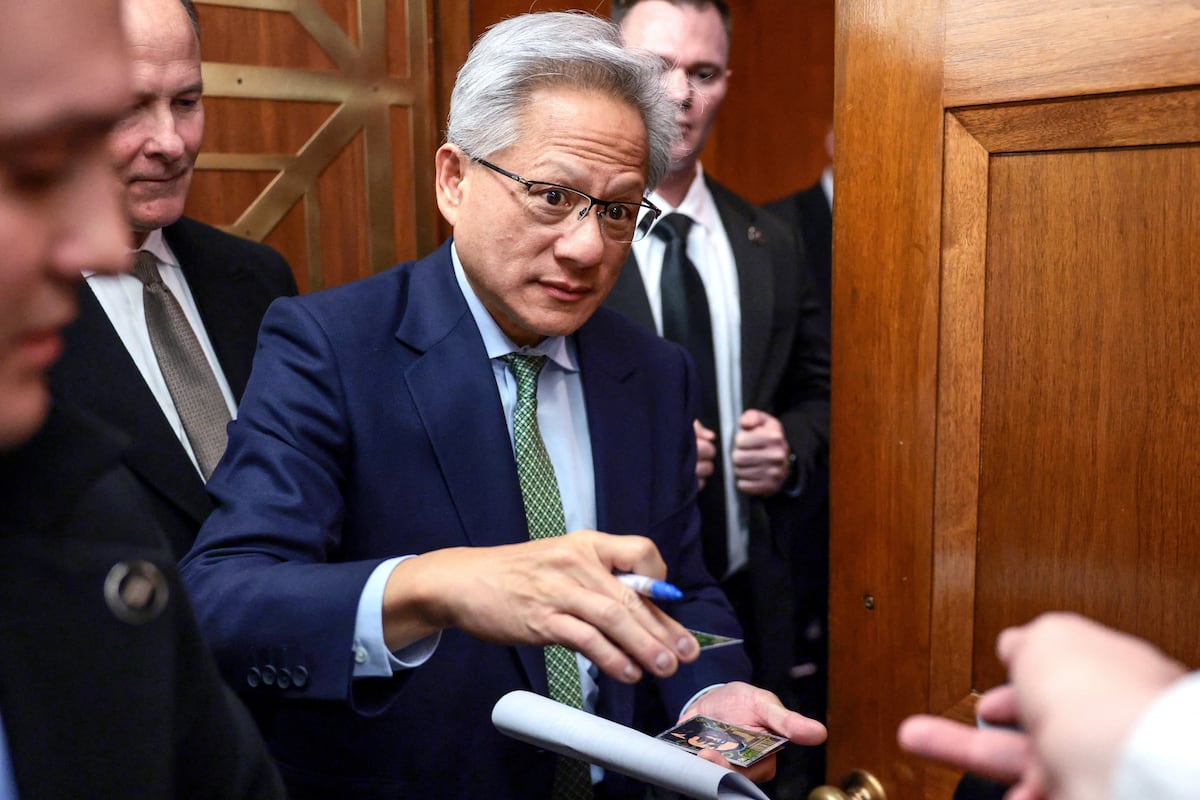
Multiple investigations, internal unrest, and circular financing: The risks behind Jensen Huang’s return to Nvidia
Full Article
Original Source
Read the full article at English →KhanList aggregates and links to publicly available news content. We do not host full articles from third-party sources. Always verify important information with original sources.