
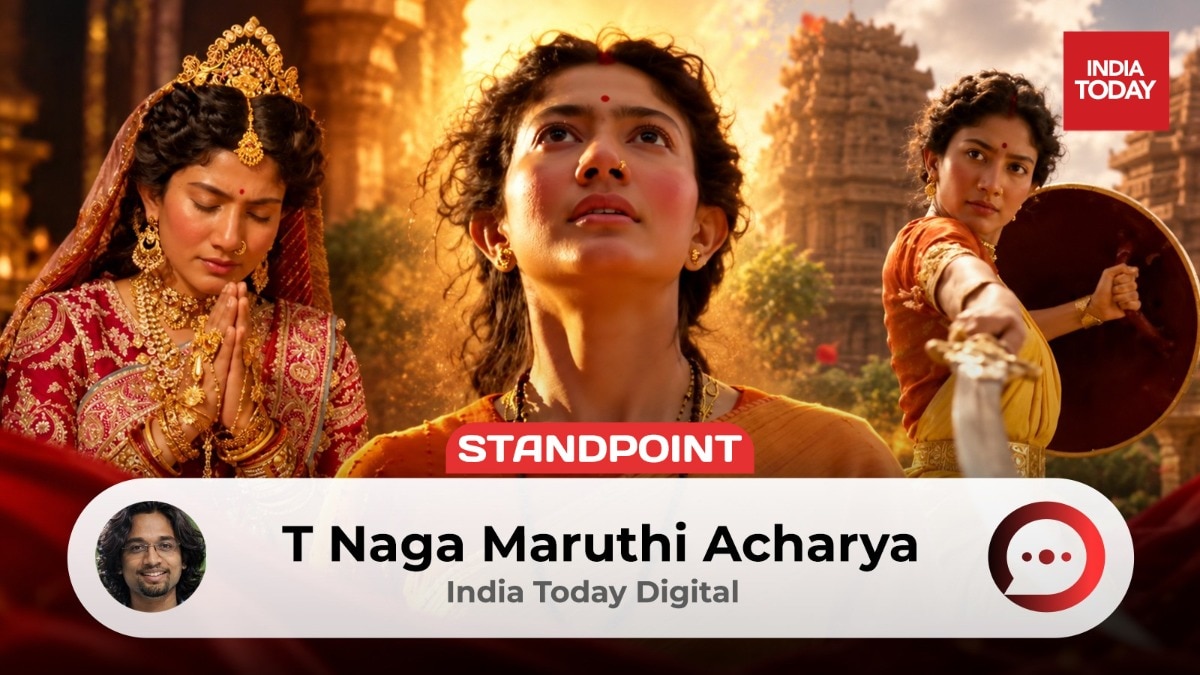
A woman playing Goddess Sita is on trial for not fitting India's idea of beauty, with social media playing judge and jury. Actor Sai Pallavi's casting as Sita opposite Ranbir Kapoor’s Lord Rama in Nitesh Tiwari's Ramayana has reignited a debate, with contrasting ideas of how the divine couple should look. While some have questioned whether Pallavi's complexion, naturally wavy hair and facial features fit their image of Sita, others have defended her appearance and acting abilities. Beneath the divide - it has acquired regional overtones - lies a bigger question: where does this ideal of Sita’s beauty come from, and how closely does it align with Valmiki’s Ramayana? The trolling has not been subtleA user called Sai Pallavi the "ugliest" actor to play Sita and compared her to the rakshashis (demonesses) of Ashoka Vatika, a garden where Ravana held Goddess Sita captive in the Ramayana. Another called for a boycott of the film over her casting. On Facebook, users scrutinised her facial hair and made derogatory remarks about her facial features, with one resorting to gender-based insults.The trolling extended beyond her complexion – it was also about her hair, makeup, costumes and overall appearance. Some criticism concerns the styling, but much of the discourse has become personal, questioning whether Pallavi is “beautiful” enough to portray a goddess.Which Sita are we looking for? For many viewers, the first visual reference point is not a painting but a television screen. Ramanand Sagar's iconic Ramayan in 1987, with Arun Govil as Rama and Dipika Chikhlia as Sita, remains deeply embedded in popular memory. Other actors, from Jayaprada to Nayanthara and Kriti Sanon, have offered their own interpretations, but the influence of that landmark series is hard to overstate.Across Indian cinema, Rama and Sita have been portrayed differently. Several southern productions have depicted Rama with a blue or dark complexion and Sita with a dusky Indian complexion, while popular Hindi adaptations have often favoured a fairer, sharp-featured and idealised portrayal of the divine couple. These are broad patterns, not rigid North-South divisions, but they offer useful context for the debate over Pallavi's casting. When an image stays familiar across generations, it begins to feel definitive. For many viewers in the Hindi-speaking belt, Dipika Chikhlia's Sita remains a reference point. But a portrayal from 1987 cannot become the casting photograph for every adaptation that follows. Otherwise, why remake the epic at all? We could simply replay the old series and save everyone several thousand crores.There is also a curious double standard in how these portrayals are received. Rama is associated with neela megha shyama, often understood as dark or blue like a rain-bearing cloud. Yet fair-complexioned portrayals of Rama, including Govil's and now Ranbir Kapoor's, have not faced the same appearance-focussed scrutiny.Kriti Sanon's casting as Sita in Adipurush did not provoke the same kind of backlash over her looks. Pallavi, meanwhile, has faced personal attacks even as many viewers defend her casting.Not everyone criticising Pallavi is motivated by colourism, or these perceived beauty standards, and it would be unfair to paint all northern audiences with the same brush. But why can Rama depart from textual descriptions without his complexion becoming a test of authenticity, while Sita's appearance invites arguments about whether she is “beautiful” enough to play a goddess? The contrast raises questions about the association of divinity with conventional beauty, particularly when the character is a woman.What does the Valmiki Ramayana say?Those invoking the Valmiki Ramayana point to its poetic descriptions of Sita's beauty. In the Aranya Kanda, Ravana addresses her as radiant as molten gold, dressed in yellow silk and resembling a lotus adorned with flowers.The text clearly celebrates her beauty, but it does not provide a modern casting photograph or prescribe the airbrushed appearance some audiences associate with divinity. Equally, the golden imagery should not be selectively interpreted to prove that Sita must have had a particular complexion. Rama, too, is associated with dark clouds and a blue-black complexion. If scriptural fidelity is the standard, it should apply to both characters, not just to the woman's face.The filmmakers have also drawn on familiar imagery from calendar art, temple depictions and paintings. That is precisely the point: the image in our heads has a history, shaped by artists, television and cinema. The problem begins when we mistake one familiar interpretation for the only possible truth.The beauty standards behind the North-South divideIt is tempting to view this from the lens of a North-South divide, with northern audiences seemingly wedded to the image of a fair-skinned, conventionally beautiful Sita, while southern audiences are perceived as placing greater value on natural beauty and acting talent. But neither region speaks with one voice. There are viewers in the South who question Pallavi’s look and viewers in the North who defend her.The divide, then, is less about two regions having opposing ideas of beauty and more about how audiences have been conditioned to recognise certain appearances as ideal. Pallavi has built her career on performances in films such as Fidaa, Love Story, Shyam Singha Roy and Gargi, where her appeal has not depended on conventional glamour. She has also spoken about her experiences with acne and beauty standards and has rejected fairness cream endorsements. For her supporters, her expressive ability and understated screen presence make her a compelling choice for Sita.The criticism raises a bigger question about how Indian cinema has conditioned audiences to equate feminine beauty with fair skin, straight hair and sharply defined features. Decades of films and advertising have reinforced those expectations. They are not exclusive to any region, and no industry is free of these standards.Not every objection to Pallavi stems from it. A complaint about a poorly designed costume is not automatically colourist. But when the conversation repeatedly returns to her complexion, hair and perceived imperfections, it is difficult to ignore the role beauty standards play. If an actor is praised for embracing her natural appearance, why should playing a mythological character suddenly demand a narrower standard?Criticise the look, not the actorThis does not mean the film is above scrutiny. When a production promises scale, grandeur and a fresh interpretation of a story millions know by heart, audiences will examine its choices. Costumes, jewellery, hair, makeup and cinematography are all fair game. A large budget does not guarantee a convincing visual world.To be honest, Sai Pallavi is a strong casting choice for Sita, but the styling in the promotional images does not always do her justice. The jewellery feels excessive, the curls look overly elaborate, and the hair, ornaments and colours together make the look feel overworked rather than naturally graceful. For a character associated with dignity and serenity, a little more restraint might have worked better. Grandeur does not always require more ornamentation.The actor is not the costume designer, makeup artist, cinematographer and director rolled into one. If the look feels unconvincing, the responsibility cannot simply be placed at her feet. If the concern is her performance, that is a different conversation, and one that can only be fairly had after watching the film.Equally, defending Pallavi does not require declaring every styling choice perfect or treating every objection as an attack on her identity. The makers have asked audiences to watch the film before reaching a final verdict, which is reasonable when promotional images offer only a glimpse of the finished work. The styling remains open to criticism, just as the casting is open to debate.Sita belongs to the story, not one screen imageThe Ramayana has survived because it has been retold across languages, regions and generations through poetry, theatre, television, cinema and oral tradition. Each adaptation makes choices, and each generation brings its own expectations. Reverence for an epic should not make its cinematic treatment immune to criticism. But if the debate is about whether Pallavi captures Sita's grace, it should examine the performance, writing and visual treatment. It should not become a referendum on whether an actor is conventionally beautiful enough to deserve the role. Sita is revered for courage, conviction, dignity and resilience, not for passing a facial examination that has no agreed marking scheme.Perhaps the most useful question is not whether Sai Pallavi looks like the Sita we remember, but why we have become so certain that the Sita we remember is the only one a filmmaker is allowed to imagine. If the styling does not work, say so. If the casting feels unconvincing, make the case. If the film fails to bring its characters to life, hold the makers accountable. But a woman's face should not have to stand trial for it.- Ends(Views expressed in the piece are those of the author).
Much ado about Sai Pallavi as Sita: India's ugly beauty standards laid bare
Full Article
Original Source
Read the full article at Indiatoday →KhanList aggregates and links to publicly available news content. We do not host full articles from third-party sources. Always verify important information with original sources.