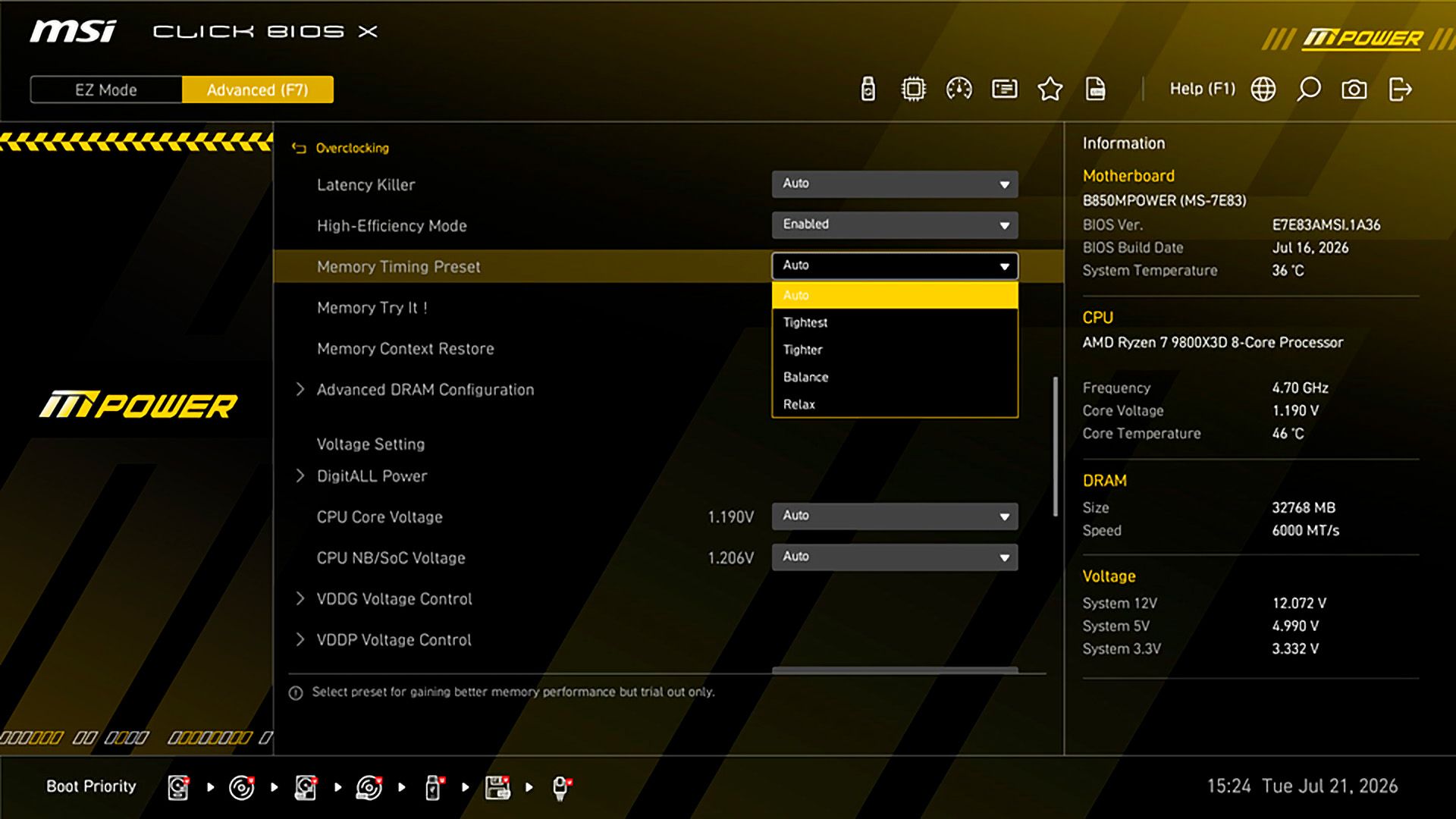
(Image credit: MSI) The best RAM on the market became even better with the introduction of AMD's EXPO ULL technology, at least for AMD users. Recognizing that not all users have access to EXPO ULL-compatible kits, MSI has stepped up by introducing a new feature called High-Efficiency Mode, which offers comparable optimizations and performance improvements for those who do not own one of the new EXPO ULL memory kits.Go deeper with TH Premium: MemoryAMD EXPO ULL memory kits are similar to standard AMD EXPO memory kits. What really sets them apart is that the former come with specially optimized memory sub-timings that lead to a noticeable reduction in memory latency. The optimizations are done at the factory. MSI's High-Efficiency Mode performs similar optimizations on regular memory kits.Even though machine tuning has improved over the years, it is not a magical formula that works for every single system since each one is unique; The level of optimization will differ with different hardware configurations, and you also have to take into consideration silicon quality. Some samples are just better than others, so you should not expect High-Efficiency Mode to magically match the same optimizations as factory-binned EXPO ULL memory kits. High-Efficiency Mode is essentially the motherboard doing the tuning for you, and as a result, it could introduce system instability similar to manual tuning.MSI High-Efficiency Mode Benchmarks Swipe to scroll horizontally Memory Kit Price Latency (High-Efficiency Mode Disabled) Latency (High-Efficiency Mode Enabled) Data Rate Primary Timings Voltage Capacity F5-6000A3038F16GX2-TZ5NXRK $629.99 71.4 ns 71.1 ns DDR5-6000 30-38-38-32 1.35V 2 x 16GB F5-6000J3038F16GX2-TZ5N $604.99 79.4 ns 71.6 ns DDR5-6000 30-38-38-96 1.35V 2 x 16GB MSI’s High-Efficiency Mode is available with four different presets: Tightest, Tighter, Balance, and Relax. Each preset dictates the level of aggressiveness you want the motherboard to use to fine-tune the memory sub-timings for your specific memory kit. There is no one-size-fits-all, so MSI encourages users to experiment with different presets to find the one that is most suited for their hardware.MSI compared the Trident Z5 Neo DDR5-6000 C30 32GB (F5-6000J3038F16GX2-TZ5N) with its EXPO ULL counterpart, the Trident Z5 NeoX RGB DDR5-6000 C32 32GB (F5-6000A3038F16GX2-TZ5NXRK), to demonstrate the effectiveness of High-Efficiency Mode. On the tightest setting, the Trident Z5 Neo exhibited a 9.8% reduction in memory latency, falling within a hairline of the Trident Z5 NeoX. The other takeaway is that since EXPO ULL memory kits already come with optimized memory sub-timings, enabling High-Efficiency Mode does not offer tangible improvements.Whether users benefit from improved memory latency depends significantly on the specific workloads they run. For instance, in latency-sensitive workloads such as large-scale databases or compiling complex code, a lower memory latency can lead to substantial improvements. On the other hand, in scenarios like video editing or 3D rendering, memory bandwidth is more important.Before the memory shortage, the Trident Z5 Neo DDR5-6000 C30 32GB sold for just $119.99. Since then, the same kit now sells for more than 5X its original MSRP. To rub salt in the wound, the Trident Z5 NeoX RGB DDR5-6000 C32 32GB debuts with an additional 4.1% premium on top of the already-inflated price.Get Tom's Hardware's best news and in-depth reviews, straight to your inbox.While we continue to live in a world with supply shortages and sky-high prices, we'll take anything that can improve performance. If a feature in the motherboard’s BIOS can close the performance gap between standard and premium EXPO ULL memory kits, we are all for it. Follow Tom's Hardware on Google News, or add us as a preferred source, to get our latest news, analysis, & reviews in your feeds. Zhiye Liu is a news editor, memory reviewer, and SSD tester at Tom’s Hardware. Although he loves everything that’s hardware, he has a soft spot for CPUs, GPUs, and RAM.
MSI promises an EXPO ULL-like boost for your existing DDR5 memory — High-Efficiency Mode brings low-latency tuning to older RAM
Full Article
Original Source
Read the full article at Tomshardware →KhanList aggregates and links to publicly available news content. We do not host full articles from third-party sources. Always verify important information with original sources.