
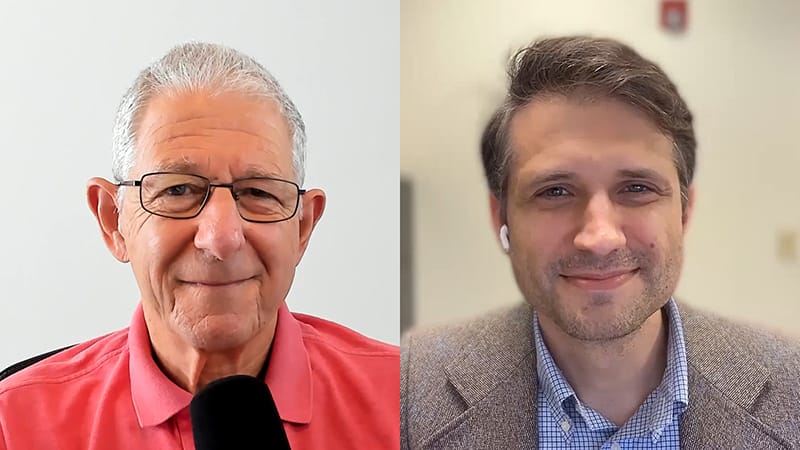
This transcript has been edited for clarity.Andrew N. Wilner, MD: Welcome to Medscape. I'm Dr Andrew Wilner, and today I have the pleasure of speaking with Dr Zachery Rohm. Dr Rohm is a neuroimmunologist at the Medical College of Georgia. Our topic today is the treatment of multiple sclerosis (MS). Welcome, Dr Rohm.Zachery Rohm, MD: Thanks for having me.Wilner: Dr Rohm, just to set the stage here, could you talk a little bit about your training and your current role in treating patients with MS?Rohm: I actually was a neurohospitalist for a year and then was a general outpatient neurologist for about 3 years before going back to fellowship in neuroimmunology. I ended up at Vanderbilt. I was there for a year, stayed on faculty, and now we're in Georgia. Half of my time I spend in the clinic seeing patients with MS and other similar conditions, and the other half of my time, I’m with the residents trying to make sure that they're doing what they're supposed to be doing.Making the MS Diagnosis: Lumbar Puncture or No?Wilner: Your experience primes you for the questions that we're going to get at, which is the diagnosis and treatment of MS for the general neurologist. Once you get to be a neuroimmunologist seeing MS patients all day, you can develop your own personal experience, so you have an algorithm, and you have access to all the new medicines. For the doctor who sees only one MS patient every week or two, I think it's much harder. Let's start with diagnosis. In the past, we would do MRI of the brain and the spine, and we would always do a lumbar puncture. I've noticed that there seem to be different schools of thought on whether that really is necessary. Is it necessary, and if so, when?Rohm: It depends on who you talk to. I've had some colleagues that want cerebrospinal fluid (CSF) on every single patient. You're not wrong to get CSF if you think MS might be in the differential diagnosis. If you look at the most updated criteria— there were new McDonald criteria, just to make things extra confusing, that came out in 2024 and published in 2025.CSF is helpful, but you don't need it. Going back to the very basics, how do we diagnose MS? Dissemination in space and time. You can still make the diagnosis of MS based on that, and you can make the diagnosis with a combination of clinical history and MRI findings. Let's say that someone comes in and they have optic neuritis, which is very classic for MS. You do an MRI. There's an enhancing optic nerve lesion, and then there's a nonenhancing paraventricular lesion. Well, there you go. Dissemination in space and time. This looks like MS. You don't have to get a lumbar puncture. For other patients, if you need more information, then a lumbar puncture can be really helpful. Let's say that you see someone and they have a bunch of white spots on their brain and you're not sure whether this could be demyelinating, small vessel disease, or something else. Then it's helpful if you do a lumbar puncture and get a negative result. There are no bands, there's no kappa-free light chain elevation. In that case, CSF can be helpful in reassuring the patient, and you, that you're not missing anythingThe Challenge of So Many Treatment ChoicesWilner: I'm just going to go back to my residency for a second. We had one treatment for MS at that time, which was steroids. Some physicians would prescribe monthly steroids. In others, of course, we would treat what appeared to be an acute relapse with IV steroids. I got very familiar with Solu-Medrol [methylprednisolone]. I've kind of lived through the evolution, and we now have, it has to be at least 20 therapies, right? We started with injections and then pills and infusions, and then I think more injections from the infusions. I think, for the general neurologist that doesn't do this every day, it's really overwhelming, and of course, you want to give the best advice to your patient. It could be a conversation of hours and hours that leads back to the beginning, where I don't know what to pick. Some guidance, please?Rohm: It can be really challenging. I think if I have my numbers correct, we have about 26 therapies that are FDA approved for MS. If you have someone with MS, once you make the diagnosis, the next challenge is, okay, I have this menu of options. What do I pick?The way that I think about MS therapies is very simplistic, but it's helpful for me. Imagine you have a pyramid. At the base of that pyramid, you have the older medications, the first-generation — what we call platform medications. Those would be the injectable interferons, glatiramer acetate, Betaseron, and Avonex. Those are all the therapies that became available in the 1990s and early 2000s. In the middle tier of that pyramid, you have the oral therapies. They came out in the 2010s. You have Gilenya [fingolimod], Tecfidera [dimethyl fumarate], and then many different variations of that. Then at the very pinnacle, you had the highly effective therapies, starting with Ocrevus [ocrelizumab] in 2017; that was kind of the third generation of MS therapeutics. If you start at the very base of the pyramid, those are the least effective medicines. They're probably the safest but the least effective at preventing relapses, disability progression, and so on and so forth. The middle tier is a mix of the two, more effective than the platform medications but less effective than the highly effective therapies. You're getting into more monitoring of blood work, and there can be some side effects. Once you get up to the highly effective therapy, there’s a potential for more side effects, but they’re the most effective for treating MS. When I say the potential for more side effects, these are still very safe medications, and we use them quite often.My very basic recommendation for my residents or the general neurologist is to start in the middle at least, so the oral medications. Ideally, you want to do a high-efficacy therapy because we know from large observational cohorts, especially in Europe, that patients who started on early, high-efficacy therapy did better over time.We have some clinical trials that are coming out in the US. Hopefully, we'll get some more data to support that. If you have a new diagnosis, please reach for the middle tier, some of the orals — preferably the higher tier, and that's really synonymous with the B-cell depleters.Wilner: I think it makes sense. Using a not very potent but very safe drug might make sense in a self-limited disease, but in a disease in a young person that isn't going to go away and that they're going to suffer with for decades, with the opportunity for that disease to progress, it makes more sense to use something a little more powerful to try to contain that over time.Annual MRIs: Yes or No?Wilner: We're going to move on to the next step. You've picked the perfect medication for your patient. Now the question is, is it working? They come in and say, "Oh, I'm a little more tired" or "I think I had some tingling," or maybe they're just doing okay but you're going to monitor them with MRI of the brain intermittently. Let's suppose they have no symptoms. How often will you monitor them? Let's start there.Rohm: It depends on the patient, and it's a bit of a cop-out. We know that earlier in the disease, the inflammatory burden is higher. If I scan someone who is in their twenties or thirties, the risk of having a new lesion is higher than for someone in their fifties, sixties, or seventies. You have to keep in mind who you're talking about and what therapy they're on.If I have someone who's on, for example, glatiramer acetate, which is not a very effective medication, I'm more likely to find a new lesion. Let's just say someone in their thirties comes to me, a new diagnosis. Typically, I get them on B-cell therapy or an S1P or one of those higher-tier therapies.My personal practice is to reestablish a new baseline MRI within about 3-6 months, so after the therapy is now starting to work. My practice pattern is changing a little bit. Now, I'll do an MRI about 3-6 months after, assuming the patient is asymptomatic, and then probably about a year after that, and then I'm starting to lengthen it.Instead of doing yearly MRIs, perhaps it’s every 2 or every 3 years. There was a study that came out in Neurology relatively recently, and they said, "Okay, for patients on B-cell therapy: If they've been on for 2.5 years on average, how many scans do you have to order to see one new lesion?" It's about 80. Once they're on B-cell therapy for about 3 years, or maybe 3.5, something like that, it's about 150. Once you get patients on highly effective therapy, we do periodically want to check MRIs, and everyone's a little bit different. Do we need yearly MRIs? It's probably overkill.Managing Breakthrough LesionsWilner: Here's a question. Suppose you do your MRI after 2 years, the patient's doing great, and you see an enhancing lesion. They have no symptoms. They're fine. It comes into your inbox. You look at it, you go, "Yeah." Now what do you do?Rohm: That's the million-dollar question. If we have someone on a highly effective therapy and they have a breakthrough lesion, are we going to change management? You could make the argument that, if they're on a subcutaneous B-cell depleter like Kesimpta [ofatumumab], you could give it IV. It's a different route of administration. I've actually done that for some people who have broken through with subcutaneous dosing. I've brought them to an IV formulation. You could do vice versa. You're “switching” between medications of the same class. I don't use Lemtrada (alemtuzumab) much because it's restricted to Risk Evaluation and Mitigation Strategy (REMS) programs, and given the side effects you have to worry about… But that could be an option if someone is really not doing well.You could switch from a B-cell depleter to Tysabri [natalizumab], which is used quite often, especially by some of my colleagues here at Medical College of Georgia and also at Vanderbilt. Tysabri is a great medication, assuming the patient's JC virus antibody index is not too high. There are things you can do. Obviously, our medications are not perfect. I tell my patients that people develop medications, and people are not perfect, so we don't have the perfect medicine. You do have some room to either change a therapy within the same class or go to another class, but it's still going to be a high-efficacy therapy.When to Refer to an MS Center?Wilner: Last question. When should a general neurologist refer a patient to someone like yourself at an MS center?Rohm: I think the field is split, if you talk to an MS specialist. I have some hardliners among my colleague group that will say every single MS patient needs to come to an MS center. I'm kind of the opposite. We don't have the ability to absorb all of the MS patients across the country and across the world, to be honest.For the general neurologist — and I did this for a while before going back to fellowship — if you have an uncomplicated patient with MS who's responding well to therapy and overall does not have that many issues, I would encourage you to please keep your patient in your community. I think that’s best for them. Of course, we're always here for a resource if there's ever a question about therapies or someone's condition is very complicated. Some patients will come here for a single consultation to ask, "Is my doctor doing the right thing?" Then we'll send them back. We're mentoring local neurologists, community neurologists, to take care of their MS patients here in the state of Georgia. We looked into the data. The number of MS centers here in the Southeast is not able to serve all the MS patients that are out there.Really, I think it's a partnership between the local neurologist and the MS specialist. I would say the hardest part about being a general neurologist taking care of an MS patient is logistical. Making the diagnosis is pretty straightforward, and if you have any questions, there are new diagnostic criteria. There's a great algorithm; you can just follow it. Making the diagnosis can be easy. Getting patients on therapy, if you don't have pharmacy support, there's no local infusion center, and if you don't have someone doing your prior authorizations, that can be a challenge. Ultimately, I would say that for straightforward-MS patients, I would like to empower the local neurologist to take care of those patients.Wilner: That's great. Dr Zachery Rohm, thanks for joining me for this informative discussion on the diagnosis and treatment of MS.Rohm: Thank you very much.Andrew Wilner is a professor of neurology at the University of Tennessee Health Science Center, Memphis, and a seasoned neurologist and epilepsy expert who has mastered the less conventional locum career path. He is the author of four books, including Bullets and Brains, and hosts the podcast The Art of Medicine with Dr. Andrew Wilner.
MS Treatment Choices: Expert Tips for the Generalist
Full Article
Original Source
Read the full article at Medscape →KhanList aggregates and links to publicly available news content. We do not host full articles from third-party sources. Always verify important information with original sources.