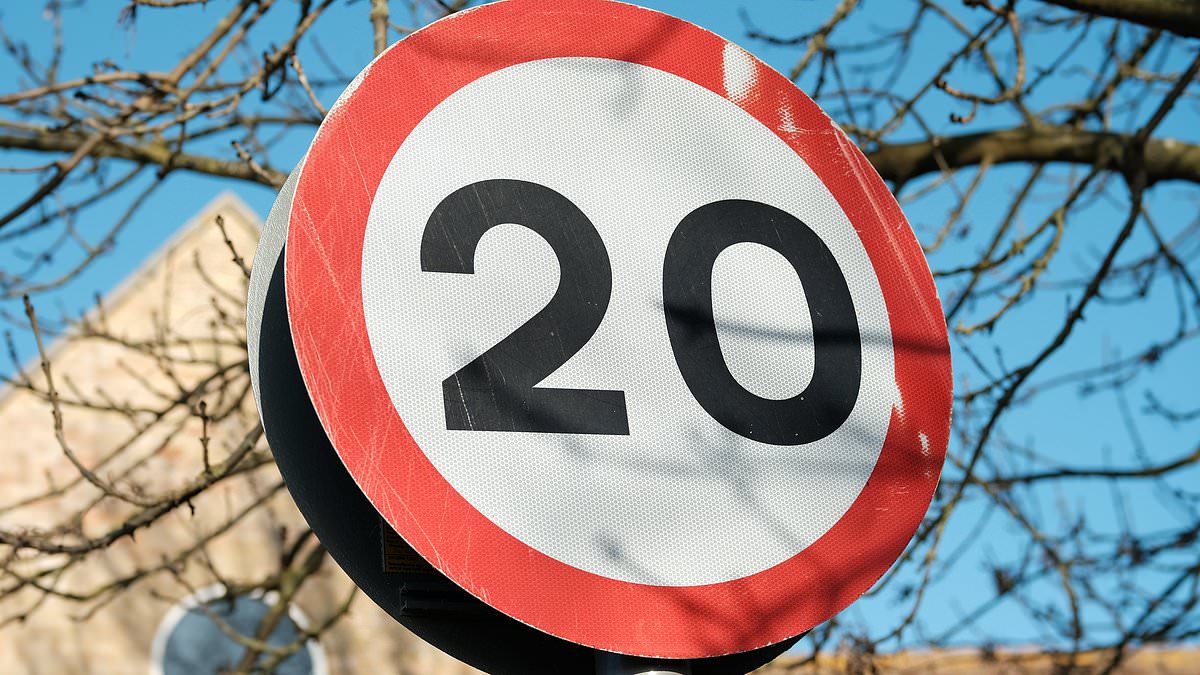
MPs have been told to ramp up efforts to make 20mph the 'default' speed limit on all roads in urban areas in England and consider tougher restrictions on drivers by making speed limiters mandatory in cars.A panel of road safety experts warned the Transport Select Committee on Wednesday that the government's Road Safety Strategy announced in January does not go far enough to achieve its target of reducing road deaths in Britain by 65 per cent in the next decade.They said the measures currently proposed 'could and should have gone further' by 'reducing speeds in civilising towns and cities to make them places where people want to live, walk, cycle and play'.Despite various reports to the contrary, the strategy does not provide a legislative framework for the government to introduce a blanket 20mph limit in England.Instead, local authorities are responsible for setting speed limits on their residential streets and the government provides guidance to these authorities on doing so.Campaigners are now pushing for revisions to guidelines that would heavily encourage authorities to make 20mph the new standard instead of 30mph on their roads.The panel also said the government should accelerate its plans to mandate the application of automatic speed limiters in cars, and suggested going one step further than the EU by making it impossible for drivers to turn off the technology. A panel of road safety experts warned that the government's Road Safety Strategy announced in January does not go far enough to achieve targets of reducing road deaths by 65% by 2035Lilli Matson, chief safety, health and environment officer at TfL, said the Road Safety Strategy was a 'missed opportunity' to introduce a blanket 20mph limit across England when addressing the Transport Select Committee on Wednesday.She urged MPs to follow the capital's lead by pressuring local authorities across England to make 20mph the new default limit on every urban road.Matson described slashing speed limits as the 'first and most important systemic change that the government and local governments can make' and being 'at the very heart of safer roads'.She said: 'In Central London, we made 20mph the default on the main road network in 2020 and that has very quickly delivered very tangible reductions of around 24 per cent of people being killed and seriously injured and, more importantly, changed the feel of those roads for people who want to use them.'In England, some 68 out of 154 local authorities have committed to reducing limits on roads in built-up areas from 30mph to 20mph. But this is well short of sweeping limits elsewhere. As of September 2024, the default speed limit in residential areas across Wales is 20mph. In Scotland, 20mph is the new standard limit in built-up areas on 'roads where it is appropriate'.The Republic of Ireland is also rolling out a national speed limit overhaul that reduces defaults in urban cores, town centres and housing estates from 50kmh (31mph) to 30kmh (19mph).Campaigners warn that the country risks slipping behind the rest of the British Isles in terms of imposing lower speed limits on its residential roads. DfT's chief safety officer Lilli Matson said slashing speed limits is the 'first and most important systemic change that the government can make' and is 'at the very heart of safer roads'Adrian Berendt, director of the '20s Plenty for Us' group, told members that around 20 per cent of killed or seriously injured casualties (KSIs) currently occur on 30mph roads, and without lowering the speed limit they 'simply cannot achieve the target' of a 65 per cent reduction in casualties.'We've modelled it and the contribution of 20mph to the government's target is by far and away the biggest single measure that could help, reducing KSIs by 10 to 20 per cent,' he said.Berendt told MPs that 20mph limits can 'change the relationship' between motorists, cyclists and pedestrians.'They look out for each other more. Your field of vision widens when you're doing a lower speed, so rather than being surprised that someone has suddenly jumped out in front of you, you've anticipated it. It has a cumulative effect.'Rob Török, a doctor in pre-hospital emergency medicine who works for Dorset and Somerset Air Ambulance, said 20mph limits in urban areas are a 'moral duty' to safeguard 'vulnerable, innocent, unprotected pedestrians, our children, the frail, cyclists, and those using non-motorised vehicles'.He said: '20mph limits nationally, set or prioritised urgently, would save countless numbers of people from injury, harm and cost.' Phil Jones, the former chairman of the Welsh Government's 20mph Task Force Group, told MPs that 'pace cars' that are limited to driving at the speed limit should be introduced Experts suggest using 'pace cars' that can't speedPhil Jones, the former chairman of the Welsh Government's 20mph Task Force Group, told MPs during Wednesday's meeting that 'pace cars' should be introduced to our roads that are permanently restricted to 20mph limits.These pace cars could be vehicles within government and council fleets, but also vehicles driven by the general public, he said.'It was something that we actually recommended to the Welsh Government, that all of the public fleet, thousands and millions of vehicles, act as pace cars', he told the committee. 'We could also get the public themselves to opt in and become pace car drivers. 'We don't need every driver of every vehicle to be obeying the speed limit to influence the majority of the traffic flow.'Ministers are already looking to mandate Intelligent Speed Assistance (ISA) technology in new cars. It has been a legal requirement for all models sold in the EU since 2022.Given they are already mandated for Europe, most manufacturers already install them in UK spec cars to save production costs.ISA uses GPS data, satellite navigation, speed-sign recognition cameras and forward-facing cameras to identify if drivers are adhering to speed limits.If it detects a motorist is over the limit, a sequence of repeated 'bongs' alerts the driver to slow down. A warning will also appear on the dashboard and some manufacturers use steering wheel vibrations.In some cases, the system can actively reduce engine power to automatically slow a car down if the driver is refusing to reduce their speed.While mandatory in the EU - and fitted to almost all new cars sold in the UK already - the technology can be overridden for short bursts by pressing harder on the throttle pedal. It can also be switched off entirely at the beginning of every journey.But members of the panel on Wednesday suggested it should be switched on at all times. Intelligent Speed Assistance will become mandatory fitment on all new cars sold in Britain soon but drivers can turn it off before journeys. Safety experts say it should be on permanently Matson said the technology is already being used in London.'We have already retrofitted our vehicle fleet at TfL,' she said. 'It reduced speeding incidents by 63 per cent.'So, very quickly, if you mandate this kind of technology, you will reap the benefits of the limits we already have.'Then, when you reduce the limits to lower limits, it will help achieve targets at a national level.'She added that new buses in London have ISA installed that cannot be deactivated.'It's required on all new buses in London and being retrofitted [to older models]. This is mandatory ISA and you can't override it.'We're a public body and we're doing it. It could be a national requirement on all vehicles.'Jones also took the opportunity to recommend a range of 'low-cost changes' to roads that could actively reduce speeds on England's roads, including narrower lanes and the wider application of cycle lanes.'We have a standard traffic lane in this country that is oddly 3.65 metres, which is just a metrification of 12 feet,' he said.'We know from lots of evidence that narrower lanes carry just as much traffic and are much safer and lead to lower speeds. You can then make more space for walking and cycling.'Removing the centre line will reduce speeds by 1 or 2mph, and it's cheap. 'People think it's less safe, but drivers react to the environment and respond to there being no centre line; they react by slowing down.'On Thursday, the government published its response to the consultation on mandating 18 vehicle safety systems for new models sold in Britain - including ISA. CARS & MOTORING: ON TEST
MPs told 20mph should be the new 'default' limit on built-up roads - and speed limiter tech in cars should be permanently switched on
Full Article
Original Source
Read the full article at Dailymail →KhanList aggregates and links to publicly available news content. We do not host full articles from third-party sources. Always verify important information with original sources.