
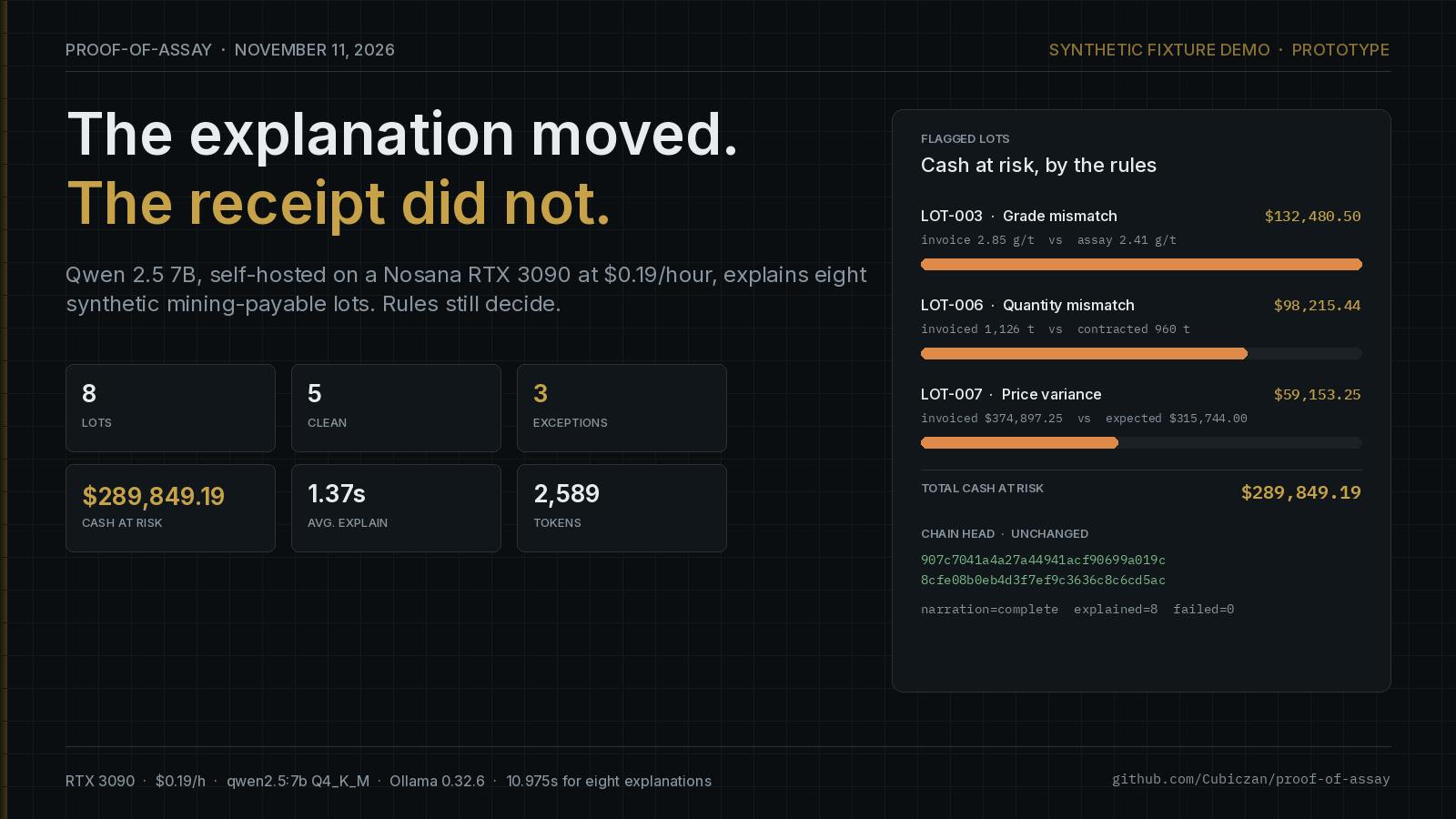
I got an email from the hackathon team this week: Proof-of-Assay had been shortlisted for the Decentralized Compute track in Round 2 of HackerNoon's Decentralize AI Hackathon, and there was a $70 credit to put an open model on their network. I claimed it on the same account I'd used for an earlier Nosana run. This is what I did with it, including the part that didn't work at first. I'm Shyam, a CFO who works in junior mining finance. Proof-of-Assay is a small audit agent for a problem I actually have: reconciling assay certificates with supplier invoices, lot by lot, and leaving a receipt that someone else can re-verify later. The verdicts are decided by plain Python rules, not by a language model. Expected amount is tonnes times the contracted price. Grade, quantity, and amount mismatches get flagged and priced as cash at risk. Every decision goes into a SHA-256 hash chain. Anyone can run two commands on a laptop and get the same 11-entry chain, ending at 907c7041a4a27a44941acf90699a019c8cfe08b0eb4d3f7ef9c3636c8c6cd5ac: python scripts/reproduce.py python scripts/verify_chain.py # PASS The model has one job: write a short explanation of a verdict the rules already made. I learned why that split matters in October, when I asked a 1.5B Qwen model on Nosana whether a low assay was CLEAN or an EXCEPTION, and it said CLEAN with complete confidence. It was wrong. So this time I didn't ask the model to audit anything. I asked it to explain work the rules had already finished. Synthetic-data disclosure: The eight mining lots in this post are fictional demo fixtures. Amounts are deterministic fixture arithmetic, not real mine payables. Proof-of-Assay is a prototype, not a production auditor. Why move the explanation step at all? Because I don't want that layer to depend on a single AI vendor's API. If the narration is an open-weight model I can start on a rented GPU, I can move it, pin the image, and keep the deterministic core exactly as it is. The audit still runs when the GPU is off; you just don't get the paragraphs. For this hackathon, Nosana was the natural place to host that model, and HackerNoon asked for a progress post. This is that post. The job, the market, and the timeout I didn't get The setup is a single container. The image is docker.io/ollama/ollama:0.32.6, pinned, serving qwen2.5:7b — Ollama's default 4-bit instruct build, 4.68 GB on disk, 7.6 billion parameters, Q4_K_M. The API is OpenAI-compatible at /v1/chat/completions, which is what proof_of_assay/llm.py calls when NOSANA_LLM_BASE_URL is set. If that environment variable is missing, the audit still produces the same chain and the narratives are skipped. I wanted a cheaper card first. On November 11, 2026, the NVIDIA 4070 premium market was about $0.10 an hour, and the 3090 premium market — the same one I used in October — was $0.19. I planned a Simple deployment, one replica, with a short container timeout, and I was ready to stop it as soon as the demo was done. The 4070 hosts were all busy, so I took an RTX 3090 at $0.19 an hour. The dashboard's create page also no longer offered the 60-minute auto-stop I had wanted, so the job was set to run to completion with a six-hour cap — about $1.14 if I let it sit. After the $70 shortlist credit, the account had $209.83 to work with. I didn't add a card, and I didn't connect a wallet. The current job definition is in the repo at nosana/proof-of-assay-llm.json. The preload missed, and the docs already had the fix The first job definition used a resources entry of type Ollama to preload qwen2.5:7b. The container came up healthy. GET /api/tags returned 200. The model list was empty. That tracks with the docs, once I went back and looked. Official Nosana resource types are S3 and Hugging Face, not a first-class Ollama preload. The documented way to stand up an Ollama endpoint is the obvious one: start the server, then pull the model. On the live deployment, I pulled it by hand with POST /api/pull. The job definition in the repo now follows that pattern, and it waits until ollama list succeeds instead of sleeping for a fixed five seconds: "entrypoint": ["/bin/sh"], "cmd": [ "-c", "ollama serve & pid=$!; i=0; until ollama list >/dev/null 2>&1 || [ \"$i\" -ge 60 ]; do i=$((i+1)); sleep 1; done; ollama pull \"$MODEL\"; wait $pid" ], "env": { "MODEL": "qwen2.5:7b" } If I start this job again, I shouldn't need the manual pull. I didn't redeploy this run just to prove it — the 3090 was already serving the model, and I didn't want to pay for another startup. The numbers from the live run Once the model was on the card, I pointed the audit at it and ran the same script anyone can run: export NOSANA_LLM_BASE_URL="https://" export NOSANA_LLM_MODEL="qwen2.5:7b" python scripts/reproduce.py --explain lots=8 clean=5 exceptions=3 cash_at_risk_usd=289849.19 chain_entries=11 head=907c7041a4a27a44941acf90699a019c8cfe08b0eb4d3f7ef9c3636c8c6cd5ac narration=complete explained=8 failed=0 python scripts/verify_chain.py printed chain_length=11 verification=PASS. The chain head is the same value the fixtures produce with no model in the loop. Narratives are written onto the results for display. They are not hashed into the receipt. I also timed the eight explanation calls separately, using the same prompts the client sends, at 1:43 PM Eastern on November 11, 2026. A first request, made after the model had been pulled but wasn't in VRAM, took 4.010 seconds to return a three-token reply. The eight lot explanations then finished in 10.975 seconds of wall time — 1.371 seconds each on average, ranging from 1.231 to 1.505 seconds. Together they used 1,877 prompt tokens and 712 completion tokens, 2,589 in total. These are measurements from one afternoon on one 3090, not a benchmark. What the model actually wrote The explanations are plain, and they stay on the numbers they were given. On LOT-003, the grade mismatch, Qwen wrote: The audit identified an exception for Lot ID LOT-003 due to a significant variance in the invoiced amount of $893,174.00 compared to the expected amount of $760,693.50, resulting in a cash at risk of $132,480.50. Additionally, there was a grade mismatch between the invoice grade of 2.85 g/t and the assay grade of 2.41 g/t, further complicating the discrepancy. On LOT-006, the quantity mismatch: The audit identified an exception for LOT-006 due to a variance of $98,215.44 between the invoiced amount ($604,903.44) and the expected amount ($506,688.00). Additionally, there is a quantity mismatch with 1126 tonnes invoiced versus the contracted 960 tonnes. These discrepancies are causing the status to be marked as "EXCEPTION." On LOT-007, the price variance: The audit identified an exception for Lot ID LOT-007, where the invoiced amount of $374,897.25 does not match the expected amount of $315,744.00, resulting in a variance of $59,153.25. This discrepancy is reflected in the high cash at risk of $59,153.25 and has been flagged as an exception due to the significant difference between the expected and invoiced amounts. That's useful for a reviewer. It is also still a paraphrase of rules that already ran. I would not replace verify_chain.py with any of those paragraphs, and I'm not going to claim the 7B model is a better auditor than the 1.5B model I asked to decide a verdict in October. It's doing a different job: narrating a decision it was not allowed to make. What's next I'll leave this deployment up long enough for a short demo video and this post, then stop it so the credits don't keep ticking at $0.19 an hour. The job-definition fix is in the public repo, so the next start should pull qwen2.5:7b on its own. I want to keep this pattern — an open model I host, and a core that doesn't care whether the model is there — for later work that needs a short explanation layer. I am not putting the model on the verdict path. The code, the job definition, a static verifier, and the demo video are public: Repo: github.com/Cubiczan/proof-of-assay Static demo: proof-of-assay.vercel.app Demo video: docs/nosana-demo.mp4 Nosana: nosana.com This is a prototype. The lots are fictional. The useful result is that I could move the explanation step onto a decentralized GPU without moving the receipt.
Moving Proof-of-Assay’s Explanation Layer to Nosana With Ollama and Qwen2.5
Full Article
Original Source
Read the full article at Hackernoon →KhanList aggregates and links to publicly available news content. We do not host full articles from third-party sources. Always verify important information with original sources.