
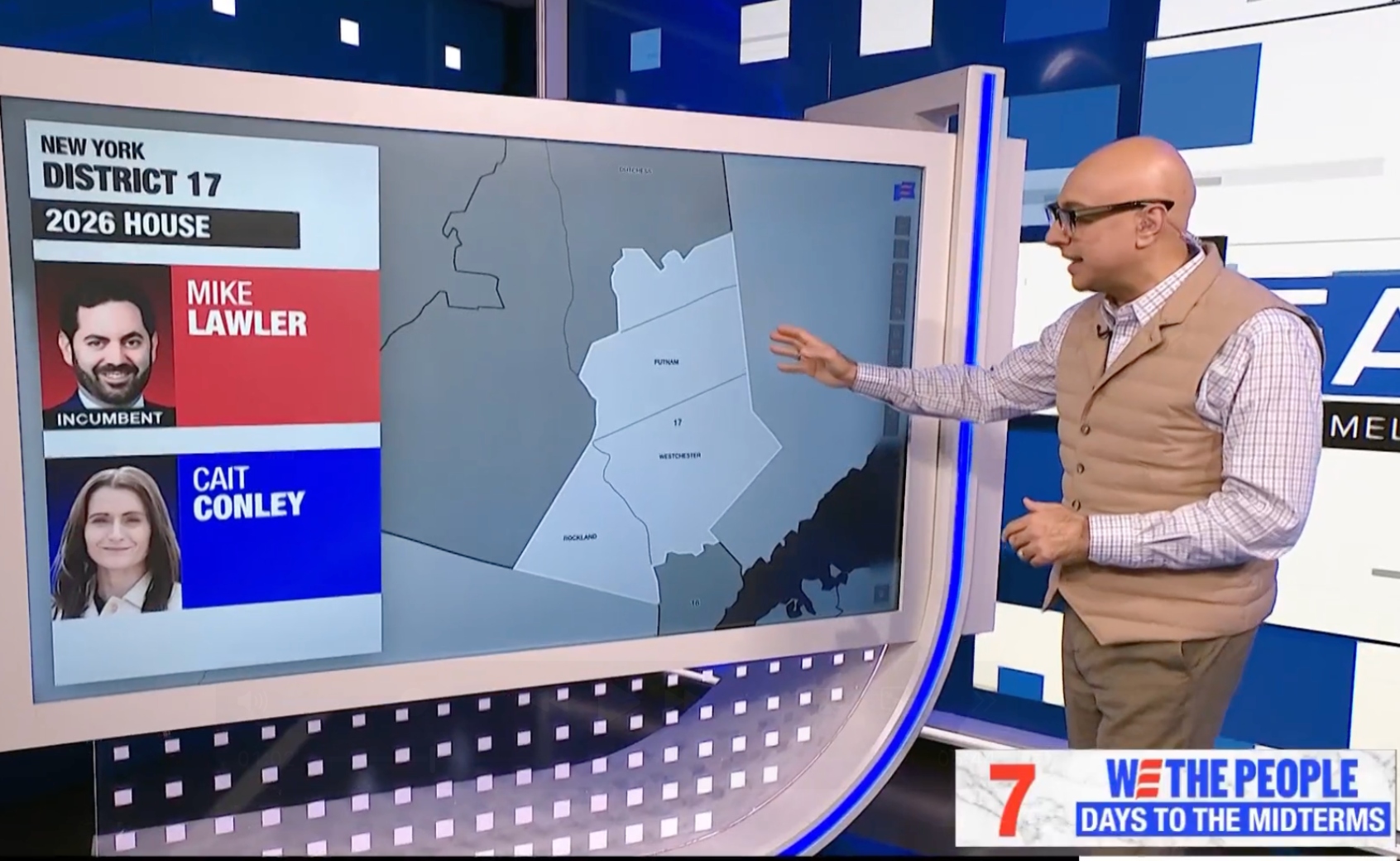
interview The MS NOW anchor on early midterm numbers and the stories behind the election-night Big Board Published November 2, 2026 12:11PM (EST) (MS Now) Six years ago, Donald Trump dropped “11th Hour” host Ali Velshi’s name at several campaign rallies as an example of the so-called “fake news media” getting what the president thought he deserved: a taste of “law and order.” In May 2020, while covering the Minneapolis protests that arose in response to the murder of George Floyd, MSNBC’s live coverage caught Velshi being struck in the knee by one of the rubber bullets police fired into the crowd. Months later, Trump referred to the incident multiple times on the campaign trail as “the most beautiful thing,” earning laughter and applause from supporters. But an emotional Velshi recalled that moment differently in June 2026, as he said goodbye to his old weekend show’s audience. In that moment and others, he told “Velshi” viewers that democracy, fairness, transparency and accountability took yet another hit. “This is how it unfolds. Not always with legislation, not always with imprisonment. Sometimes with a rubber bullet. Sometimes with a police escort. Philosophy repeated until enough people believe it. . . and they believe that the next step becomes possible,” he said. “The press is not the enemy of the people. The press is the people’s guarantee that they will know what is done in their name.” Then, he reminded everyone watching that the midterm elections were 148 days away. When I spoke with him last Thursday, the veteran journalist repeated his belief in the press’ witnessing role, unshaken by the massive changes occurring in the news industry. One of those changes places him at the network’s famous Big Board as the chief data reporter for MS NOW—formerly MSNBC—carrying on an election-night tradition made famous by Steve Kornacki. Velshi’s on-air analysis will be augmented by an additional feed called VelshiCast, a behind-the-scenes look that will stream on MS NOW’s YouTube channel. Other aspects of MS NOW’s live coverage remain familiar to longtime MSNBC viewers, with Rachel Maddow leading the channel’s supergroup of Nicolle Wallace, Chris Hayes, Jen Psaki, Lawrence O’Donnell, Stephanie Ruhle, Michael Steele, Symone Sanders Townsend, Ari Melber and Peter Alexander. As for Kornacki, he became NBC News’ chief data analyst after NBCUniversal’s owner, Comcast, spun off MS NOW along with USA Network, Syfy, E!, and its other cable channels into a venture known as Versant. Journalism is in a precarious time, but this administration has placed particular pressure on TV newsrooms. With Paramount Skydance’s acquisition of Warner Bros. Discovery, CNN’s and CBS’ teams are facing rounds of buyouts and return-to-office orders to thin their ranks. Meanwhile, Status reported that October 2026 is Fox News’ lowest-rated month since December 2023, with the network averaging 1.1 million total-day viewers. Velshi remains optimistic about his profession, as he said in our wide-ranging conversation about his plans to make the Big Board even more essential on this midterm election night. This interview has been edited for length and clarity. Salon: A lot of coverage cited what you said in your farewell message for your last weekend show. One of them, and I think this is important, is that you were reminding people that the show was ending 148 days before the midterm elections. Velshi: Yeah. Well, we’re here now. You’ve started your weekday show, and I’m curious to hear your impressions of how you think things are going, in terms of that dialogue with viewers and what’s coming up about Tuesday from a data perspective. Thanks for actually thinking that through because there is a real through line. I miss my old show a lot, but you know, that moment was so important. What I was trying to do that night, and what I’ve been trying to do since, is convey the idea that this isn’t about partisan politics. This is about civic engagement. This is about democracy, and nobody’s going to do that for you, right? Democracy is not something you pick off a shelf. It is work for all of us all the time, and I don’t think we’ll ever be free of a moment when democracy is on autopilot. And so, right now, everybody’s responsibility is to participate actively. I have a sense that pretty much all of our regular viewers, certainly people in our MS NOW community, are heavily engaged. They’re big consumers of news and information. They probably already voted. If not, they’re planning to, because some people just like voting on election day because it’s exciting. But this moment wants more of us. It needs us not just to vote, but to be engaged in the dialogue, to commit to democracy, to help other people vote, to feel like we are in community with each other, to save democracy. This doesn’t matter whether you’re a Democrat or Republican or an independent, or you don’t even think politics matters to you. And I will say that since that day that I left the show, I’ve only felt stronger about this, and I’ve only felt that people are understanding their assignment very, very well. And we’re seeing this from a data perspective. How so? Every single day, we get new data that shows early voting and advance voting. It is remarkable. At the low end, the states are up 20% compared to the last midterm elections in 2022. We’re not even bothering to compare it to a presidential election because they’re different beasts. In some states, early voting is up 40%. Now, what would possibly explain that? It’s enthusiasm amongst voters. So people are going out and they’re taking the assignment very, very seriously. I’m very heartened by that. So let’s talk about your new role and what you do with the data, and the conversation you have with people about that. Because I think that especially around elections, some of our pessimism and optimism comes from polling, but not necessarily from data. You’re 100% right. Thank you for that question too. I led the show on Monday night with three people: Kabir Khanna, who’s our head of data and analytics; Dave Wasserman from the Cook Political Report; and Larry Sabato from the University of Virginia’s Crystal Ball. These are the three data nerdiest guys around. I think it’s important to understand that raw data is of no use to anyone. Even slightly interpreted data is of no use to anyone. You have to be able to look at it holistically. You have to look at polls and also understand their margins of error. You have to understand trends in polling so that even if a poll is good, meaning it’s statistically sound, that doesn’t mean it’s correct. Polls have errors, and then the decision about how an election goes depends in part on polling, in part on trends, in part on the weather, in part on the news cycle, in part on whether your decision in an election is because you’re voting in favor of someone you’re excited about or you’re voting against someone you’re mad at. (MS NOW) I think raw data without analysis should be a crime … OK, in this world where people make crimes out of everything, I’m not sure that’s the right thing to say. But my point is, it’s really bad. It’s bad for democracy to throw raw data at people and hope that they interpret it. It’s also bad for democracy to throw raw data at people and hope they follow it. Like, what am I trying to tell you? If I tell you these races are all ahead, I may not be giving you useful information for you. So part of it is also managing expectations amongst voters. A “blue wave” or a “big blue wave,” I don’t use that terminology . . . But I’ll give you a range. I’ll tell you that as of today, the Democrats are likely to win a minimum of eight seats in the House and a maximum of probably in the mid-30s. That’s probably the range. Might I be wrong? Absolutely. But that’s what I want people to understand. And then I’m going to give you the clues to understand how I got there, so that you can follow along with me. I’d rather make a data interpreter out of everybody who watches us than be their data interpreter. “[P]eople are understanding their assignment very, very well.” In terms of the election night and you being at the Big – are you guys still calling it the Big Board? We are. Yes. I tried to call it The Magic Board of Wisdom, but no one took to that. What you and Kornacki were doing at the Big Board really became a thing over the last decade or so. Absolutely, yes. People learned to consume election night coverage based around it. I know a lot of folks who may not necessarily watch every single moment of coverage, but keep an eye on developments with the sound off, based on what’s going on with the Big Board. It’s kind of like a lot of folks might go into a restaurant or a bar with the TV tuned to a game, but on mute. I’d like to know how you feel about that mode of consumption. Well, look: The bottom line is, scientifically, people’s visual consumption is their No. 1 source of information consumption. I mean, you can make the argument that smell is actually more important for your survival, but we’re not talking about survival here. The visual component hits before the auditory component does, so that’s never going to change. What may change is whether people watch it on their phone or their TV or, you know, through AI glasses, but the visual component is still stronger for everyone than anything else. So we spend a lot of time adjusting the size of the boxes on TV and deciding whether there are too many of them, and whether this is helpful information or confusing information. We want to make it very obvious that this is complicated information, and we’re working hard because it’s our job to present this to you in a way that is consumable and accessible. Which, by the way, has been sort of my stock in trade for my entire career. So I’m committed to making this the most visually easy experience. If you don’t have audio, and if you’re sitting in a bar or sitting on a plane or wherever, and you can’t hear me, you’ll still understand everything that’s going on. In this election, there’s emotional sentiment, psychological underpinnings, and consumer sentiment to account for. How much are you able to go into those factors on election night? Because each is also locally dependent. We have a lot of reporting determining the key races, but if you look down the ballot beyond the candidates, you have initiatives and other legislation driven by sentiment. So we have two ways of measuring sentiment. One is in what we call our voter poll. That’s what you would know of as an exit poll, right? We do that in partnership with others. It’s probably 1000 questions that really allow you to put meat on the bones of the result you just saw. And I actually think that’s one of the sad things about fast-moving election coverage, is that you sometimes don’t get to sit there and say, “Let me explain to you. We actually know. We asked these voters why they made the decision they made, and they actually told us. So we don’t have to extrapolate. We don’t have to, you know, twist ourselves into pretzels. We actually have that information.” “Our capabilities are better today than they were a year ago.” So I will tell you, a lot of that will happen prior to polls closing. So people think to themselves, “Your coverage always starts before the polls close, or before the polls close in the place that I care about” – that’s actually where you get the most context. So we’re going to start early in the evening on Tuesday with our exit polls. I think we release them at 5 o’clock, and that’s great information. And then subsequently, we are covering every one of those ballot measures. In fact, that’s part of what I’m studying today. I’m studying both the exit polls and the ballot measures today to really understand how they’re going to correlate with the results. You know, I’m an economics reporter, so things like consumer sentiment are really, really clear to me. You know, people keep saying the economy is the most important thing in this election. I remind people the economy is the most important thing in pretty much every single election there is, with the exception of an actual war in which Americans have troops on the ground or an international threat. That’s the truth. People care most about how this affects them. I think there’s an interesting intersection in this election between people who care about the things that affect them, like the economy, gas, things like that, and people who care about democracy deeply. The second one can be a bit of an extra abstraction for people. The first one’s absolutely not. So I have to measure how I tell those stories. So I’m going to take a little bit of a 30,000-foot view here and look at this in terms of MS NOW’s position in the news industry. On one side, you have Fox, part of a massive media conglomerate, with ratings declining right now, days before the election. And on the other, CNN. There’s a lot of restructuring going on there related to the Skydance merger, a lot of conversation about that. And then there’s you guys. I’m wondering if, at this point, things feel different, just in terms of what you’re able to do. I don’t necessarily mean just kind of financial resources, but also what kind of backing Versant is giving you this time versus when you were part of the larger NBC Universal structure. I realize this is still a very new situation, but again – I’m curious about the pros and cons. At the moment, it’s all pros. So first of all, we’re the scrappy, leaner player in the game now. . . Can we compete with other people? Yes, we can, and we’re doing it very well. As I said, the things that matter – the ability to conduct the analysis, and I don’t mean that just for the big board – we’re able to do that. We are going to match everybody’s expertise and probably exceed it. Our capabilities are better today than they were a year ago. No. 2, we’re literally the tip of the spear for the conversation that is happening in America right now around what country do we want to be. How is this solvable? We’re right there. And I’m sorry for the folks around us who are dealing with these structural issues and trying to figure out what they are and how to represent themselves in this moment of turmoil, but we’re not struggling with this at all. But we are not one thing, right? We are covering the story with all the complexity of an electorate that is spread out along the political spectrum. I’m sure there are some of our viewers who love the idea that the [Democratic Socialists of America] is ascendant, and there are some of our viewers who love the fact that there are ex-conservatives, ex-Republicans like David Jolly running for governor in Florida. Or that there are some Republicans who are running for office because they’ve demonstrated their ability to be independent thinkers. We have the ability at MS NOW to have those discussions across the political spectrum. We’re very comfortable with it. In 2024, I interviewed Lawrence O’Donnell right before the election, and we talked a lot about the state of journalism, and specifically how effective the media was in terms of questioning Trump and holding him accountable. I think we’ve seen shifts since then, but I’d love to know whether you’ve seen any shift one way or another. I think so. Once in a while, maybe even daily, I’ll see some headline from a mainstream news organization that makes me cringe. That makes me think: Are these reporters and editors not understanding the moment that we’re in? Are they not understanding that that weirdly neutral headline that you just wrote doesn’t actually communicate what just happened? It doesn’t capture the fact that your reader and your viewer and your listener are shocked and possibly outraged and really struggling with what’s going on. But you just wrote a headline that looks like this is just a governmental development, something that the Department of Justice did. I think most of us are better at this than we were in 2024, and certainly better than we were in 2020 and 2016. Yes, we’ve all gotten a lot better. There are still remnants in mainstream media of journalists who treat the activities of this government and this administration as normal, and that’s not a journalistically difficult thing to unwind, right? It’s not. It’s not difficult to say that journalism exists for two reasons: to bear witness for those of our consumers who cannot bear witness on their own because they can’t travel to go see the scene, they can’t go to the protest and they can’t go to the press conference. We are there to bear witness, and we are there to hold power to account. That’s it. If you are not doing those two things every single day, you are not doing your job. And there are still some members of the mainstream media who are not doing their job. This has nothing to do with what your opinion is or where you are in the political spectrum. Are you bearing witness and are you holding power to account? I think we are generally better at that. Now, what that has done is result in lawsuits. It has resulted in bans for some of us from the White House. That’s the consequence of doing your job properly, and that’s okay. We will meet and face the consequences. We’ll fight back, and we will fight for our right and our viewers’ and our listeners’ and our readers’ rights to get the information that they deserve. That’s how you can tell we’re doing a better job at this. When they come for you, it means you’re doing your job. MS Now’s live election coverage begin at 6 p.m. ET/ 3 p.m. PT on Tuesday, Nov. 3. Related Topics ------------------------------------------ Related Articles
Move over, Steve Kornacki: Ali Velshi is on the Big Board now
Full Article
Original Source
Read the full article at Salon →KhanList aggregates and links to publicly available news content. We do not host full articles from third-party sources. Always verify important information with original sources.