
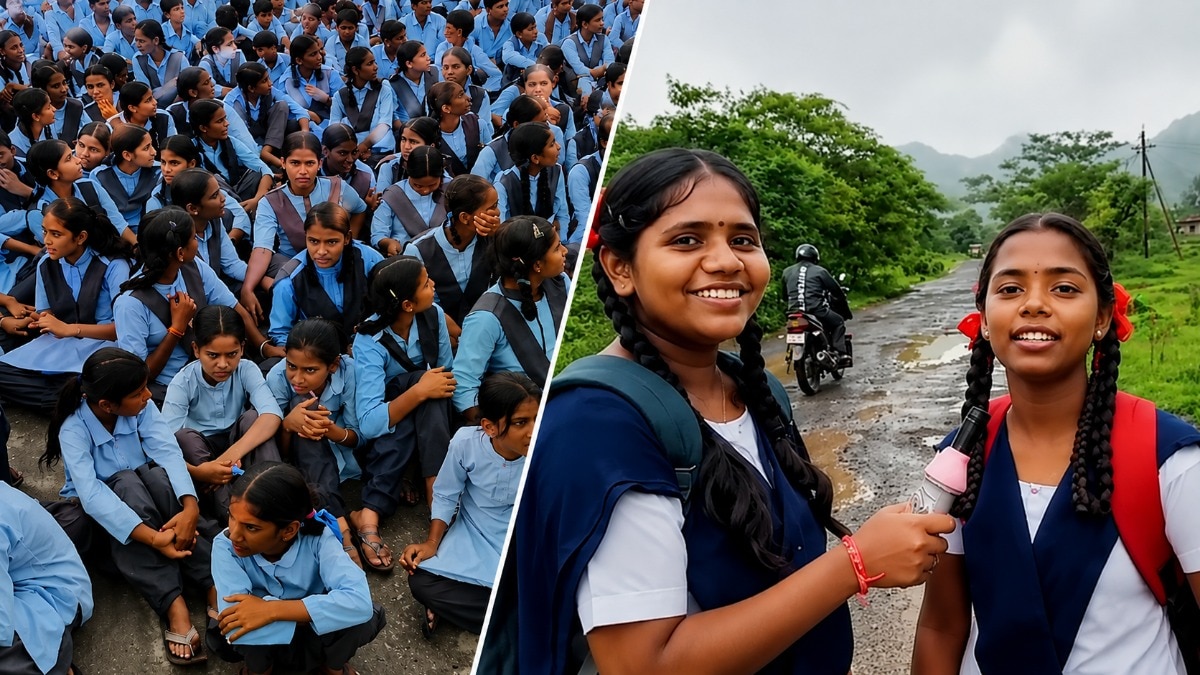
It's child's play to deal with their complaints, until the children take to the streets. We have seen that happen over the last two weeks, and it is a sign of a change in how Indian children, not just the youth, are responding to problems around them. In the past fortnight, children have walked out of classrooms, marched to government offices, locked school gates, sat on roads and demanded answers from officials. About? Fans in classrooms, clean drinking water, functioning toilets, teachers, better food, desks, libraries and, in one case, a road to school.Separately, these protests look like local disputes over facilities in schools and related logistics. But this is also India's first-of-its-kind, visible, multi-state wave of protests by Gen Alpha, people born from roughly 2010 to 2025.Gen Alpha protests, as many have called them, have taken place in Uttar Pradesh, Bihar, Rajasthan, Madhya Pradesh and Maharashtra so far. While older adults have been spotted accompanying children in some of these demonstrations, the protests are centred around children's problems.The first Gen Alpha protest was reported on July 29 (Saturday), just four days after Dharmendra Pradhan resigned as Union Education Minister and the CJP ended its Jantar Mantar protest, which had continued for 50 days. The protests could be organic, with Gen Alpha taking cues from Gen Z protesters, and it is equally possible that strings are being pulled by older adults. We do not know for sure, but we are seeing a pattern.Though different in their immediate triggers, the protests are similar in their method. Instead of whining, brooding, or complaining to their parents or teachers, they organised, stepped out of their homes, and marched, staged sit-ins, and refused to leave until someone listened.GEN ALPHA MARCHES TO COLLECTORATE FOR ROAD TO SCHOOL On August 11, students and villagers from Chandu Pur gram panchayat in Uttar Pradesh's Hamirpur district travelled about 5 km in a "Tiranga Yatra" to their local Collectorate. The children demanded a paved road to their school. They said they had to walk through mud, particularly during the rainy season, and that no paved road had been built in the area since Independence. They sat at the District Magistrate's office gate and said they would remain there until work began.The administration said the road project, estimated to cost around Rs 1 crore, had been pending for years. An NOC had been received from the Forest Department and the proposal had been sent to the government, with a tender to follow after approval, an official said.The Hamirpur protest, however, showed one of the obvious questions that might follow this movement of kids. How much of it is being driven by the children themselves and how much by adults around them? The ADM in Hamirpur alleged that some "anti-social elements" were escalating the issue by bringing children to the forefront.The protesters, though, continued to demand that the roadwork begin.GEN ALPHA PROTESTS IN UP, MP, MAHARASHTRA, BIHAR AND RAJASTHANA similar situation arose in Fatehpur district, Uttar Pradesh on July 28.Nearly 1,500 students of Sarvodaya Inter College in Kishanpur town walked out of their classrooms and held a protest against the institute's facilities. Their demands included proper desks and benches, toilets, drinking water, midday meals and a lack of facilities like a library and computer lab, among other things.The school administration had to bend. The authorities said the demands would be addressed, including installing four fans in every classroom, repairing electrical wiring, and midday meal arrangements.The children were asking for the basics to be covered, and nearly everywhere, the pattern was the same.In Bihar, around 40-50 students from Simuara Middle School in Gaya walked nearly four kilometres to the SDM's office to speak to him directly. Not the junior officials. Straight to the top.Their complaints also included providing edible midday meals, cleaning up of dirty toilets, fans in classrooms, and replacement of broken benches, and also, the repairing of a broken hand pump. The administration ordered an enquiry and gave the headmaster a deadline to address the complaints.In Rajasthan's Barmer, students locked the gates of government schools over vacant teacher posts. The protest continued until the District Education Officer assured students that three teachers would be deployed immediately. In Jalore, students similarly protested over teacher shortages.In Madhya Pradesh, students at a residential school in Chhindwara protested over the quality of the mess food, alleging that insects had repeatedly been found in dal and vegetables.Meanwhile, in Maharashtra, students protested over toilets, water supply and teacher absenteeism, with many students demanding teachers before their board examinations.Different states, the same struggle for the basics.Gen Alpha is using unity to force their educational institutions to respond. They are moving beyond the traditional route of complaining, and are taking their grievances to the streets.Rajdeep Sardesai, Consulting Editor at India Today Group, said in his show on India Today TV, "School students across India seem to have taken a cue from the Gen Z and are increasingly taking their grievances to the streets. This is not just in one part of the country, but from Uttarakhand to Madhya Pradesh to Uttar Pradesh, suddenly protests and viral videos are actually forcing authorities to act.""From reels to street protest, Gen Alpha are using all tools to make their point, and the system is struggling to answer their pointed questions," he added.This mobilisation might be pointing to a change in political behaviour, one that Gen Alpha is picking up from the generation just ahead of it, Gen Z.THE GEN Z TEMPLATE IN GEN ALPHA PROTESTSThese protests by kids did not emerge in a vacuum.Barely a year ago, young people in Nepal led protests that brought down Prime Minister KP Sharma Oli's government. The protests were driven by a combination of anger over corruption, political privilege and a social media ban, and put Gen Z's ability to mobilise large numbers of people on the streets under international attention.It was the world's first meme-glazed protest. Seemingly unserious, yet consequential.The Nepal protests also changed the political conversation in India too. Leader of the Opposition, Rahul Gandhi, first invoked India's Gen Z in September 2025. Other political quarters followed with their own attempts to engage younger Indians.Just a year after the Nepal protests, Gen Z had become a political constituency that parties could not easily ignore.This was a generation that had grown up online, was comfortable questioning institutions in public, and had watched young people elsewhere use social media to organise rapidly.The CJP protests around NEET-UG paper leaks added a layer to this. The anger was no longer about individual grievances.That is the environment in which Gen Alpha is now growing up.Uttarakhand-based journalist, Robin Singh Chauhan, said in a post on X, "There's plenty of discussion about Gen Z, but Gen Alpha is now learning to ask questions too. Students at the Eklavya Model Residential School in Khatima, Uttarakhand, staged a 3-day protest over basic issues like poor food, expired rations, electricity, drinking water, and sanitation.""The new generation isn't staying silent. It's asking questions and demanding accountability," Chauhan also said.GEN ALPHA WATCHING GEN ZMost of the children participating in these recent protests are too young to vote. They have little formal political power. They cannot change a government through an election and, in most cases, have limited influence over the institutions they are confronting.Yet, they have discovered a form of leverage — visibility — and they have social media as one of their strongest tools to make it work.A group of schoolchildren marching down a road, carrying placards or sitting outside a government office is difficult for an administration to ignore, particularly once videos of the protest begin circulating online.The students are also growing up watching Gen Z use precisely this language, and Gen Alpha appears to be learning that lesson early."Well done Gen Alpha! This is what we need to do -- take responsibility of our own future," posted Saurav Das, one of the CJP protest leaders, resharing a video of children protesting at the collectorate for a road.WHAT THE GEN ALPHA DEMAND MATTERSThere is also something revealing about what they are demanding.Previous generations of students often accepted poor infrastructure, absent teachers, inadequate facilities and irregular services as part of everyday life.The children protesting today are less willing to treat no fans in classrooms, no teachers, and no road to school as normal. They are growing up in an India where information about how things work elsewhere is available on a phone. They can see what they are missing out on, and hence, the rage of an alpha.The adults around these children will inevitably shape some of these protests. But that does not make Gen Alpha's grievances less real.The more interesting question might be what the children are learning from the experience.Across the protests in five states in the last two weeks, officials have responded with committees, inspections, deadlines, and assurances. They saw their preceding generation's first successful protest because of which Union minister Dharmendra Pradhan resigned.The children, therefore, are already learning a basic lesson, that institutions respond when pressure is organised and visible.The Alpha instinct is simple. If something isn't working, change it.- EndsPublished By: Anand SinghPublished On: Aug 13, 2026 16:03 IST
Move over Gen Z, a Gen Alpha wave of protests has spread to five states
Full Article
Original Source
Read the full article at Indiatoday →KhanList aggregates and links to publicly available news content. We do not host full articles from third-party sources. Always verify important information with original sources.