
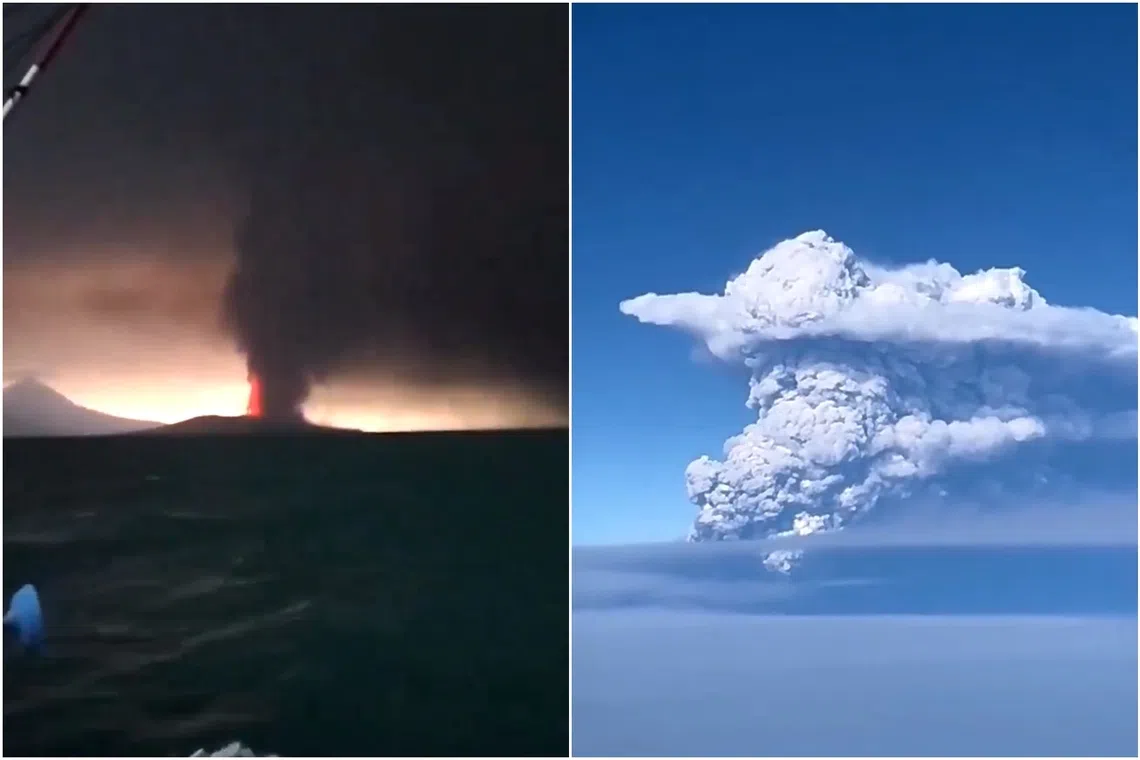
Follow our live coverage.SINGAPORE – A series of eruptions at Indonesia’s Mount Anak Krakatau since Sept 4 have disrupted flights and daily life as volcanic ash spread more than 150km away, blanketing Jakarta and nearby areas.Several schools in Indonesia cancelled activities on Sept 5 after students and residents reported suffering eye irritation from the ash, while fishermen scrapped their fishing trips.Eight Indonesian airports, including two in Jakarta, remained closed on the morning of Sept 7, with at least 170,000 people affected by flight cancellations.Here are some key facts about the Mount Anak Krakatau volcano:Volcano emerged less than 80 years agoMount Anak Krakatau lies in the Sunda Strait, which separates the islands of Sumatra and Java.The young volcano emerged from the strait less than 80 years ago, and its crater is located south-west of the centre of the island.It was formed along the 3,000km-long Sunda Arc, where the Australia Plate sinks beneath the Eurasia Plate, where earthquakes and volcanic eruptions are common, according to NASA.Formed after biggest volcanic eruptions in historyAnak Krakatau, which means “child of Kratatau”, was formed after its parent, Krakatau, disappeared in one of the biggest volcanic eruptions in history more than 140 years ago.In 1883, a two-day eruption of Krakatau from Aug 26 to 27 led to two-thirds of the island, measuring about 23 sq km – about five times the size of Sentosa island – sinking into the Sunda Strait.Parent volcano’s explosions produced loudest known soundThe explosions heard from the 1883 eruption remain the loudest noise on record. The sound was heard across the Indian Ocean, as far as Rodriguez Island, 4,653km to the west, and Australia, 3,450km to the east, according to NASA.The massive eruption also generated a series of tsunamis across Sumatra and Java, which produced waves up to 30m high and led to most of the 36,000 deaths linked to the eruption.Sporadic activity observed since 1927Anak Krakatau has been the site of frequent eruptions since 1927, according to the Smithsonian Institution.Since July 2, the volcano has been on alert level 3, the second-highest.An eruption on July 7 sent an ash column 100m into the sky.A man clearing volcanic ash from his car windscreen in Bogor, West Java, on Sept 6, following the eruption of Mount Anak Krakatau. PHOTO: AFP2018 tsunami after partial collapseIn December 2018, a large part of Anak Krakatau collapsed, following an eruption.The landslide triggered a tsunami, which killed more than 400 people and injured thousands in the surrounding Java and Sumatra islands.The volcano also lost about two-thirds of its height, down from 338m to 110m, and three-quarters of its mass. Its estimated mass after the 2018 eruption was about 50 million cubic m, or about 20 per cent to 25 per cent its original size.Indonesia’s national disaster management agency said on Sept 5 that there was no imminent risk of a tsunami from the recent volcanic eruptions.
Mount Anak Krakatau: What to know about the volcano disrupting Indonesia flights
Full Article
Original Source
Read the full article at Straitstimes →KhanList aggregates and links to publicly available news content. We do not host full articles from third-party sources. Always verify important information with original sources.