
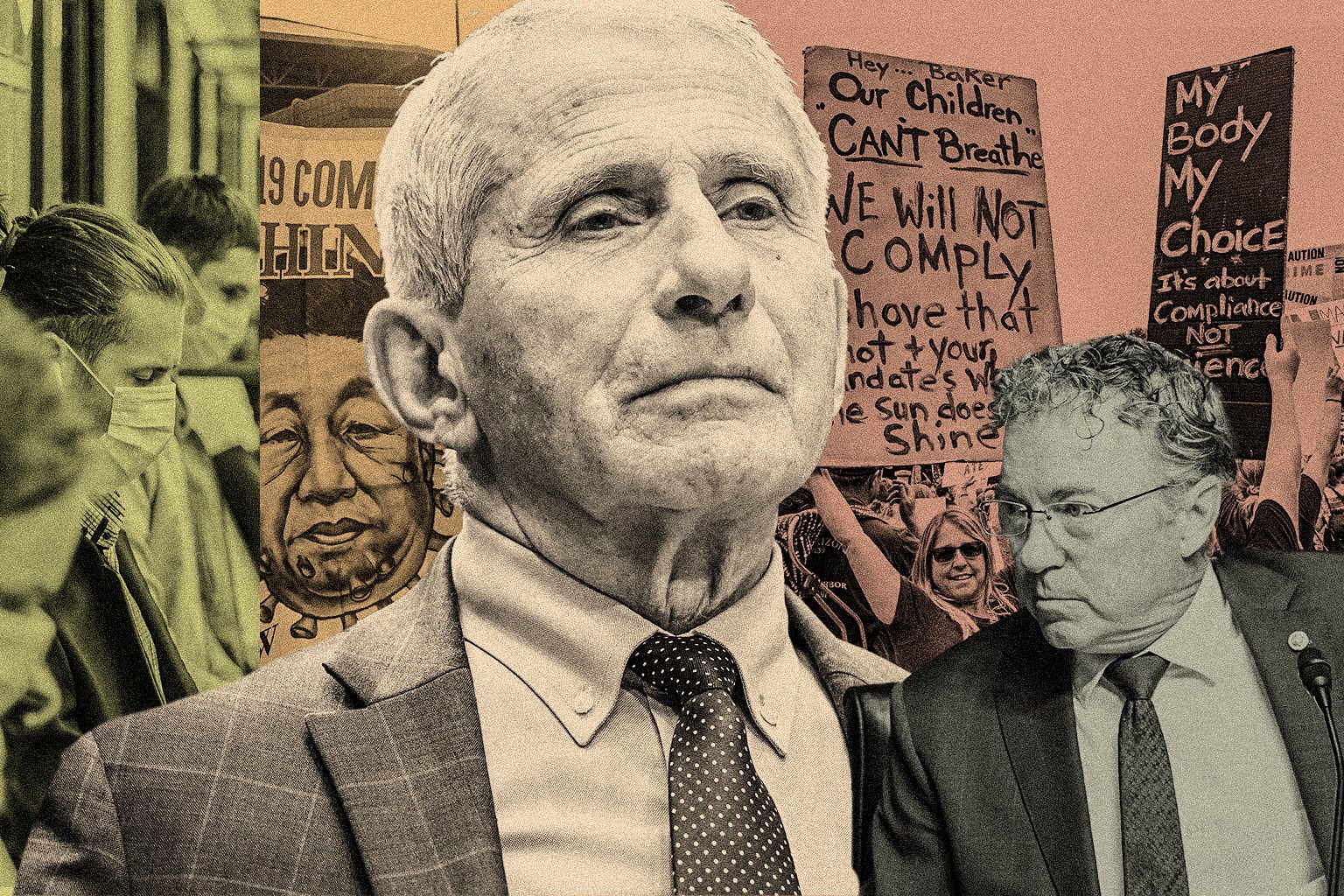
Politics The GOP Thinks Relitigating the Pandemic Will Help Them in the Midterms There are some ways in which they’re right. But then there are all the ways that they’re wrong. By Enter your email to receive alerts for this author. Sign in or create an account to better manage your email preferences. Unsubscribe from email alerts Are you sure you want to unsubscribe from email alerts for Molly Olmstead? Aug 03, 20263:17 PM Photo illustration by Slate. Photos by YurolaitsAlbert/Getty Images Plus, Joseph Prezioso/AFP via Getty Images, Patrick T. Fallon/AFP via Getty Images, Alex Wroblewski Images. Sign up for the Slatest to get the most insightful analysis, criticism, and advice out there, delivered to your inbox daily. If you have vivid memories of President Donald Trump’s bungling of the COVID pandemic response, you may find yourself a little bewildered that in the lead-up to the midterms, the Republican Party is trying to remind us as much as possible about that era. Many Americans remember watching the then president lie about the severity of the disease and tout quack cures (never forget the suggestion to maybe inject bleach into your veins). Spending time relitigating that era may seem, to the non-MAGA public, like the opposite of common sense for Republican messaging. And yet, it’s becoming abundantly clear that this is the GOP’s plan. For months, Republicans, led by Sen. Rand Paul, have pushed investigations and hearings into theoretical wrongdoing by Anthony Fauci, the former head of the National Institutes of Health. This culminated in a hearing on Wednesday in which Paul and other Republican senators berated a silent Fauci and accused him of cover-ups and evil schemes. Fauci’s decision to take the Fifth did not prevent influencers from turning the clips that did surface into rage bait, packaged with campaign messaging. As the conspiracy-theorist influencer Jack Posobiec wrote on X on Wednesday, “The Fauci hearing is a reminder of who comes back into power if the Democrats get back in office.” This strategy appears to be an effort to revive the anger of a population that saw the pandemic as its political origin story. Right-leaning Americans who had never been particularly civically engaged found themselves at city hall meetings or out in protests, furious about business closures and stay-at-home orders. The conservative impulse to champion individual liberty—at least individual liberty as it applied to them—butted headfirst against the collectivist nature of a public health response. We all remember this; what some may have not noticed is how that anger, in certain segments of the population, never went away. Plenty of internet pundits, however, have kept their eye on this and continued to deliberately stoke the anger themselves. For the past five years, conservative influencers and right-wing news media have periodically reminded their users, in heated language, of the injustices of that time. But more than that, they’ve pushed conspiracy theories that have spun policy disagreements and health misinformation into sordid tales of sadistic health officials. Those theories now include the claims that Fauci’s NIH funded research that created the virus. That Fauci knew this and covered it up. That he knew that ivermectin and hydroxychloroquine were useful treatments for COVID but suppressed them. That remdesivir, an intravenous treatment for COVID, was actually a killer and that he knew it. That his NIH ran freaky experiments involving transgenic mice and aborted baby parts. And, most catastrophic of all, that Fauci knew that the vaccines caused injury and death but forced them on the population anyway. These conspiracy theories had circulated among the right-wing information ecosystem for a while, but somehow, lately, they have started to be treated as established facts—not just by Republican activists, but by actual members of Congress. After Wednesday’s hearing, Rep. Anna Paulina Luna, who said she believes that Fauci lied about the vaccines, described Fauci as “Dr. ‘Mengele’ Fauci,” in reference to the monstrous Nazi scientist who ran experiments on prisoners. Sen. Ron Johnson asserted that the “injection-injured” were committing mass suicide. Sen. Tommy Tuberville told Newsmax’s viewers, “He killed millions of people, folks.” And now the GOP has united enough around these conspiracy theories that audiences have begun to see the question of their validity as fully settled, in part because it is a pet issue for Health and Human Services Secretary Robert F. Kennedy Jr., who wrote an entire book dedicated to disparaging Fauci. On Instagram, mommy influencers made smug posts about being proved right by the hearing. So did right-wing publications such as the Daily Wire. If you closely watch the hearings and the conservative talking points, though, you’ll notice that this anti-Fauci rhetoric is actually two different lines of attack. The first taps into a natural source of anger—over children at school in masks and stories of people being unable to visit dying loved ones in the hospital. These are reminders of very real hardships from that time, and in this line of attack, it was not the disease itself but liberal hysteria around the disease that ruined lives. For a certain portion of the population—mostly those who are white and not elderly—this felt true, even at the time. A 2021 poll from Pew found that some 30 percent of white Americans didn’t know anyone who had been hospitalized from COVID; if people who didn’t experience COVID in their everyday lives lost jobs or missed educational opportunities because of the public health measures, their frustration shouldn’t be entirely surprising, or even out of the realm of legitimate political debate. After all, people across the political spectrum have had to grapple with the question of whether closing schools was the right decision, and evidence has since piled up indicating that students suffered long-term consequences. “We harmed young people in very real ways,” said David Barnes, a public health historian at the University of Pennsylvania. “And we never had a public conversation about whether it was something we were prepared to do and live with the consequences of.” This first source of right-wing anger related to the policies of the pandemic is fairly reasonable—in those early months, the many unknowns led to decisions that look almost silly in hindsight. The problem is that the people who attack Fauci on the masks and lockdowns often seem to operate on the belief that the virus was never a big deal and that it was abundantly clear that the protective health measures were wildly disproportionate. COVID killed more than 1 million Americans, but there seems to be some kind of mass amnesia about this in the right-wing-pundit space. According to Barnes, this is actually quite typical, historically: “Societies forget epidemics quickly,” he said. And what was left, once memories of the crisis faded, were the harms of the choices we made to cope with a whole host of unknowns: the learning losses, socialization issues, and shuttered businesses. All of that boils down to this: Republicans believe they can persuade people not to vote for Democrats by reminding them of how much they hated online school and stay-at-home orders—ideas they now associate with Democrats, given how compliance ultimately fell along ideological lines. The other line of attack—about evil experiments and deadly vaccines—is very different. It’s less organic, less targeted to swing voters, and less concerned about logical coherence. ( For example, Fauci could be a killer because he released a deadly virus, but he also could be a killer because COVID was harmless and the vaccine was deadly.) Because of this general messiness, it’s unclear how much the conspiracy theories actually resonate with the general public. But there is definitely a core MAGA crowd that buys into the idea of Fauci as a monster and that is eager to continue being mad about it. These voters aren’t ones the party is worried about turning out in an election, but Trump and certain lawmakers do seem to enjoy whipping them up. It’s possible that reaching voters with pandemic anger isn’t the point of any of this. Perhaps, as political forecaster Alan Abramowitz notes, Republicans just need to focus on anything else aside from what is happening right now. He sees this as an attempt to draw attention away from gas prices, inflation, the war in Iran, and Trump’s other unpopular ideas. These conspiracy theories will get picked up and circulated among the MAGA die-hard, he says, taking up space in political discussions. It seems to him a desperation play during historically low popularity numbers for Trump. And to him, that’s a problem: “It won’t persuade swing voters more concerned about the economy,” he said. “I don’t think it’s going to be an effective strategy.” It’s predicted that Republicans are about to take a beating in the midterm elections. In the lead-up, it seems likely that they will continue to pursue a punishment of Fauci and other NIH figures. Already, lawmakers and governors are making noise about state-level prosecutions of Fauci to circumvent the blanket pardon President Joe Biden issued before Fauci left office. It remains to be seen if these strategies will work—some voters will be energized; others will become fatigued by it and lose interest. Maybe it will help distract people from gas prices; maybe only die-hards will care. But the MAGA movement is committing to its story about the COVID pandemic, and in doing so, it has successfully legitimized fringe conspiracy theories and rewritten history for millions of Americans. Get the best of news and politics Sign up for Slate's evening newsletter. Donald Trump Republicans Coronavirus Anthony Fauci Conspiracy Theories
Most People Want to Forget the Pandemic. Why Does the GOP Want to Keep Reminding Them of It?
Full Article
Original Source
Read the full article at Slate →KhanList aggregates and links to publicly available news content. We do not host full articles from third-party sources. Always verify important information with original sources.