
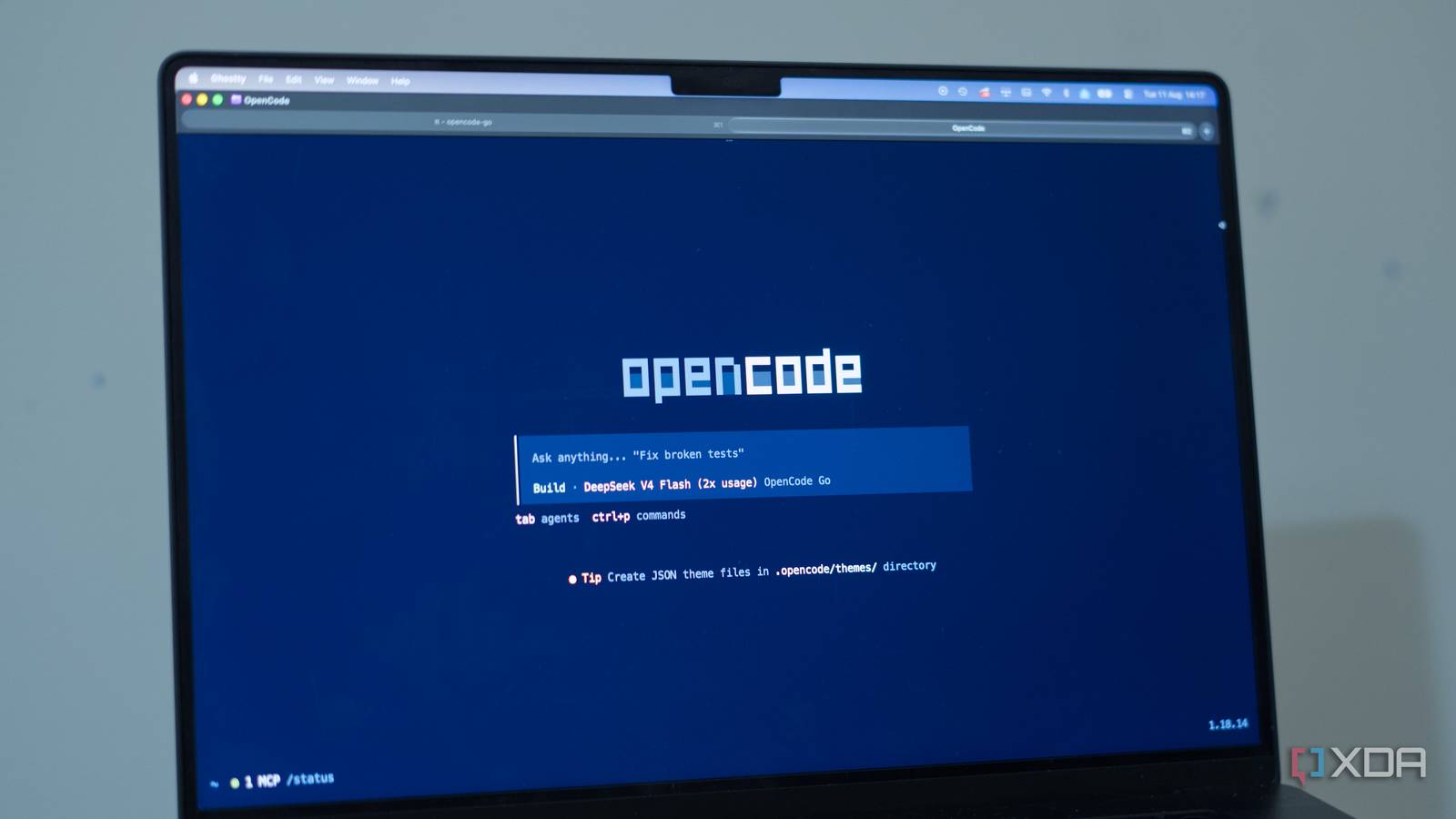
If you're paying for Claude Code, you're probably familiar with its different tiers. It's $20 a month for Pro, $100 for Max 5x, or $200 for Max 20x, and whichever tier you pick, there's a 5-hour window and a weekly cap drawing from the same pool as your web-based chats. It's good value for what it is, but it's not cheap, and the limits can often show up at the wrong time. There's a $10 subscription from the team behind OpenCode that gives you access to the best open-weight coding models on the market. It's called OpenCode Go, and after spending a few weeks with it, it's hard to argue that it's not one of the best deals in AI right now. In my testing, one of its models costs me about $0.03 for a full day of heavy use. Another model is so capable that the White House has publicly accused its creators of stealing American technology. And both come with the same $10 a month plan. To be clear, OpenCode Go isn't a perfect replacement for Claude Code. The premium models burn through their usage caps quickly, and there are tasks where Claude's reasoning genuinely still wins. But for the 80% of everyday coding work, refactoring, debugging, writing tests, building out features from a spec, this subscription makes Claude's pricing look even more astronomically expensive. DeepSeek V4 Flash is the model that makes OpenCode Go a great deal It borders on free OpenCode Go gives you an API key with access to 18 models that you can use in any coding harness (not just OpenCode), but the most important model, by far, is DeepSeek V4 Flash. It's the cheapest model in the lineup by a wide margin, and you get an incredible amount of usage. OpenCode's docs estimate 31,650 requests per 5-hour window, with a current promotional 2x multiplier bringing it to 63,300. The per-request pricing works out to fractions of a cent either way. I checked my own usage logs from a day of pointing it at codebases and asking it for analysis. Across multiple sessions, I sent about 44 requests with input contexts ranging from 18,000 to 216,000 tokens, which is the kind of massive context windows you get when you're working on a real codebase and the agent keeps accumulating conversation history. Total cost reported in the OpenCode console: three cents. All of that analysis, with genuinely good insights, cost mere cents. At that burn rate, the $12-per-5-hour cap is essentially unreachable. I'd need to repeat that day's workload roughly 400 times to hit it. At my burn rate, the $60 monthly cap might as well not exist. I'm paying $10 a month and using maybe a dollar's worth of it. This isn't promotional pricing designed to hook users before a price hike. Dax Raad, one of the builders at OpenCode, posted on X that the company's total global V4 Flash inference spend was about $120,000 in a single day. For context, OpenRouter's estimate was around $20,000. Dax called it "nothing", and it puts into perspective how cheap this model is to serve. When someone asked if they were losing money on it, he replied that OpenCode has been able to reproduce DeepSeek's token cost on rented GPUs. OpenCode is still using DeepSeek's API, but when those API costs go up (which the company has already announced), it seems like OpenCode is positioning itself as being able to take on that load. V4 Flash scores 79% on SWE-bench Verified, which puts it within spitting distance of Claude Sonnet 4.6 at 79.6%. For the bulk of coding tasks, the code review, single-function refactors, test generation, and debugging that you do every day, you're not going to feel the difference. It's fast, it's cheap, and it handles large contexts without an issue. Kimi K3 is incredibly capable So capable that the White House has accused its creators of theft The other end of Go's lineup is Kimi K3, a 2.8-trillion-parameter open-weight model from Moonshot AI, a Chinese company. It's the largest publicly available open-weight LLM, and it's drawn attention at the highest levels of the US government because of its capabilities. In July, White House science advisor Michael Kratsios posted on X that Moonshot built Kimi K3 by distilling Anthropic's Fable model. He accused the company of "large-scale, covert industrial distillation aimed at stealing proprietary U.S. technology," amid reported discussions about banning Chinese open-weight models. Treasury Secretary Scott Bessent echoed the sentiment, claiming the US was "finding watermarks of our U.S. large language models on many of the Chinese models." But multiple respected AI researchers say that explanation doesn't hold up. Braden Hancock from the Laude Institute and Snorkel AI pointed out that Fable had only been publicly available since July 1st, and there simply wasn't time to distill that much data and train a model in two weeks. Nathan Lambert from the Allen Institute for AI argued that distillation is becoming less impactful as frontier model training increasingly shifts toward reinforcement learning anyway. Hancock put it most directly: "in general, Americans are understating the technical expertise of these Chinese teams. One of the founders of Moonshot was a CMU PhD student. These are legitimate researchers and engineers doing solid work." Kimi K3's predecessor, Kimi K2.6, won Day 12 of an AI Coding Contest ahead of GPT-5.5 and Claude Opus 4.7. K3 is the successor, and while no SWE-bench Verified benchmarks have been published for K3 itself, K2.6 scored 80.2%, competitive with DeepSeek V4 Pro at 80.6% and sixteen points behind Claude Opus 5 at 96%. A meaningful gap for the more difficult tasks, but not one that matters for most everyday work. Accessing Kimi K3 through OpenCode Go costs the same $10 a month as the rest of the subscription. Moonshot's own API pricing is $3 per million uncached input tokens and $15 per million output tokens. Go's pricing is identical, which means OpenCode isn't getting a discount on K3, and that's why it only gets 110 requests per 5-hour window. But you're also not managing a separate API account, and you're paying $10 instead of Moonshot's own cheapest monthly membership plan at $19 a month. Hybrid workflows are what OpenCode Go is all about Change your model whenever OpenCode Go is essentially a routing system, and there's a pretty common pattern emerging with regards to how people actually use it. V4 Flash handles the volume: code review, boilerplate, test writing, single-function refactors, and debugging, because it's fast and it's effectively free within the subscription. Kimi K3, meanwhile, is reserved for the hard problems: complex multi-file refactoring, architectural decisions, and tasks where you need a bigger, smarter model. Compare this to Claude Code. Pro costs $20 a month and gives you a single model family with 5-hour session windows (which were doubled in May) alongside weekly caps. There's a lot of value, to be fair; Claude Opus is still one of the best models for genuinely hard reasoning tasks. But for routine work, you're burning expensive Opus tokens on things V4 Flash could handle at near-zero cost. The subscription model works against you here: you pay the same $20 regardless of which model you use. Using cheaper models consumes less of your limit, but unless you're constantly hitting those limits, there's no incentive to route cheap work to a cheap model. OpenCode Go flips that. You pay $10, and you naturally start with the cheap model first because it's the smart thing to do. The premium models are there for when you need them, and their scarcity forces you to use them deliberately rather than wastefully. A split of usage like 80% cheap model, 20% expensive model will vary person to person, but it's still similar for everyone: the cheap model covers most of what you do, and the premium model covers the edge cases. Claude Pro at $20 a month gets you one model family with session limits that share a pool with your web chats. Go at $10 a month gets you a cheap model for the volume and an expensive one for the edge cases, both in the same subscription. OpenCode Go's best product isn't any one model, it's the routing choices it gives to users. It's not a Claude Code replacement for everything It can still fall short Left: DeepSeek V4 Flash // Right: Claude Opus 5 This subscription doesn't include Claude Opus, Gemini, or the full GPT-5.5 (it does include GPT 5.6 Luna, though). For the hardest reasoning tasks, complex multi-step architectural decisions, novel algorithm design, or tasks where benchmark improvement actually matters, Claude Opus 5 still leads pretty much all of these models. If your work lives in that territory, Go is a supplement rather than a replacement. The premium models also burn through their caps fast. Kimi K3 gets 110 requests per 5-hour window in a $15 monthly budget bucket. Grok 4.5 is similarly limited, allowing for just 120 requests in the same $15 bucket. These are scarce resources designed for occasional use, rather than daily drivers you would use continuously. If you try to use K3 the way you'd use Claude Opus, you'll hit that wall pretty quickly. On top of that, 16 of the 18 models come from Chinese AI companies, which matters for some companies' data policies. Grok 4.5 and GPT 5.6 Luna, the two US exceptions, have 30-day data retention instead of the zero-retention policy that applies to most of the Chinese models. DeepSeek V4 Flash's zero-retention agreement is renewed monthly, so it's not a permanent guarantee, and it's important to know that if data policies are a hard constraint for your workflow. OpenCode Go is still a relatively young product, and the documentation says usage limits may change as the team learns from early usage. The model lineup has already grown from 3 models in March to 18 today, and it's going to keep changing as time goes on. Even still, all of those caveats matter less the more you use V4 Flash. At the burn rate I'm seeing, I'd have to try very hard to spend more than a dollar or two of my $10 subscription in a month. The rest of the budget sits there as headroom for the rare occasions I need K3 to unpick something the primary model can't handle. No matter what, a $10 a month plan for a default model that's so cheap it borders on free and a premium model so powerful that it's earned White House scrutiny is a combination no other provider has an answer to. Especially not Claude Code.
Most people pay $20 for Claude Code, but OpenCode Go is $10 and I can barely spend a dollar of it
Full Article
Original Source
Read the full article at Xda-developers →KhanList aggregates and links to publicly available news content. We do not host full articles from third-party sources. Always verify important information with original sources.