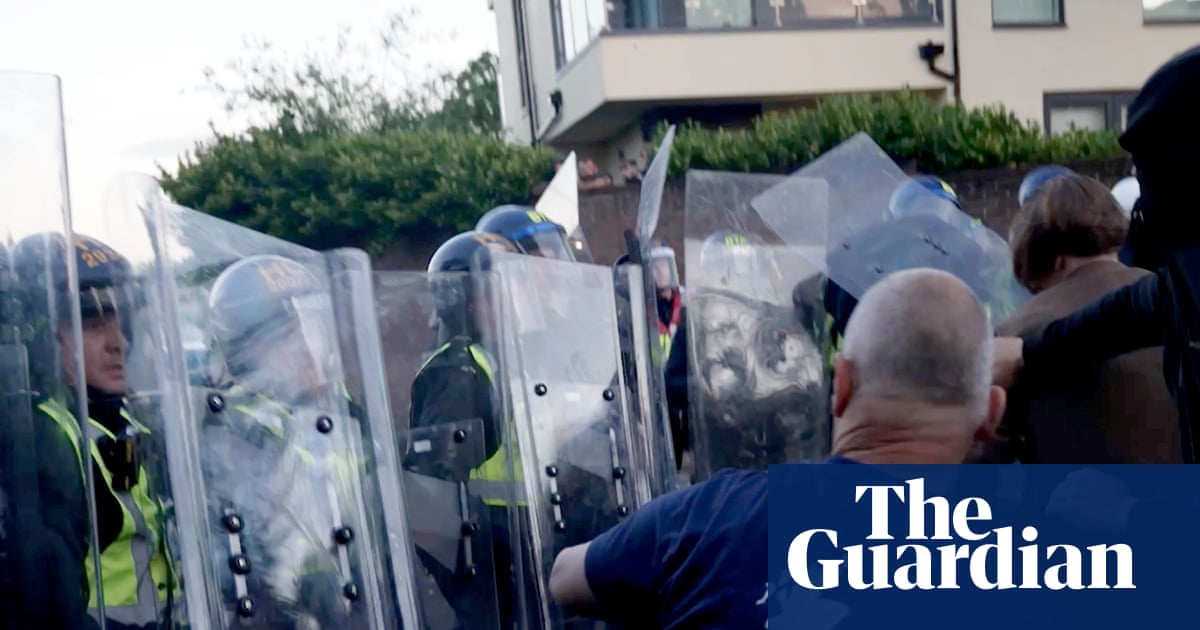
Most people arrested during violent protests after the sentencing of Henry Nowak’s murderer had previously been reported to the police for domestic abuse, the Guardian can disclose.Data released by Hampshire police under freedom of information laws shows that 22 of 37 people (59%) detained in Southampton after Vickrum Digwa was jailed for life have also been reported for crimes associated with intimate partner violence.Protests took place on 2 June after police bodycam footage was released showing Nowak, 18, handcuffed as he lay dying after being stabbed by Digwa, who had falsely accused him of racism. Nowak repeatedly said he had been stabbed.Digwa stabbed Nowak with a large blade he claimed to carry as part of his Sikh faith, before falsely telling police he had been the victim of a racist attack, leading officers to initially arrest the white teenager rather than his killer.The footage led to claims from Nigel Farage and others that it was evidence of “two-tier policing” and “anti-white prejudice” within police forces.Demonstrators initially gathered outside a city centre police station, with several hundred people then attempting to march towards the murder location and the street where Digwa’s family lived. During prolonged violent disorder, 12 police officers were injured, and nearby properties and vehicles were damaged.Twelve police officers were injured during the clashes with protesters in Southampton last month. Photograph: Isabel Infantes/ReutersHarry Varney, 34, claimed he attended the public gathering to pay his respects to Nowak, but was later filmed swearing at police and punching their riot shields. He was sentenced to three years’ imprisonment.In 2023, he pleaded guilty to assault by beating after pinning his partner against a bedroom wall, bruising her neck. He claimed she deserved to be beaten by a previous abusive ex-partner and continued to threaten her after this attack.She said in a written statement read out in court: “I suffer with flashbacks, anxiety attacks and nightmares. I also now struggle with my social life trusting people. I can’t be left alone with a man without feeling scared.”Dillon Crawford, 29, was sentenced to three years’ imprisonment after throwing a brown bin and a metal chair “with some force” at police officers during the disturbances. He has 19 previous convictions, including for domestic abuse offences. During one incident, he broke a partner’s front teeth, punching her unconscious, and, after she woke up, told her he had put bleach in her hair.Andrew Summerhayes, 38, was seen throwing a wheelie bin at police during the disorder. He was sentenced to three years and two months for violent disorder and possession of an offensive weapon.Hampshire police confirmed that 33 people had now been charged for their involvement in the public disorder. The force has referred itself to the police watchdog, with two officers who attended the scene being investigated for potential gross misconduct by the Independent Office for Police Conduct. The investigation is considering potential failures to identify that Nowak needed urgent medical help and the decision to arrest and handcuff him before providing first aid.The Guardian previously revealed that two out of every five arrested for participating in riots in 2024 had been the subject of a domestic abuse report before their involvement, with one in five subsequently being reported for domestic abuse.Farah Nazeer, the chief executive of Women’s Aid, said: “Over the last two years, we have seen recurrent anti-migrant protests that have erupted into violence, with many of those arrested also carrying convictions for domestic abuse or other crimes against women and girls. It is not surprising that someone who is violent in public may also be violent at home, as there is a proven correlation between the two.”A Home Office spokesperson said: “Violence against women and girls is a national emergency. We will continue to deploy the full power of the state to bring perpetrators to justice and prevent harm before it occurs.“Our violence against women and girls strategy sets out how we will pursue and manage domestic abuse perpetrators, including through the rollout of new domestic abuse protection orders.”
Most people arrested during Henry Nowak protests had been reported for domestic abuse
Full Article
Original Source
Read the full article at Theguardian →KhanList aggregates and links to publicly available news content. We do not host full articles from third-party sources. Always verify important information with original sources.