
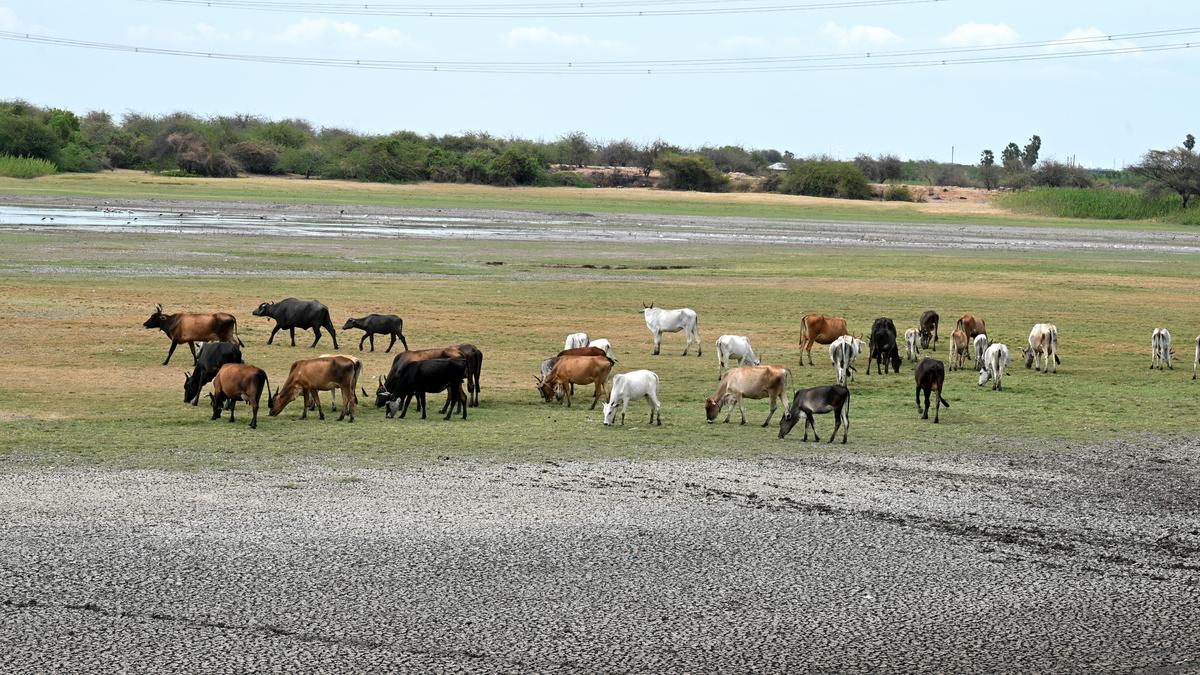
Cattle grazing in the almost dry Perumkulam tank in Thoothukudi district. | Photo Credit: N. RAJESH Most of the 107 irrigation tanks in the district, including 54 non-systemised tanks and 53 systemised tanks, are bone dry now, leaving farmers, their cattle and birds that would usually camp in the forests near these waterbodies in the lurch.After the southwest and northeast monsoons let down the southern districts last year and this year, the farmers of Thoothukudi district, who solely rely upon water released from the Papanasam and Manimuthar dams for irrigation, are at a crossroads. While most farmers who raise banana and paddy with water from the Tamirabharani did not take the risk of planting crops, only a few having their ranches close to the irrigation tanks and canals took the calculated risk. Now, with the tanks almost dry, these farmers pump stagnant water from the tanks to their ranches to save the standing crops.“After the not-so-good ‘pisanam’ paddy season, most farmers did not want to take the risk during this ‘kar’ season as we were clear that the southwest monsoon would not be very promising this year, as predicted by the Meteorological Department. Hence, agricultural operations are very limited this year even along the Tamirabharani watercourse,” said farmer S. Ramesh of Pandaravilai. Birds searching for their lunch in the remaining water in the Sivakalai tank in Thoothukudi district. | Photo Credit: N. RAJESH All sprawling irrigation tanks between Srivaikundam and Pandaravilai, which would usually enliven farming operations in this area with decent storage during this season, are almost dry now. While shepherds take their cattle right inside the dry tanks for grazing, small flocks of painted storks and other birds are searching for prey in the small pools of water at a few places within the tanks.“Even watering our domestic animals during this summer is a difficult task as the tanks do not have water,” said shepherd Sudalaimani of Sivakalai.The situation in the rain-fed tanks, all in the northern parts of the district where farmers would usually raise grams, chilli, millets and sunflower, is still worse. The Eppodumvendraan Tank, the largest non-systemised tank in the district, catering to 443.11 hectares of fields in this dry region, is almost dry now.The Tharuvaikulam new tank (162.11 hectares) and Tharuvaikulam old tank (157.09 hectares), which collectively nourish chilli and the famous ‘Tharuvaikulam Tomato’, are also completely dry now.“After the old and new Tharuvaikulam tanks were in a state of neglect for several years, with damaged bunds and no desilting, the quantity of water getting collected in both the tanks has dwindled a lot. Hence, most farmers having their rain-fed lands in this area have sold their fields to salt manufacturers,” said A. Manoharan of Tharuvaikulam, a coastal hamlet which was once getting drinking water from these tanks.The farmers, who are sceptical about the outcome of agricultural operations even during the upcoming northeast monsoon, have demanded that the government utilise this dry situation for desilting the tanks.“If farmers are allowed to take the silt from the dry tanks under the watchful eyes of officials even as the bunds are strengthened, the new-look waterbodies will hold more water this time if the northeast monsoon bails us out. Moreover, the hitherto neglected channels should also be desilted,” the farmers said. Published - August 25, 2026 08:09 pm IST
Most of the irrigation tanks in Thoothukudi district are dry now; farmers demand desilting of waterbodies
Full Article
Original Source
Read the full article at Thehindu →KhanList aggregates and links to publicly available news content. We do not host full articles from third-party sources. Always verify important information with original sources.