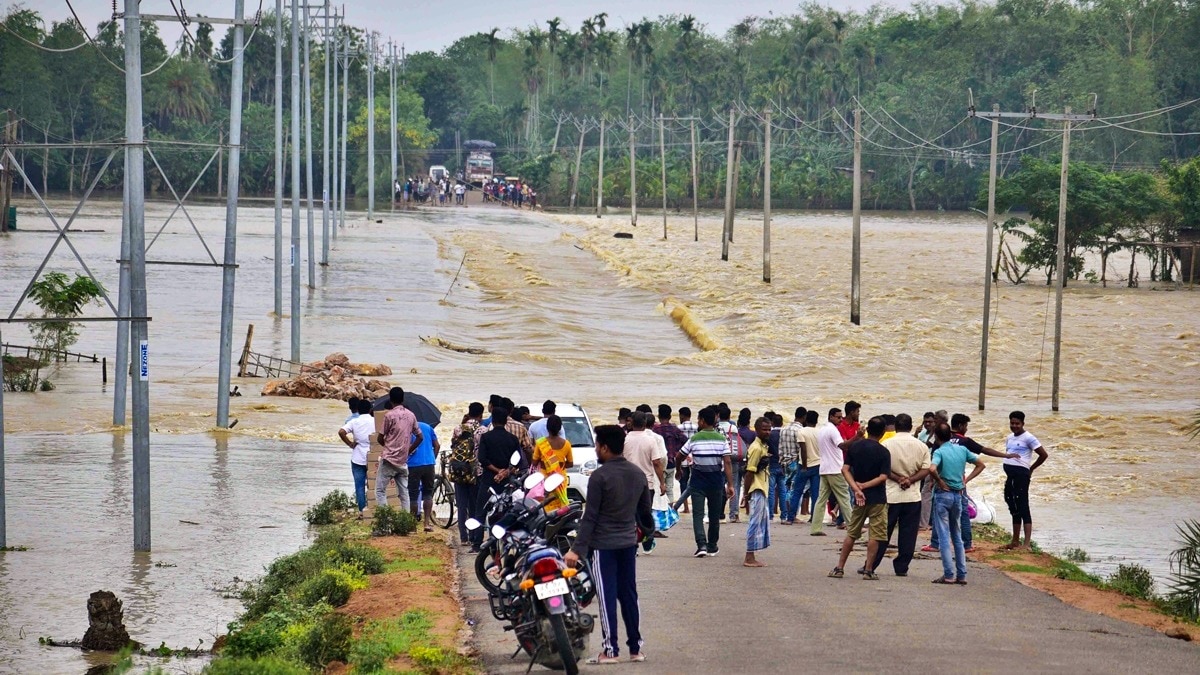
A national survey found that many Indians facing worsening extreme weather still could not define global warming. The findings suggest climate communication may work better when it starts with heat, water and pollution.Villagers stand near the flooded portion of a road following rains in the aftermath of Cyclone Remal, in Hojai district. (Photo: PTI)India is one of the fastest-growing major economies in the world. Yet, its large population and rapidly growing economy are severely exposed to climate change impacts in the form of increasing intensity and frequency of extreme weather events, such as heat waves, floods, and cyclones.In 2024, India recorded its warmest year since nationwide records began in 1901, with the annual mean temperature over India about 0.65°C above the long-term average. In 2025, India's annual mean land surface air temperature was 0.28°C higher, making it the eighth warmest year on record. In 2026, the India Meteorological Department had warned of warm nights and above-normal heat-wave conditions for the April–June season, pointing to how quickly climate risks are becoming everyday realities.Public understanding of "global warming" is not uniform across India despite high exposure to its impacts. That gap matters because people cannot prepare for extreme weather events or support and sustain solutions for a problem they cannot easily name or recognise.For them, Mother Nature has become increasingly unpredictable, and random types of extreme weather incidents are occurring at random places at random times. The irony is, these random things are happening at regular intervals now. That is their lived experience, but they can’t put that all under one single umbrella of definitions yet. To better understand how people in India intuitively make sense of "global warming," we asked 2,164 respondents randomly selected across India an open-ended question: "When I say 'global warming,' what is the first word or phrase that comes to your mind?" We transliterated "global warming" into multiple Indian languages, following common usage by governments, the vernacular press, and civil society.While terms like "Jal Vayu Parivartan" exist in Hindi, such translations have yet to become popular, pan-Indian terms, given India's vast linguistic diversity. Interviews were conducted over the phone in 11 Indian languages as part of our Climate Change in the Indian Mind survey series, for which new waves are being added almost on an annual basis now. Responses were recorded verbatim, translated into English for analysis, and coded into categories such as references to weather changes, heat, pollution, water, and others.MOST INDIANS DON'T ASSOCIATE ANYTHING WITH THE TERM 'GLOBAL WARMING'A majority of Indians (58%) in our national survey said they did not know or could not provide a specific response when asked what comes to mind when they hear the term "global warming." This finding is consistent with our broader survey results showing that many Indians say they know "just a little" about global warming or have never heard of it.We asked a similar open-ended question in 2011 and found that even 15 years later, more than half of Indians are largely unfamiliar with the term "global warming."This does not mean people in India are not noticing climate-linked disruptions. Indians are suffering from extreme heat, erratic rainfall, floods, droughts, air pollution, and water stress. What this result indicates is that the concept of "global warming" remains unfamiliar to many Indians, even as its impacts become more familiar through lived experience.WHEN INDIANS DO THINK OF 'GLOBAL WARMING,' THEY THINK HEAT, WATER, AND POLLUTIONAmong those who offered an association other than "don't know," the most common responses were related to Heat (10%), Water (8%), and Pollution (8%). Other notable categories included Alarmed (6%), which refers to short statements pointing to catastrophic impacts for present and future generations, such as "nature is getting destroyed."Very few respondents mentioned trees or forests, industry, or action, and even fewer spontaneously referenced glaciers, weather changes, or health. The pattern tells us a climate story unique to India: "global warming" is most often understood through the most immediate, visceral things people feel, such as hot days and nights, water problems, and polluted air.This stands in contrast to findings from other countries. In the United States, for example, frequent associations with "global warming" include dismissal of it as a hoax or references to distant threats such as melting glaciers.This is a crucial signal for communicators and policymakers that some people are already connecting climate change to lived risks, but they are not always doing so using the same vocabulary as experts. If climate communication starts with technical terms and distant timelines, it can miss the public's entry point. For many Indians, climate change communication that begins with heat, water, and pollution is likely to be perceived as more relevant for them and their families.EDUCATION, INCOME, AND PLACE SHAPE WHO RECOGNISES 'GLOBAL WARMING'Education was the strongest predictor of who could provide a response to our open-ended "global warming" question other than "Don't know." Among respondents with very low education (those who did not complete primary school education), a large majority (85%) gave "Don't know" responses. But among those with postgraduate education, "Don't know" responses were far less common (25%), and associations with heat, water, pollution, and climate change were much more frequent.Income and urbanicity also mattered. Lower-income and rural respondents were more likely to say they did not know when asked what "global warming" brings to mind. Urban respondents were more likely to associate global warming with heat, while semi-urban respondents were more likely to mention water.We also observe smaller differences by gender and age. For example, women were somewhat more likely than men to mention heat. Mentions of water varied across age groups, and climate change associations tended to increase with age. More than half of younger respondents (ages 18–24) said "Don't know" (59%), indicating that India's large young population should be a priority audience for climate change communication campaigns.CLIMATE COMMUNICATION SHOULD START FROM PEOPLE'S LIVED EXPERIENCESPublic opinion data like this can help decision-makers and communicators design messages that connect climate policy to what people already recognise as urgent: heat stress, water insecurity, and the persistent problem of air and water pollution across Indian cities and towns. It can also help avoid a common mistake of treating low familiarity with the term "global warming" as an indication of low concern about climate risk.As India updates state and national climate strategies, communicators must continue to explain the cause-and-effect relationship between burning fossil fuels and worsening heat, shifting rainfall, and rising risks of climate change.(This is an authored article. Anthony Leiserowitz is a Professor at the Yale School of the Environment and the Director of the Yale Program on Climate Change Communication, Jagadish Thaker is a Senior Lecturer at the University of Queensland, and Yashwant Deshmukh is the Founder and Editor-in-Chief of CVoter.)- EndsPublished By: Sibu Kumar TripathiPublished On: Jul 23, 2026 17:51 IST
Most Indians can't define 'global warming,' even as they feel its impacts
Full Article
Original Source
Read the full article at Indiatoday →KhanList aggregates and links to publicly available news content. We do not host full articles from third-party sources. Always verify important information with original sources.