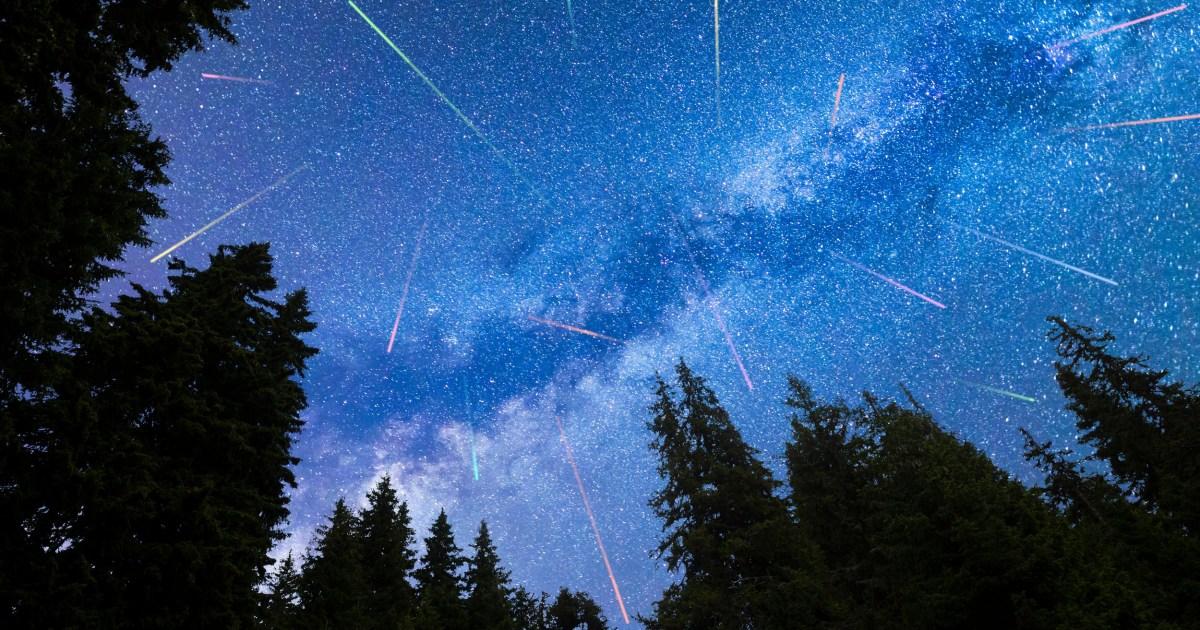
The gorgeous Perseid meteor shower has returned, and you’ve got a month to see it (Picture: Shutterstock) One of the universe’s most mesmerising events is returning – and the UK has a front-row seat. The Perseid (Per-see-id) meteor shower is one of the strongest meteor showers of the year, with dozens of colourful shooting stars whizzing past every hour. The shower returned to UK skies last night and will be active through the next month until August 24, but when is its peak? And will you actually be able to see it? All of the details are right here. What causes the Perseid meteor shower? Space is full of near-endless rubbish, from dirt and dust to ice. Sometimes, all of this ice gets clumped into one big dirty snowball called a comet. After gravity slings them into our Solar System, they leave behind trails of ice and rock that linger in space for years. Eventually, as the Earth laps the Sun, we drift into clouds of these particles, which enter the atmosphere at such a speed that they burn up and become shooting stars. Comets are the cosmic equivalent of making a snowball out of the ice that gets mushed within a car tyre (Picture: Getty) Many small meteors vaporise to leave behind a trail of light, while larger meteors explode as fireballs. This process can last for days and even weeks, with the peak occurring when our planet passes through the densest part of this cosmic debris. Perseid’s bright fireballs come from the muck left behind by the Comet Swift-Tuttle, which was discovered in 1862 by both Lewis Swift and Horace Tuttle. Officially known as 109P/Swift-Tuttle, the comet takes 133 years to orbit the sun. It reached the closest point to the sun, called perihelion, in 1992 and is expected to reach it once again in 2125. When does it peak? The meteor shower will be viewable from all over the UK but visibility will depend on several factors (Picture: Shutterstock) The Perseid meteor shower began on July 17 and will be visible until August 24. The shower will reach its peak in mid-August, overnight between August 12 and 13. Between now and then, the number of meteors will increase each night, and predictions suggest there could be up to 150 meteors an hour during the shower’s peak. According to the Royal Museums Greenwich, the meteor shower can be seen after the sun sets from anywhere across the UK, but it warns that certain kinds of places will ‘increase your chances of spotting meteors’. How to watch the Perseid meteor shower in the UK Look to the night skies over the next month to catch colourful meteors (Picture: Shutterstock) Unlike many other meteor showers, you don’t actually need telescopes and binoculars to view the Perseids – although they can help, depending on your location. The shower will be visible everywhere in the UK, but if you want to see it, you’ll need to find a dark location with little light pollution and a clear view of the horizon. You’ll also need to give your eyes around 15 minutes to adjust to the dark before you can see the meteors. Where to look for the Perseid meteor shower The meteor shower peaks next month at the same time as the arrival of a full moon (Picture: Getty) From our point of view, the meteor shower will come from the direction of Perseus – a constellation in the north-eastern sky – so try to look that way to catch the shower. There are a number of stargazing apps that can help you find the constellation’s location in the sky. In the end, however, the number of meteors you’ll be able to see will greatly depend on your location and the weather, so be sure to check the forecast before you head out! Unfortunately, the peak of the 2026 Perseid meteor shower occurs at the same time as the arrival of the Buck Moon, which will make the comets a little more difficult to see. Regardless, there is plenty of time to catch the shower. Get in touch with our news team by emailing us at webnews@metro.co.uk. For more stories like this, check our news page. Arrow MORE: Major clue to the origin of life found in floating space sugar Arrow MORE: ‘Missing’ black holes holding together a galaxy have been found deep in space Arrow MORE: US company to send giant mirror to space so it can sell reflected sunlight News Updates Stay on top of the headlines with daily email updates.
‘Most beautiful’ meteor shower returns to UK skies – here’s how to see it
Full Article
📰 Original Source
Read full article at Metro →KhanList aggregates and links to publicly available news content. We do not host full articles from third-party sources. Always verify important information with original sources.