
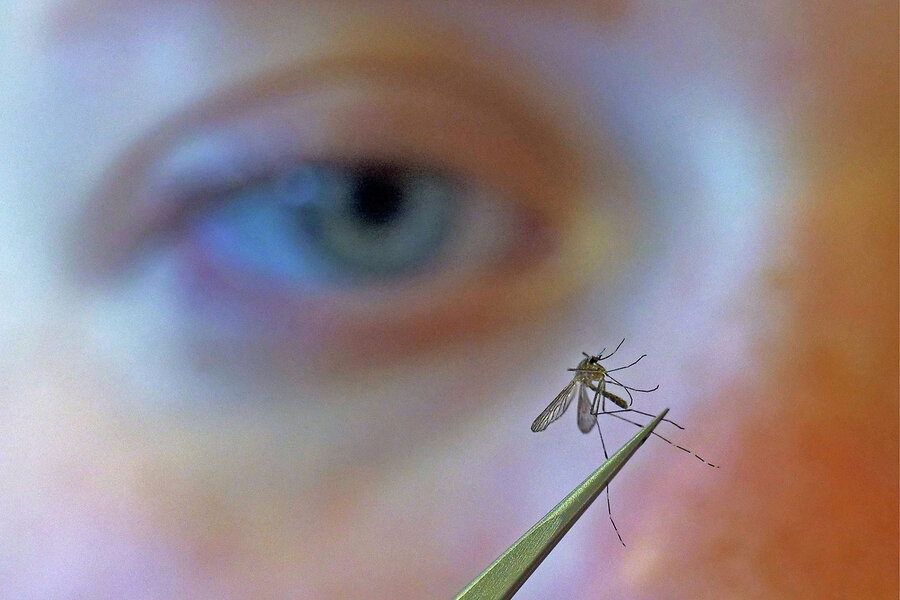
“At dusk on the evening of October 16th, I caught sight of a strange fly on a red wine ribbon.”If these ominous words do not strike fear in your heart, then you are almost certainly not an Icelander.Iceland has many distinctions as a land of fire and ice spanning the North American and European tectonic plates. It contains some 10,000 waterfalls, and if you believe polls of Icelanders, it is possibly home to trolls. Why We Wrote This The geography and climate of Iceland have prevented mosquitoes from establishing a foothold. But recent discoveries of the pests in the island nation’s wilds have made locals wary. Yet perhaps most remarkable of all: It is the only nation on Earth without mosquitoes.Maybe.The chilling quotation above comes from insect enthusiast Björn Hjaltason’s discovery of a mosquito last October on a farm just north of Reykjavík. One could almost imagine the theme from “Jaws” playing as he told the Icelandic National Broadcasting Service of his initial find: “I immediately suspected what was going on and quickly collected the fly. It was a female.”What comes next, no one really has any idea. The situation is extraordinarily rare. Some small, remote island chains like the Faroes in the North Atlantic or South Georgia in the subantarctic region do not have mosquitoes. But everywhere else (except Antarctica itself) has mosquitoes, so no one quite knows what happens when mosquitoes come to a place for the first time.For Iceland, it is more than a matter of annoyance. It is a question of how mosquitoes could change ecosystems (or not). For researchers worldwide, the discovery makes Iceland an urgent but little-studied opportunity: What does a relatively temperate, thriving world without mosquitoes look like? And how long can it remain so amid accelerating changes in travel and climate? Bessastaðir, the residency of the president of Iceland, is near Reykjavík, Jan. 17, 2024. As climate change makes Iceland more temperate, the possibility that mosquitoes could gain a foothold on the island rises. “I don’t think we’ve had this kind of experience before. That’s why it is so potentially interesting,” says Lauren Culler, a senior fellow at the Institute of Arctic Studies at Dartmouth College in New Hampshire. “It’s important for science to capture the ‘before’ conditions.”Mosquitoes were discovered at three locations last year. Mr. Hjaltason collected five in Kjós. Another was collected nearby in Mógilsá. These were cold-adapted Culiseta annulata mosquitoes common in the Arctic. But hundreds of the worldwide genus Culex were also discovered in a horse barn far to the south in Ölfus.None of this means Iceland’s status as a mosquito-free nation is now history.“A record of several mosquitoes does not automatically mean that Iceland will develop large mosquito populations or become comparable to regions elsewhere that are quite mosquito rich,” says Matthías Alfreðsson, an entomologist at the Natural Science Institute of Iceland, in an email interview.This is not the first-ever detection of a mosquito in Iceland. In 1986, one was found on an aircraft at Keflavík Airport.“What makes the recent findings [in Kjós and Mógilsá] different is that these mosquitoes were collected outdoors in Icelandic nature,” adds Mr. Alfreðsson.What does that mean? There’s no real way of knowing.The situation in the horse barn involves “a large number of mosquitoes ... in a very specific, sheltered environment,” Mr. Alfreðsson says. He is taking steps to manage the situation and says he is seeing progress. The mosquitoes found in the wild present a potentially more complicated picture, though no more have been captured. This autumn’s monitoring period could offer further clues.So why have mosquitoes never made Iceland their home before now? There is certainly no lack of mosquitoes in the Arctic. Recalling research trips to Greenland, where mosquitoes bit through thick socks, Dr. Culler says, “They can be absolutely miserable.” Colleagues in other fields of research often plan their trips to the Arctic specifically to avoid mosquito season, she adds.The prevailing theory is that Icelandic winters are notoriously variable, which wreaks havoc on the dormant phase of Arctic mosquitoes’ life cycle, killing eggs in unpredictable freezes and thaws.In a warming world, the discovery is a wake-up call, Dr. Culler says. “This is kind of a little warning sign that things are on the move around the Arctic. We need to understand what’s going on.”
Mosquito sightings put Iceland on alert against buggy invaders
Full Article
Original Source
Read the full article at Csmonitor →KhanList aggregates and links to publicly available news content. We do not host full articles from third-party sources. Always verify important information with original sources.