
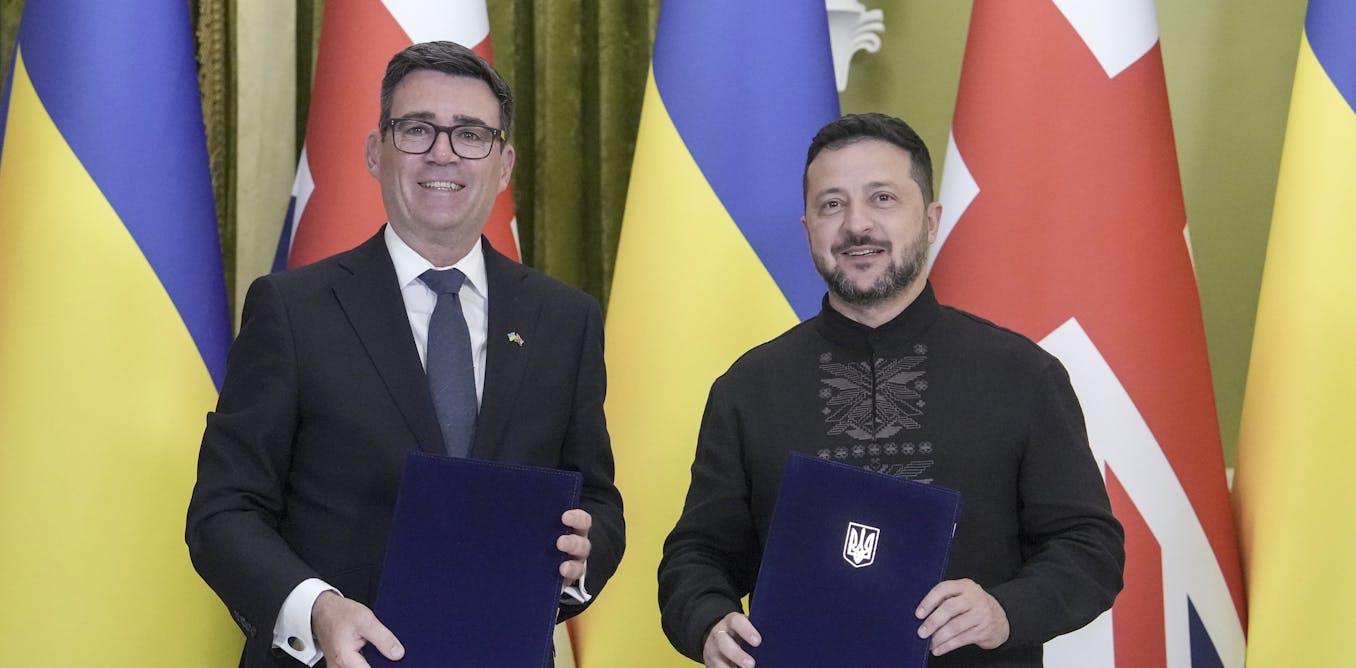
Relations between London and Moscow reached another peak of tension in August over the UK’s support for Ukraine. The success of Ukraine’s long-range strikes against targets deep inside Russia, with the help of UK-made drones, and the UK’s commitment to supply blueprints to help it manufacture long-range missiles, led the Kremlin to accuse the UK of deliberately escalating the conflict. Russia’s London embassy promised that the deeper the UK’s involvement in the war “the higher price it will pay”. The embassy accused the UK government of “seeking to contain Russia and inflict maximum damage on it by proxy”. Kremlin spokesman Dmitry Peskov, meanwhile, described Britain as “methodically and regularly” fuelling war and “hatching schemes” to sabotage peace. Foreign ministry spokeswoman Maria Zakharova warned that British military targets could now be attacked because of Ukrainian strikes using British weapons. The UK prime minister, Andy Burnham, responded by reaffirming Britain’s position, saying the UK would “support Ukraine 100%”. But Russia is presenting Britain not simply one of Ukraine’s principal supporters, but an influential member of an anti-Russian coalition, operating behind the scenes and pursuing its objectives through proxies. The Kremlin’s messaging is crediting the UK with outsized influence. But this image of British power closely resembles Soviet thinking exactly 100 years ago. In the mid-1920s, the Soviet leadership made similar accusations about British support for another country on its western border. This time it was Poland. Poland and Soviet Russia had fought a bitter war in 1919–20, ending in a stunning Soviet defeat. Soviet hostility towards Poland was therefore hardly surprising. Nor was distrust of Britain, which had intervened in the early years of the “Russian civil war” in support of the Bolsheviks’ enemies, the counter-revolutionary “White Armies”. But by the mid-1920s, these real antagonisms had become entangled with a conspiratorial understanding of international politics. Britain, still the world’s preeminent imperial power, increasingly appeared in Soviet thinking as the hidden hand behind apparently independent threats to the USSR. Poland, in this way, occupied a position remarkably like that assigned to Ukraine in Russian rhetoric today. Soviet officials struggled to imagine Poland acting entirely on its own. From the early 1920s, Soviet military intelligence and the security services reported that Britain was actively organising an anti-Soviet bloc including Poland and other border countries that could be pushed into war against the fledgling Soviet Union. These suspicions deepened in May 1926 when Józef Piłsudski, a nationalist figure who had led the Polish Army to victory in 1920, seized power in Poland. Senior Soviet officials interpreted Piłsudski’s coup as having been inspired by Britain. Marshall Józef Piłsudski and political allies during the May 1926 coup in which he seized power in Poland. Marian Fuks/Wikimedia Commons The head of the increasingly powerful soviet secret police, the OGPU, Feliks Dzerzhinsky, was convinced the coup was “entirely supported by England” and warned Josef Stalin that Poland now intended to seize Ukraine and Belarus. Another intelligence assessment from senior police officials described Piłsudski vividly as Britain’s “guard dog” in eastern Europe. Reports from influential figures such as the Soviet representative in Warsaw, Pyotr Voikov and Soviet diplomat Maxim Litvinov – who arguably had access to better information and who contradicted this narrative – struggled to be heard. When Litvinov complained about the Soviet tendency to see “the malevolent hand of the British government everywhere”, Stalin disagreed. He insisted that there was an international conspiracy against the Soviet Union, which would make another war inevitable. The ‘hand of England’ Fears that Britain would manipulate Poland into war intensified in June 1927, when Voikov was assassinated by a Russian émigré in Warsaw. Stalin immediately wrote to his closest ally, Vyacheslav Molotov: “I feel the hand of England in the murder of Voikov. They want to provoke a conflict with Poland. They want to repeat Sarajevo.” Soviet hostility was not entirely detached from reality. Only weeks earlier, British authorities had raided the Soviet trade mission in London and uncovered what it said was evidence of clandestine Soviet activity and had broken off diplomatic relations. This was seen in Moscow as evidence of British hostility towards the Soviet Union. But Stalin went considerably further, insisting that Britain was coordinating hostile activity against the Soviets by countries such as Poland and sponsoring assassinations. In the days following the Voikov murder, the main Soviet newspaper Izvestiia accused Winston Churchill of directing a secret group of assassins, charged with the elimination of Soviet officials. All smiles as US president, Harry Truman, joins hands with Winston Churchill and Josef Stalin. But Russia was always deeply suspicious of Churchill. Winston Churchill collection. The Soviet commissar of foreign affairs, Georgy Chicherin, summarised this understanding of British power clearly. In 1928, in discussion with the king of Afghanistan, he argued that Britain was “always striving to push others instead of itself into military actions against us”. This image of Britain persisted into the early 1930s, until the rise of Nazi Germany reorientated Soviet perceptions of the principal military threat. A familiar view of British power Things are very different today. The Soviet leadership badly exaggerated the danger it faced in the 1920s. Neither Britain nor Poland was preparing an anti-Soviet war that Stalin increasingly forecast. By contrast, Britain is not only providing substantial military and political support to a country fighting Russia, it is playing a prominent role in coordinating a coalition of other countries to do the same. There is a strong parallel in the way that British power is perceived in Moscow. As in the 1920s, the Russian government’s rhetoric once again presents Britain as a malevolent force, working behind the scenes in the war in Ukraine. This is in tune with the Russia government’s wider framing of Nato’s role in the war – yet Britain has been given an outsized role in this. As former Russian president Dmitry Medvedev remarked in 2023: “Britain was, is and will be our eternal enemy.” It’s interesting to note that Russia’s new standard history school textbook, first published in 2023, has an account of the events of the war scare in 1927 which reinforces this idea that Britain was playing a leading role in an international campaign against the Soviet Union. As relations with Britain have deteriorated, these ideas have found fresh relevance in the official history now being taught to a new generation of Russian students.
Moscow has a long history of paranoia about Britain’s support for Russia’s enemies
Full Article
Original Source
Read the full article at Theconversation →KhanList aggregates and links to publicly available news content. We do not host full articles from third-party sources. Always verify important information with original sources.