
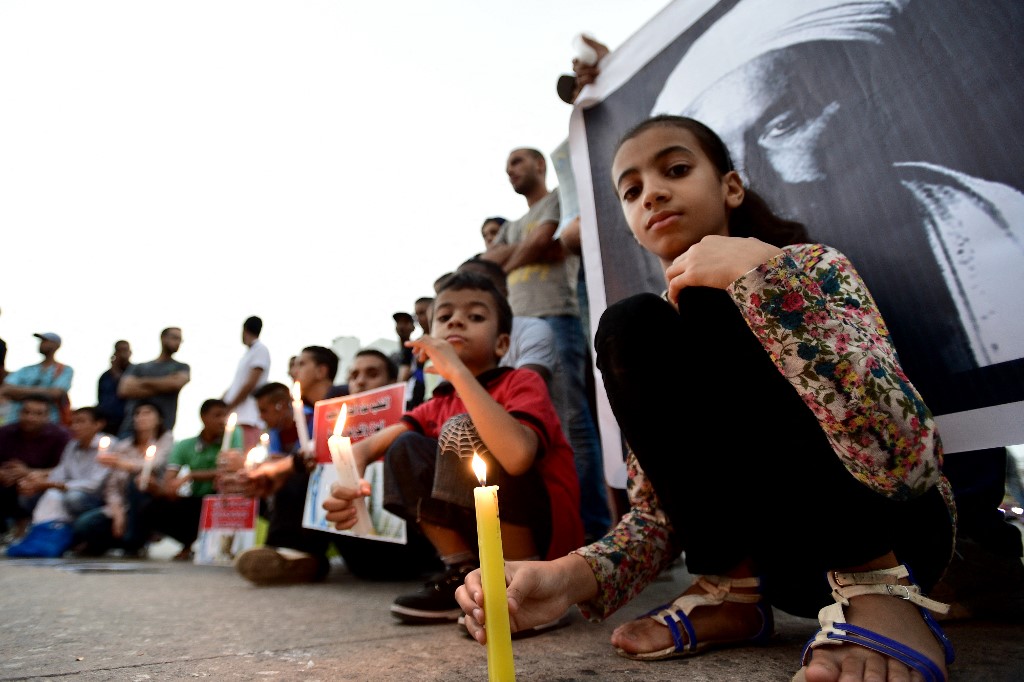
“Our family has been through a lot. My mother’s health has deteriorated, but despite everything, she continues to hold on.” Mohamed Ahamjik has done everything he can to help his family since his younger brother, Nabil, was arrested in 2017 over his role in Morocco’s Rif protest movement. He is serving a 20-year prison sentence. Since then, Mohamed has worked to raise awareness about his case. “This has always been a duty towards my mother, my brother Nabil and our family,” he told Middle East Eye, speaking ahead of Wednesday’s anniversary marking a decade since protests erupted in the kingdom’s northern Rif mountains over poverty, marginalisation and underdevelopment. The movement was sparked by the death of fishmonger Mouhcine Fikri, who was crushed inside a rubbish truck in Al Hoceima on 28 October 2016 while trying to retrieve his confiscated catch. New MEE newsletter: Jerusalem Dispatch Sign up to get the latest insights and analysis on Israel-Palestine, alongside Turkey Unpacked and other MEE newsletters Ten years on, the wounds left by repression and decades of marginalisation are still felt across the region, while six prominent Hirak figures remain in prison, including the movement's leader Nasser Zefzafi, who was sentenced to 20 years. According to Moroccan historian Maati Monjib, the Rif uprising was “one of the most significant social movements” in Morocco since King Mohammed VI ascended the throne in 1999. Initially centered in Al Hoceima and its surrounding province, the protests were tolerated for several months before authorities launched a crackdown in late May, resulting in hundreds of arrests. Authorities branded the movement as separatist - a label Monjib described as “false accusations made to discredit their demands”. He told MEE that although a small minority of activists expressed separatist views, mostly in Facebook groups, the main leaders who remain imprisoned never did. The state’s response reached a new turning point on 20 July, when riot police used tear gas and batons to disperse demonstrators in Al Hoceima, severely injuring 22‑year‑old Imad el‑Attabi, who died the following month. The crackdown triggered widespread solidarity protests across Morocco throughout the summer of 2017. An uprising against ‘hogra’ Nabil played an important role in the movement. His activism, Mohamed told MEE, was driven by his rejection of “hogra”, a term referring to humiliation and oppression, and by what he saw as “the historical injustice that the region suffered for decades from the central power”. His arrest did not come as a surprise to his family. “After the parliamentary majority falsely accused the Rif movement of separatism, we understood that a vast wave of arrests was being prepared,” Mohamed said. ‘After the parliamentary majority falsely accused the Rif movement of separatism, we understood that a vast wave of arrests was being prepared’ - Mohamed Ahamjik, brother of a jailed Rif activist Transferred between several prisons over the years, Nabil is now held in Tangier. From his cell, he wrote a master’s thesis on the Rif’s relationship with the state at Mohammed I University in Oujda, earning an 18 out of 20 and a recommendation for publication. Now a doctoral student, he staged a 10‑day hunger strike last month after authorities denied him a proper space to work on his PhD. In recent years, rights groups have denounced the arrests of Rif protesters, along with allegations of torture, ill-treatment in custody and violations of fair-trial standards. The crackdown did not stop with those who took to the streets. Journalists who covered the protests and activists living abroad were also caught up in the wave of repression. Said El Amrani, a digital creator, former journalist and human rights activist, is one of them. Born in the Rif, he moved to Belgium in the 1990s to pursue his studies. In 1991, he was briefly arrested upon his arrival at Tangier airport for his activism. In 2016, two months before the outbreak of the Rif protests, he returned to the region for what would be the last time. As the crackdown extended to the diaspora, he and other activists have not returned since. “Since the beginning of the Rif movement, at least 11 activists have been arrested when arriving in Morocco. Two of them were sentenced to prison, one of them is still in jail,” El Amrani told MEE, adding that like many other activists in the diaspora, he has also been targeted online. “Photos were taken from my personal social media account, including pictures of my younger daughter, manipulated to create sexualised images, and then shared on Facebook.” He has also been repeatedly targeted by a news outlet reportedly close to Morocco’s intelligence services. Today, he told MEE, the region remains under tight security. “They built at least five new police stations since the protests,” he said. A history of revolt and repression Over the past century, the history of the Rif has been marked by resistance and repression. Jamal El Khattabi, born in Al Hoceima in the early 1960s, grew up on stories of armed struggle and of relatives killed in the Rif War, the anti‑colonial uprising fought from 1921 to 1926 between Berber tribes of the Rif and Spanish - later French - colonial forces. His father was among the young fighters who joined Abdelkrim El Khattabi, the leader of the resistance movement who united the Rif’s tribes and proclaimed an independent republic in 1921. It took the combined forces of France and Spain to crush the uprising in 1926, marking the end of the self-proclaimed republic. On his mother’s side, El Khattabi’s grandfather died before she was born. The family was told he had suffocated after exposure to chemical weapons used by the Spanish to squash the resistance. An undated picture taken in Cairo in February 1948 of Abdelkrim El Khattabi, left, former leader of the Rif rebellion, with his brother Mohamed Khattab (J. Weinberg/AFP) The repression did not end with his parents’ generation. After Morocco gained independence from French and Spanish colonial rule in 1956, the army under Crown Prince Hassan, later King Hassan II, brutally suppressed uprisings in several regions, including the Rif. Jamal, who joined activist groups during university, was arrested twice under Hassan II, who was known for ruling with an iron fist. After his first arrest in 1989, he was beaten with a thick stick and thrown from a roof, leaving him with a serious back injury. He described being taken blindfolded to Derb Moulay Cherif in Casablanca, where the torture included severe beatings, threats involving dogs and prolonged exposure to bright lights. “I could no longer stand without them having to ‘help’ me,” he told MEE. After his second detention, he fled Morocco for Spain and eventually settled in the Netherlands. When Mohammed VI took the throne in 1999 after his father’s death, the kingdom appeared to be entering a more open era, with promises of reform, and the years of political persecution, torture and enforced disappearances seemed to be over. The Arab Spring protests of 2011 led to constitutional changes that formally limited the monarchy’s powers, but hopes for lasting political reform soon began to fade. Repression intensified in the years that followed, becoming particularly pronounced after the Rif protests. Over the past decade, numerous reports have shown how the monarchy crushes dissent, increasingly relying on surveillance technologies - including the Israeli spyware Pegasus - as well as defamation campaigns and unfair trials. The worsening crackdown was stark during last year’s Gen Z protests over failing public services, unemployment and corruption, even as billions were poured into stadiums for the 2030 World Cup. While the Rif protests were initially tolerated for months, the Gen Z demonstrations were crushed within weeks: 6,000 people were arrested, most of them in the first days. A year later, around 700 remain in jail, including dozens of minors, according to the Moroccan Association for Human Rights (AMDH). ‘They have no future’ The memory of the Rif uprising a decade ago has taken on new relevance amid a turbulent year for Morocco. While the kingdom has experienced rapid economic growth and made history last month with the election of its first female prime minister, deep economic and social frustrations remain. Youth unemployment, at 37 percent, and rising living costs are among the deepest issues. Those frustrations came into sharp focus again this summer, when tens of thousands of people attempted to cross into the Spanish enclave of Ceuta. Many of them were young Moroccans from the Rif region. ‘There continues to be a deep desire for dignity and equal recognition - where a Moroccan, in the Rif or elsewhere, should be the equal of every other Moroccan, regardless of status or background’ - Maati Monjib, historian While Atlantic cities such as Casablanca, Rabat and Tangier, and tourist hotspots like Marrakech, have drawn billions in investment and gleaming new infrastructure, the Rif and other impoverished regions like the Atlas Mountains have been left on the margins. The Rif has the highest number of cancer patients in Morocco, a toll linked to the chemical bombs Spain dropped during the Rif War. Yet the hospitals and specialised equipment that could treat patients lie hours away. This mirrors a wider divide, one that shaped the debate in the recent elections: a Morocco of two speeds. In Tangier, the Tanger Med port, industrial zones, car factories and booming exports drive rapid growth. In the Rif, young people still face high unemployment and few prospects. The state did respond to some of the protesters’ demands: a new faculty affiliated with the University of Tetouan was opened. But in El Amrani’s view, most initiatives fall short. A hospital was recently built, “but there is not enough medical staff”. For young people, “there is no work,” he added. “Many have left, most of them clandestinely for Europe. Others have moved to Moroccan cities such as Tangier and Tetouan.” For decades, thousands of families in the borderlands lived off the informal trade that flowed through the Spanish autonomous cities of Ceuta and Melilla. In recent years, as controls on the borders with the Spanish enclaves tightened, that trade became impossible. That left the borderlands poorer and pushed more and more young people to risk their lives to reach Europe, as the latest mass attempt to cross to Ceuta this summer showed. “They have nothing to lose,” El Amrani said. Many are out of school, without work and without access to healthcare. “They feel they have no future. For them, the only solution is to leave.” Monjib, who himself spent three months in prison for his activism and is now routinely targeted by the authorities, told MEE that although heavy state repression largely paralysed the Rif movement and shifted its focus toward demanding the release of political prisoners, its core pursuit of equality endures. “There continues to be a deep desire for dignity and equal recognition - where a Moroccan, in the Rif or elsewhere, should be the equal of every other Moroccan, regardless of status or background,” he said.
Morocco: Ten years after the Rif uprising, its leaders are still jailed and its demands unmet
Full Article
Original Source
Read the full article at Middleeasteye →KhanList aggregates and links to publicly available news content. We do not host full articles from third-party sources. Always verify important information with original sources.