
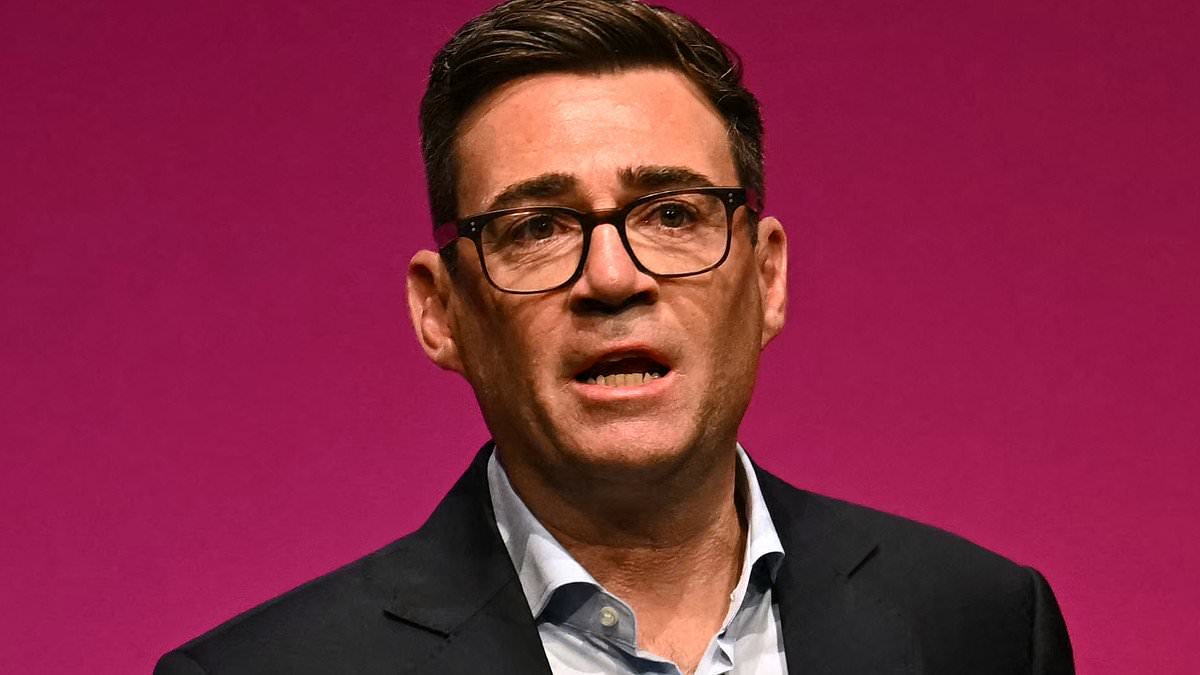
If you hanker for the decade of flares, shag carpeting and the Bay City Rollers, Andy Burnham’s conference speech was pitched directly to you.For the Prime Minister’s address to the Labour faithful in Liverpool was a gushing love letter to the suffocating socialism of the 1970s.His remarks, the most chilling from any Labour prime minister of my lifetime, outlined a wild lurch to the Left that went far beyond anything even Jeremy Corbyn attempted during his time as Labour leader.Nationalisation, property seizures, ‘democratic control’ over housing, and the rolling back of Margaret Thatcher’s market reforms – this was a speech of the Left, by the Left, and for the Left.The delegates lapped it up, one ovation after another. This was the reddest of red meat. More state control over one sector after another: homes, water, energy, transport, even social care. The Prime Minister’s address to the Labour faithful in Liverpool was a gushing love letter to the suffocating socialism of the 1970s Burnham promised ‘good growth in every postcode, hope in every heart’ – and the paternalistic prod of the state in every conceivable crevice of the marketplace.Angela Rayner would front ‘the biggest council-house building programme since the post-war era’, he said. But these homes would be unlike the council housing of today, and the past 40 years: there would no longer be a right to buy. Instead, the state would exert ‘democratic control over our housing stock’.This announcement came halfway through a speech which had begun with Burnham emoting about his grandparents buying their home and the opportunities this had created for his family. There’s nothing too good for the workers – or some of the workers, at least.He didn’t stop there, either. councils would be given new powers to seize private property where it was deemed to be unused, or which landlords were failing to keep well-maintained.The Prime Minister kept reminding us of how important housing was, which was why he refused to see it ‘as a market’ and insisted on treating it ‘as an essential that everyone needs’.But it is precisely because housing is an essential that it requires the involvement of the market.Contrary to Burnham’s resentment-flecked world view, the market is not an external imposition on honest, hard-working folks.The market is those folks, their preferences, and the pricing signals sent by their economic activity. Homeowners and would-be homeowners understand better than any bureaucrat what they want in a home and what they are willing to pay for.Burnham wishes to sever the connection between consumer and price, a fool’s errand – and a costly one.The most deafening cheer came when he told the hall of his intention to repeal Margaret Thatcher’s prohibition on public ownership of water companies. He seemed to believe this would make the utility more affordable.In the words of the lady herself: No. No. No. Inefficient state companies do not drive down prices; they limit the consumer’s options, which is what makes it possible to raise prices. Anyone satisfied with the results of placing healthcare into the hands of a bureaucratic behemoth will relish the possibilities of creating a second one for social care. 1970s Britain was blighted by power cuts, three-day weeks, ceaseless strikes and indifferent state industries. Rubbish piled up on the streets of London during strikes by binmen in 1979That was another major theme of the speech, and like much of what the Prime Minister had to say, it was an analysis of market forces from someone whose entire career has been shielded from any contact with them.Burnham spelt out his ‘theory of growth’, which involved ‘control’ of the essentials… followed by the devolution of powers from Westminster to lower-level politicians and officials.It’s the sort of theory that ought to be kept far away from practice.In reality, it will mean third-rate national politicians seizing control of sections of the economy and handing them over to fourth-rate regional politicians to regulate them into ruin.What Burnham forgot in his nostalgia trip back to an era he never experienced outside of childhood is that, by the time Mrs Thatcher came along, the British public was well and truly sick of nationalised industries.They were inefficient, unresponsive, one-size-fits-all, and simply allergic to innovation. When the state held a monopoly on a service or utility, it not only locked out private enterprise, but it also denied consumers the most powerful tool of all in the marketplace: choice.Where there is choice, there is competition – and no mechanism can raise quality and lower prices like competition. State control, even where it is not monopolised, deprives the consumer of the power he enjoys in a free market.The next generation, to whom Burnham directed his remarks, knows nothing of the days when Britain was served by nationalised industries.Take the publicly owned British Telecom. If you wanted a phone line, you had to be prepared to wait six months. And forget about choosing a model to suit you: there was one model in whatever colour they gave you.Younger voters might well be taken in by the Prime Minister’s tempting talk of lower prices and affordability, but this is wholly at odds with the British experience of socialism. They will come to learn what their grandparents did once the peace time idealism of the Attlee government gave way to the realities of collectivism. When state intervention fails it prompts more, not less, intervention.Burnham cannot fathom this basic rule because, more than a socialist, he is a sentimentalist, and he came of age at a time and in a place where Thatcherism was spoken of as an almost metaphysical evil. The handbag-wielding market warrior was a cruel and wicked woman who tore society to shreds for the sheer hell of it.In fact, the MP for Finchley was responding to the abject failure of post-war socialism. She did not secure three election victories in a row because she brainwashed the voters, but because the voters – in particular working-class Labour ones – were fed up with the endless misery of 1970s Britain, with power cuts, three-day weeks, ceaseless strikes, and indifferent state industries. The most deafening cheer came when Burnham told the hall of his intention to repeal Margaret Thatcher’s prohibition on public ownership of water companiesBurnham was indulging in the very rose-tinted – or, in this case, deep red-tinted – nostalgia of which progressives so often accuse conservatives. Where the Right longs for a romanticised past of unlocked doors, respectful youths, and cohesive neighbourhoods, the Prime Minister’s yearning is for a social and economic idyll that was far from idyllic for those who lived through it. He is that oddest of political creatures: a Left-wing conservative.Curiously, the only area where Burnham wasn’t keen on the warm embrace of big government is the state pension, where he announced the scrapping of the triple lock from April 2030. From then, old-age payments will be only double locked, rising annually by whichever is higher between inflation or 2.5 per cent.Ironically for a speech that spent so much time taking a sledgehammer to the Thatcher legacy, Burnham’s double lock will make him the first prime minister since the Iron Lady to break the link between pensions and earnings.The true oddity of the Prime Minister’s address, however, was the eleventh-hour revelation of a commission on electoral reform. Anyone feeling glum at the prospect of a reversion to stultifying state control can console themselves that the Labour leader seems on the brink of a historic blunder.Electoral reform is a hobby horse for middle-class liberals who have no firm policy preferences or philosophical beliefs and therefore prefer to talk endlessly about process. The technical term is ‘Liberal Democrats’.The notion that proportional representation, for example, would aid Labour’s electoral fortunes is ludicrous. Labour is a beneficiary of first-past-the-post because of the geographic spread of its vote in the inner cities, university towns, the north of England, the Scottish central belt, and the Welsh valleys. This is how Keir Starmer was able to record such a mammoth landslide on a very weak vote share in 2024.A more proportional system would aid several parties – Reform, the Lib Dems and the Greens – but it would make it highly difficult for Labour to form another majority government without the backing of smaller parties.Given the sweeping schedule of state controls spelt out in Liverpool, that eventuality could only be greeted as a blessing.
More than a socialist, our new PM is a sentimentalist - driven to this wild lurch to the Left by an adolescent loathing of Mrs Thatcher
Full Article
Original Source
Read the full article at Dailymail →KhanList aggregates and links to publicly available news content. We do not host full articles from third-party sources. Always verify important information with original sources.