
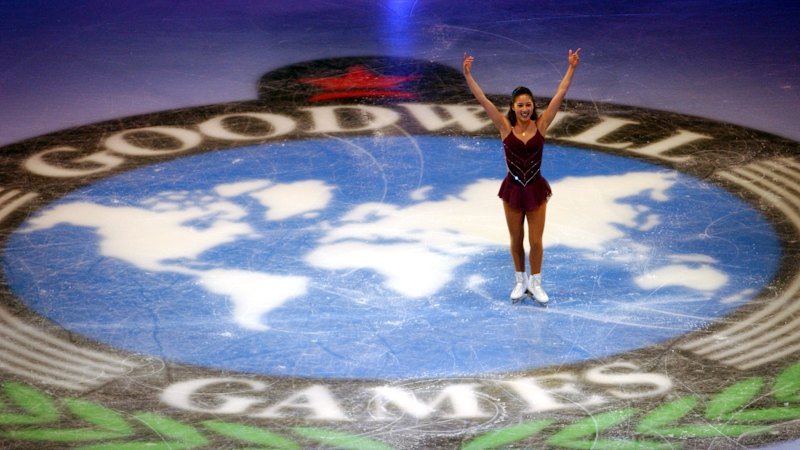
A stepping stone, or second-rate sideshow. The Brisbane 2001 Goodwill Games could be remembered in several ways, perhaps none as enduring as the pedestrian bridge that bears its name.Friday marked a quarter-century since of the Goodwill Games opening ceremony at the Brisbane Entertainment Centre, with competition starting 25 years ago on Saturday.Created by recently departed media mogul Ted Turner in 1986 after the Cold War-era Moscow 1980 and Los Angeles 1984 Olympic boycotts, the Goodwill Games were designed to bring elite athletes from rival nations together and promote international goodwill.Unlike other competitions, the event offered substantial prize money – about $US10 million by the time Brisbane came around – and sought to provide a politically neutral stage.Ted Turner with his then-wife, Jane Fonda, at the Brisbane Convention and Exhibition Centre for the 2001 Goodwill Games.Robert RoughThe Queensland government spent $30 million in 1997 to attract the Goodwill Games, beating Shanghai, Guangzhou, Hong Kong, Cape Town, Osaka, Rio de Janeiro and Buenos Aires.Brisbane would become the first, and ultimately the last, host outside the United States and Russia.Then-premier Peter Beattie says it was part of a broader strategy to elevate Brisbane’s international profile.“For us, it was a step-stone of using sport to attract major events to Queensland,” he says.“We had a major event strategy designed to not just attract the world’s attention, but to put Brisbane on the world map.”Ice skating at the Brisbane Entertainment Centre.Darren England/GettyQuite literally, as 2001 Goodwill Games chief executive Campbell Rose recalls.“It seems a bit trivial, but the fact was that Brisbane didn’t exist on the CNN weather map. Melbourne did, Sydney did, but Brisbane didn’t,” he says.“Well, since the Goodwill Games, Brisbane’s been on the CNN weather map.”Having the network’s owner behind the Games helped, but Beattie says Turner’s involvement meant far more than map placement.“Ted Turner was a billionaire. Obviously, business people came with him and we were looking to get money invested into Queensland,” he says.“Australia’s problem is that we are short of cash. We don’t have a lot of capital, so you’ve got to find imaginative ways to attract people to come.”The Goodwill Games attracted potential investors from the world’s largest markets. The USA. China. Japan. Germany. And of course, Russia.As Rose says: “It projected Brisbane right into those markets with pinpoint accuracy.”Held less than a year after Sydney 2000, Australia was basking in the post-Olympic glow when Turner’s circus rolled into town.Rose, a Melburnian who was poached from the city’s major events office, says Sydney 2000’s shadow loomed large, and the Goodwill Games attracted its share of sceptics.“You would get things like, ‘Is it a second-rate event for a second-rate city?’” he says.Campbell Rose in 2001 at Goodwill Games HQ.Robert Rough“There was that cloud of Sydney being a hard act to follow and, yes, it was a hard act to follow, but we did a couple of key things.“We developed an outstanding cultural festival called Paint the Town Red. We lit the Story Bridge and staged events across the city throughout the Games, which really resonated with the Brisbane population.“The other key thing we did, very successfully, was that the Goodwill Games was all about having the best 10 or so athletes in every discipline compete.”Investment, tourism and putting-on-the-map aside, the Goodwill Games were an elite sporting competition and that invitation-only format set them apart from the Olympics.No qualifiers, no Eric the Eels.Instead, there was Ian Thorpe. Michael Johnson. The since-disgraced Marion Jones.And two-time Sydney 2000 Olympic gold medallist Grant Hackett.Grant Hackett was a 2001 Goodwill Games ambassador, along with childhood hero Michael Johnson.Paul Riley“What was really cool about [the Goodwill Games] was the good rivalries that came out of that Olympic Games,” Hackett says.“Like we saw the men’s 4x100 freestyle relay when Michael Klim broke the world record and Thorpey brought that home. We also saw Peter van den Hoogenband beat Thorpey in the 200-metre freestyle, and there was going to be another rematch of that race less than 12 months later.”While his Goodwill medals might not take the same pride of place in his trophy cabinet as the Olympic golds, Hackett still remembers the Goodwill Games fondly.“It didn’t come with the pressure of like a World Championships, or an Olympic Games, or Commonwealth Games – it was one of these major international meets where you could really enjoy it and enjoy other events,” he says.“It just had more of a relaxed feeling about it.”Gold Coast native Hackett, along with US track superstar Johnson, was an official Goodwill Games ambassador.Australian Bronwyn Thompson during the Women’s Long Jump.Scott Barbour/Getty“Michael Johnson was a hero growing up, wearing his gold shoes, and I got to jump in the car with him and drive around and do a few things and get to know him really well.“The Goodwill Games probably was not a meet that you would have put up on your goal list when you’re a teenager, but once you’re in the sport representing your country, you want to be doing all the meets like that.”Another home-town hero coming back to Brisbane with Olympic gold was beach volleyballer Natalie Cook – one of Brisbane 2032’s most enthusiastic cheerleaders.Beach volleyball was held at the South Bank Piazza – a unique experience for Cook and her teammate, Kerri Pottharst.“It was very intimate, with a roof as well, and small – I think it held about 5000 maximum, with people bumped in around the edges,” she says.“I enjoyed the crowd being so close. There was security, but it wasn’t as restrictive as an Olympic Games, so people could get closer to the action.”Natalie Cook loved playing at the South Bank Piazza.Scott Barbour/GettyHackett also loved that aspect of the Goodwill Games.“Natalie’s right – there was a lot more interaction with fans and other sports, and it just felt easier. We could roam free a little bit,” he says.But those relaxed days ended about 50 hours after the Goodwill Games’ September 9 closing ceremony, when 19 men boarded flights in the US armed with box cutters.Everybody knows how that story ended.“I didn’t even feel like I noticed [the security] in Sydney. But then when I went to Athens [in 2004], it was like there was military every 100 meters around the fence,” Hackett says.“But that [freedom] was the best part of the Goodwill Games and I think Brisbane can use that moving forward [to 2032] – to make it fun, make it interactive, put the big screens up at the parks and in and around the city.“Create an atmosphere so everyone is inspired – and I think the Goodwill Games did that in Brisbane in 2001.”For all the star power, television reach and economic impact, the Goodwill Games have faded somewhat from Brisbane’s collective memory.When chronicling Brisbane’s “coming of age”, two events typically enter the conversation – the 1982 Commonwealth Games and World Expo ’88.So why aren’t the Goodwill Games mentioned in the same breath?Grant Hackett winning the 200m freestyle at the 2001 Goodwill Games. John FrenchFor a start, the Goodwill Bridge connecting South Bank and Gardens Point is the only enduring piece of infrastructure associated with the 2001 Games. They did not leave a stadium, arena or sporting precinct, unlike what is planned for Brisbane 2032.The 1982 Commonwealth Games, meanwhile, left Rose a major stadium and aquatic centre.“We could not have done it without the infrastructure that had been built for the Commonwealth Games,” he says.Rose says the fact Brisbane hosted the last Goodwill Games meant it no longer has the continuity – or the currency – of an Olympics or Commonwealth Games.“It’s a travesty that it didn’t continue,” he says.Michael Johnson bringing the curtain down on his illustrious career with Goodwill gold.Darren England/Getty“There’s no doubt that the significance of it, the impact, the benefits it brought got lost.”Rose says the Games’ demise came as a surprise, especially given Brisbane 2001’s $26 million operating surplus.“It was the most financially viable and profitable of all the Goodwill Games,” he says.Cook says the Goodwill Games could have continued to have a presence on the international sporting calendar – and be a trailblazer for athletes’ pay.“The Goodwill Games could have been an accelerator of invite-only potential commercial return for an athlete and start to be celebrated that way – look at the way tennis players get an appearance fee before they even enter the tournament,” she says.“That was where the Goodwill Games could have built its relevance.”Although the Goodwill Games were orders of magnitude smaller than the upcoming Olympic and Paralympic Games, Beattie says 2032 organisers could still learn a lot from them.Then-premier Peter Beattie at the Goodwill Games opening ceremony in Boondall.Darren England/Getty“Firstly, ignore the whingers and the knockers – they don’t understand how investment works, where the jobs come from. They don’t understand the importance of tourism and investment,” he says.“Then, focus on delivery – make sure you do things as quickly as you possibly can.“And finally, take people with you … Have a long-term strategy, share the problems with the public, and tell them: this is what we’re doing, these are the challenges, but this is what we’re doing about it, so they understand what they are.“In the end, you have to take people with you.”Start the day with a summary of the day’s most important and interesting stories, analysis and insights. Sign up for our Morning Edition newsletter.
More than a bridge: Remembering Brisbane’s 2001 Goodwill Games
Full Article
Original Source
Read the full article at Smh →KhanList aggregates and links to publicly available news content. We do not host full articles from third-party sources. Always verify important information with original sources.