
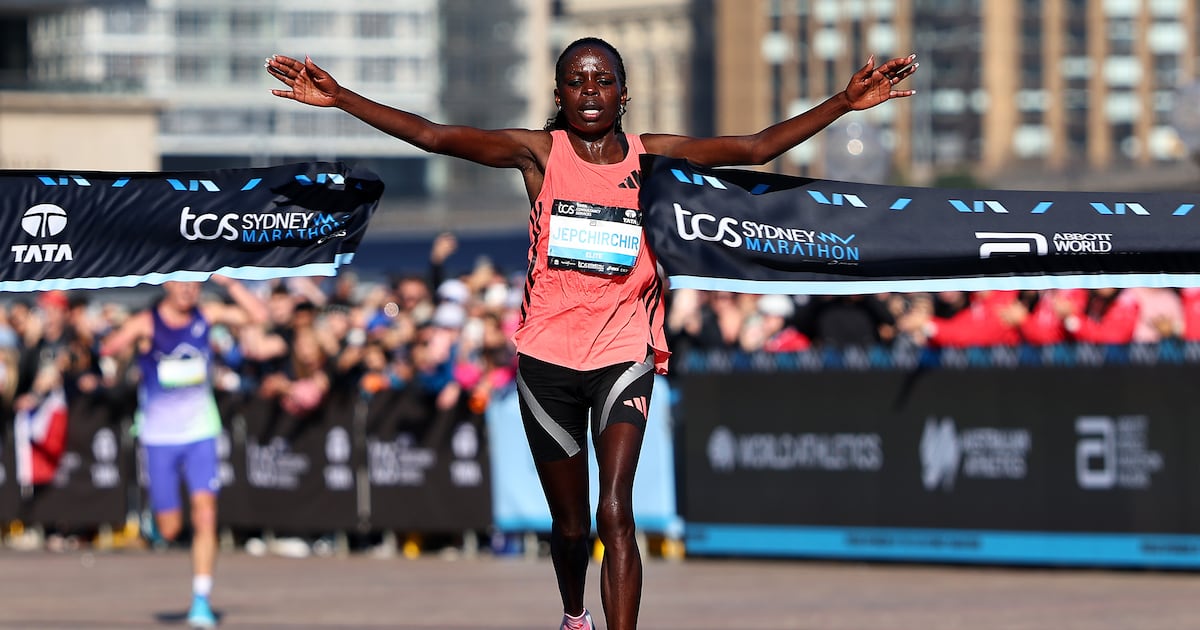
The red carpet has been rolled out this week to parade some of the former winners of the New York City Marathon, and organisers are hoping, if not praying, their running reputation will still be intact by the time the race is run. That may or may not be a slight exaggeration, but such is the relentless pace at which former big city marathon winners from Kenya are being caught for various doping offences, it’s become increasingly hard to keep up. The latest of them is Peres Jepchirchir, the 33-year-old from Kenya who was provisionally suspended by the Athletics Integrity Unit (AIU) last Friday after testing positive for the old reliable performance-enhancing substance EPO. The positive test came from a sample collected in July, six weeks before Jepchirchir won the Sydney Marathon, adding to her already lengthy roll of honour.Now she’s facing a lengthy ban, and with that helping to bring the reputation of Kenyan distance runners to another new low. Jepchirchir is also the reigning world champion in the women’s marathon, winning gold in Tokyo last year, and a three-time world half-marathon champion. Can any of those title wins be truly trusted now?READ MOREAlthough, as with most Kenyan doping positives of recent years, Jepchirchir will likely get to keep her various championship medals and titles. These include the New York City Marathon title she won in 2021, just three months after winning the women’s marathon at the delayed Tokyo Olympics, before also winning the Boston Marathon in 2022, and then the London Marathon in 2024.Albert Korir of Kenya winning the men's New York City Marathon in 2021. Photo: Elsa/Getty Images With those victories Jepchirchir became the only runner in history, man or woman, to win New York, Boston, and the Olympics. But she’s now the 10th winner of the World Marathon Majors (which also include Boston, London, Berlin and Chicago) to be suspended since 2017, and nine of those 10 runners are Kenyan. That includes Albert Korir, who won New York in 2021 and finished third last year. In March, Korir was handed a five-year ban after admitting to three separate doping offences involving Cera, the slightly more modern version of EPO.Sadder still, the curiously self-coached Jepchirchir is now the second women’s Olympic marathon champion from Kenya to test positive, after 2016 Rio gold medal winner Jemima Sumgong. A year later, Sumgong was all set to defend her London Marathon title, until she tested positive for EPO two weeks before, and later had her ban doubled to eight years after she was found guilty of tampering with doping controls, fabricating medical records, and lying about her whereabouts to the independent disciplinary tribunal.[ Ian O’Riordan: Why I lost all faith in Kenyan distance runningOpens in new window ]If all this is starting to sound like a broken record, it is because 148 Kenyans are currently serving active doping bans in athletics (which is more than any other country) and more than 300 have been banned since the AIU’s creation in 2017. Look back at the list of winners of the World Marathon Majors over the last decade, and Kenya’s list of doping offenders is also far ahead of anyone else. Some are less accomplished than others, such as Diana Kipyokei, who won the 2021 Boston Marathon without any previous pedigree and was later banned for six years for lying about her doping violation.Sunday’s New York City Marathon also marks the 50th anniversary of the five-borough course, first run in October 1976, which is why they’ve been inviting back some of the former champions. At one of the elite pre-race media conferences this week, Kenya’s defending New York women’s champion Hellen Obiri also found herself in the awkward position of being questioned about this doping reputation of her country for the second successive year.That’s because last October, Kenya’s women’s marathon world record holder Ruth Chepngetich was formally banned for three years, after testing positive for HCTZ, a banned diuretic also widely used as a masking agent. Her sample contained 190 times the amount needed to trigger a positive test, and yet Chepngetich’s world record time of 2:09:56, clocked when winning the Chicago Marathon in 2024, somehow still stands.Ruth Chepngetich of Kenya celebrates after crossing the finish line to win the 2024 women's Chicago Marathon, setting a new world record. Photo: Michael Reaves/Getty Images It would be wrong to point the finger solely at Kenya when it comes to these big city marathon busts, as this week alone, three Ethiopian runners were handed doping bans by the AIU. Former Tokyo Marathon winner Ruti Aga, who finished third in New York in 2019, was also banned for six years earlier this month after submitting a fake prescription to explain her failed drug test.Against this deep-rooted doping backdrop, however, Kenya was last month awarded the 2029 World Athletics Championships, prompting concern this was both premature and improper given their running reputation. Ross Tucker, the South African sports scientist who has often been the voice of reason when it comes to all doping matters, told the Science of Sport podcast this week that threatening to withdraw Kenya’s hosting of the 2029 event would do little to improve the situation. [ Irish marathon record holder Peter Lynch primed for another top finish in New YorkOpens in new window ]“If you said to Kenya, you can’t host these World Championships, because at the moment, you’re producing 60 positive tests a year. And if you can’t get that number down to 30, we’re going to take the World Championships away from you ...“But you know what will happen? They will bring the number down to 30, and just catch half the number. It’s not a solution to the problem, because you’ve directed the punishment at the person who is not responsible for the crime.“So until someone can show me that Athletics Kenya are facilitating this doping, I can’t see how it’s justified. If anything, it flips the incentive in the wrong direction ... Athletics Kenya has supported and allowed the AIU to do its thing in their country, and I certainly don’t think they should be punished on the basis of what seems to me to be a decentralised, out-of-control problem on the ground, not of their own making.”World Athletics president Sebastian Coe has also spurned any sort of blanket ban, like that imposed on Russia in 2015, claiming Russian doping was state-sponsored, whereas Kenyan doping is not. But when it comes to any running reputation, most people can’t tell the difference.
More testing times for Kenyan athletics as running reputation reaches new low
Full Article
Original Source
Read the full article at Irishtimes →KhanList aggregates and links to publicly available news content. We do not host full articles from third-party sources. Always verify important information with original sources.