
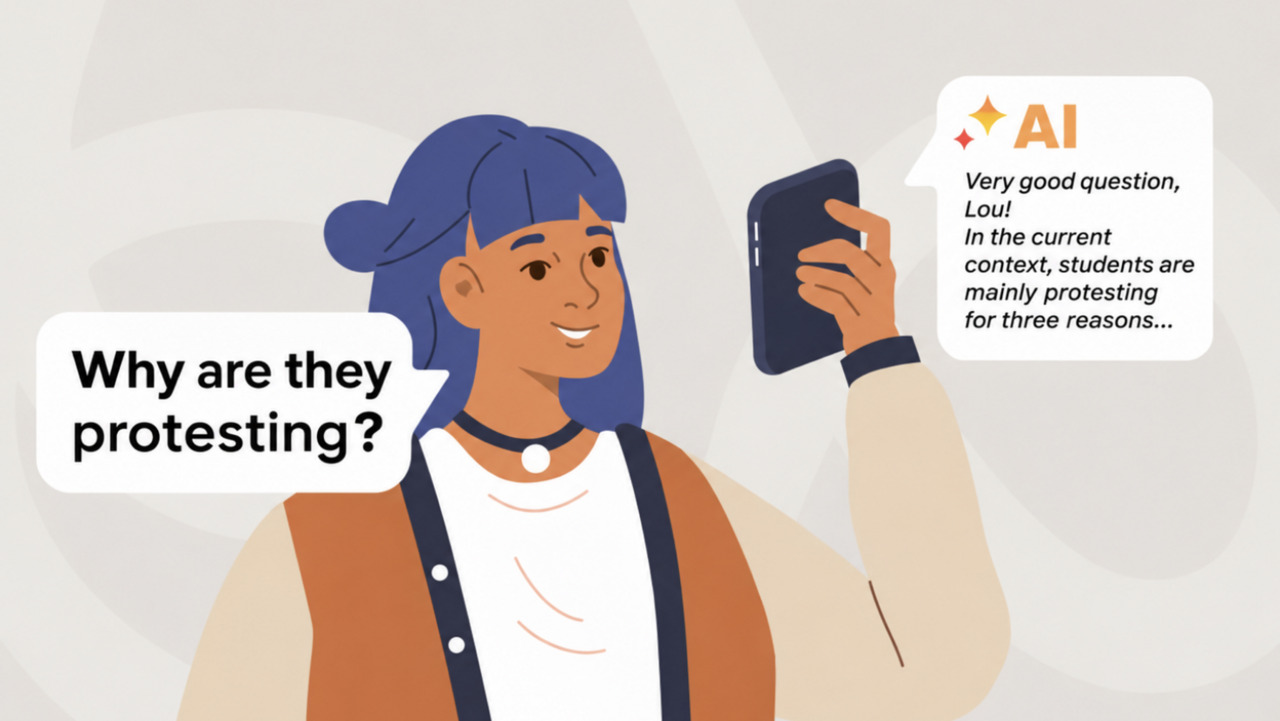
Artificial intelligence is changing how people follow the news, helping them understand the background to major events, get summaries of latest developments and find answers to specific questions. But as more people turn to chatbots for information, concerns have been raised about the reliability of their answers, which news sources they favour and the impact on news websites already experiencing falling traffic. Behind the wheel of his Tesla, a ride-hailing driver asked his car for the latest news. A female voice with a surprisingly natural tone answered and immediately began reading out the headlines. The exchange, observed by an RFI journalist, raises the question of whether AI could eventually replace traditional radio news bulletins as a way of keeping up with current events. In France, 30 percent of people aged 18-75 say they use AI to keep up with the news at least once a week, a survey published in October found. Some 14 percent use it daily, with this figure rising to more than a third among 18 to 24-year-olds. The study, carried out by French consulting firm the Society and Consumption Observatory and the Jean-Jaurès Foundation think tank, reflects a wider international trend. Across 48 countries and markets, 10 percent of respondents said they had used a chatbot to follow the news in the previous week, up from 7 percent a year earlier, a June study by the Reuters Institute for the Study of Journalism at the University of Oxford found. However, just 1 percent considered chatbots their main source of news. For some, these tools have become a way to create personalised news bulletins. "I use Perplexity to catch up on the news on Monday mornings," Vivian, who works in the AI sector, told RFI. "And I've set up ChatGPT to send me a daily briefing on news in my field, so technology news." Like the other interviewees identified only by their first names, Vivian preferred not to give his surname. Mistral boss denies French AI firm is Macron's 'personal project' Beyond the headlines Most people who use chatbots for news are not simply looking for the latest headlines. In the Reuters Institute study, 42 percent said they used them to ask follow-up questions about current events, compared with 35 percent who wanted the latest news. "People who use AI to get their news are looking for specific answers to targeted questions about current events," explained Olivier Koch, a senior lecturer at the Sorbonne Paris North University who studies changes in media and journalism. That is the case for Luc, who often comes across news stories after they have already been developing for some time. News articles tend to focus on the latest developments, which can make it more difficult to find out what has happened earlier. "I often turn to AI to get either a summary or the earlier articles," he told RFI. One example he gave involved anti-Semitic messages attributed to Jordan Bardella, president of France's far-right National Rally party. "I could see something was going on, but I couldn't work out why." His first question to the chatbot was simple: "What happened?" Next, he asked which outlet had originally reported it. The AI directed him to French investigative website Mediapart, which had broken the story. Previously, Luc's instinct was to turn to Google. But he finds the search engine "unpredictable" and criticises it for mainly showing the newest articles. An October survey by the Reuters Institute found that people in nine countries who used AI to search for information reported a bigger decline in their use of search engines than of news websites and apps. 'AI cannot do everything': bullying experts warn against confiding in chatbots News made to measure Like Vivian, Matthieu is familiar with AI chatbots. A marketing director at a company that trains people in AI, he uses them both at work and in his personal life to get information tailored to his needs. The aim is "hyper-personalisation". When his 14-year-old daughter had no school because of protests by pupils in France, Matthieu turned to his AI assistant on WhatsApp. "Listen, my daughter doesn't have school, so what's going on? What's the latest on the protests? Where are the blockades?" he asked. The tool flagged disruptions on metro line 12 and an area to avoid at certain times, Matthieu told RFI. "I leave all my information gathering to AI, which goes and finds it for me. It comes straight to me in my conversation thread." That does not mean he has stopped following traditional media: he still reads French business newspaper Les Échos and the BBC, and receives news notifications from RFI. "In the morning, I like to spend 10 or 12 minutes watching France 24's news bulletin because it's a reputable outlet and I trust it," he said, referring to RFI's sister TV channel. "Otherwise, during the day I use AI agents more. They go and look for things for me and give me information that's already been summarised." People who use AI for news are often already heavy consumers of information, the Reuters Institute noted in its June study. Gaël, who works for a non-governmental organisation, limits his personal use of AI partly because of concerns about its environmental impact. At work, however, he uses it to summarise how the international press has covered a report by his organisation. "It's infinitely faster," he told RFI. 'The major risk remains a human-directed attack', cyber threat expert warns RFI The reliability problem Easy access to news, however, raises questions about how reliable the answers are. When using AI for work, Matthieu selects his news sources and always asks for references. Sometimes he even uses another AI chatbot to check the answers he receives. But he admits he is less careful when using AI for everyday questions. Luc has learned to be more cautious after discovering mistakes in AI-generated answers. "At first, I trusted it a bit blindly," he said. On two or three occasions, he spotted glaring errors, including a past event being given a date in the future. Since then, he has changed his habits and mainly uses AI to "look for links to articles". Among those who use AI to get news, 47 percent say they often or always check the sources it provides, while 40 percent regularly compare its answers with other media, a January survey by France's Regulatory Authority for Audiovisual and Digital Communication (Arcom) found. Of the answers that four AI assistants gave to questions about the news, 45 percent contained at least one significant flaw, such as factual errors, problems with how sources were credited or missing context. The findings came from a study published in October last year by the BBC and the European Broadcasting Union, an alliance of public service media organisations. France unveils €80m drive to boost AI skills in the workplace What AI means for journalism AI chatbots are also changing which news organisations people encounter when they search for information. Koch's research found that their answers draw heavily on major media outlets, particularly those in English and from the United States, while independent and local publications appear less often. In the responses he studied about Gaza, for example, Al Jazeera was the only Arabic-language news outlet to appear frequently. Koch pointed out that France has rules governing newspaper distribution at newsstands to protect the diversity of titles available to readers. But there is no similar transparency over how AI chatbots select and rank their sources. "We don't know how they select them," he said, describing the process as "completely opaque". The problem also extends to how those sources are presented. Their visibility is reduced in chatbot conversations, which can keep people asking questions without ever leaving the platform or knowing which news organisations produced the information. "Few users click on the sources when they're recommended," Koch said. That is a concern for publishers already facing falling website traffic. In France, visits to the websites of 40 news outlets fell by 22.9 percent in September 2026 compared with September 2025. The figures come from an analysis of data from the Alliance for Press and Media Figures, a French organisation which measures media audiences. Google's AI-generated summaries, which appear at the top of search results, have been blamed for some of that decline, although their contribution remains difficult to measure. By his own admission, Matthieu reads fewer articles than before. But to dig deeper into topics he cares about, he still turns to podcasts and in-depth journalism. "I need analysis, and I prefer a human being who has done research on a subject that interests me." This article was adapted from the original version in French by Aurore Lartigue.
More people are using AI to follow the news, but can they trust what it tells them?
Full Article
Original Source
Read the full article at Rfi →KhanList aggregates and links to publicly available news content. We do not host full articles from third-party sources. Always verify important information with original sources.