
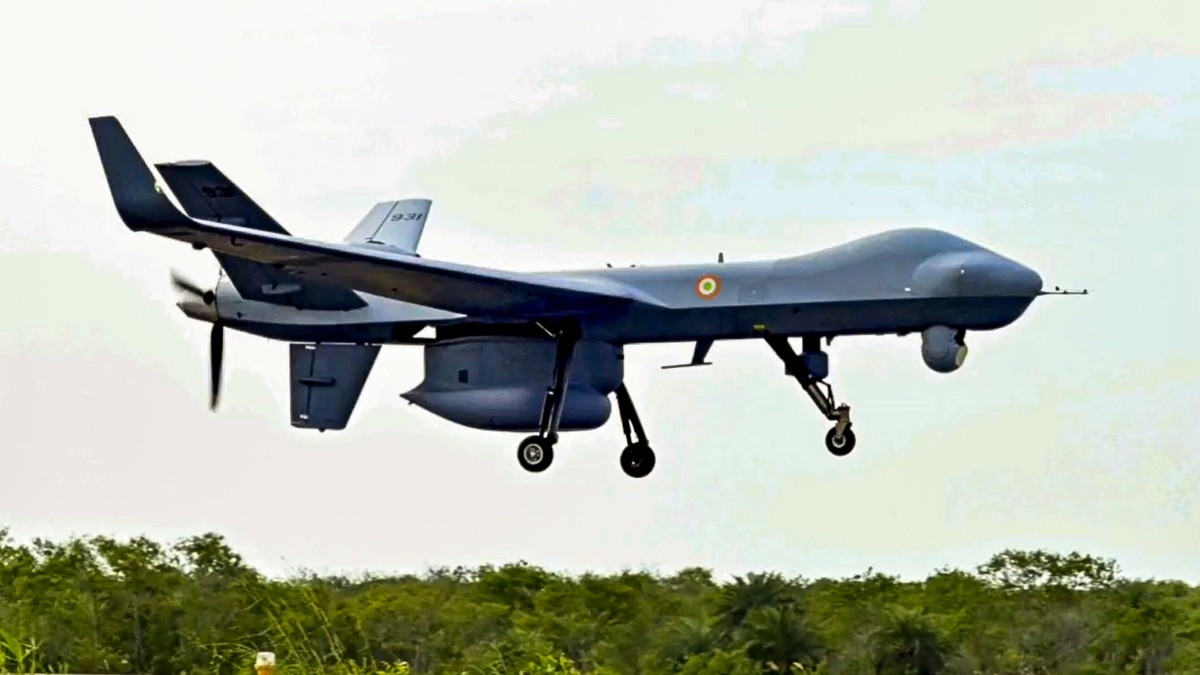
A Rs 1,943-crore deal gives the navy immediate surveillance capability with two MQ-9Bs while India awaits the fleet of 31 MQ-9B Sky and SeaGuardians from the USMilitary drones have been around for more than eight decades. During World War II, the US used radio-controlled B-24 Liberators against German submarine pens and rocket sites. In Vietnam, reconnaissance drones carried cameras over battlefields on a much larger scale. Israel later used drones for surveillance and decoy missions over Lebanon’s Bekaa Valley in 1982. By the early 2000s, the Predator had become central to US counterterrorism operations, including missions that helped track Al Qaeda chief Osama bin Laden.The Indian Navy is adding two more MQ-9B SeaGuardian High-Altitude Long-Endurance (HALE) remotely piloted aircraft to its existing unmanned surveillance fleet, but the significance of the latest lease goes beyond simply adding two drones. The Rs 1,943-crore contract with General Atomics Aeronautical Systems Inc. provides the navy with two MQ-9Bs for 30 months, giving it an immediate surveillance capability while India waits for the much larger fleet of 31 MQ-9B Sky and SeaGuardians ordered from the United States.MQ9B is a series of Predators drones, produced by the San Diago-based General Atomics. The ‘M’ stands for multi-role, the ‘Q’ refers to a remotely piloted aircraft system and the ‘9’ means the ninth in the series of remotely piloted aircraft systems, noted the US Air Force (USAF).The distinction is important. India already has two MQ-9Bs on lease, although one of the two was lost in a technical incident in September 2024. The latest lease therefore provides additional near-term capacity while the 31-aircraft acquisition remains a separate long-term programme. Under the October 2024 agreement, the navy is to receive 15 SeaGuardians while the Indian Army and Indian Air Force will receive eight SkyGuardians each. Deliveries are scheduled to begin in 2029. However, the deal was under question for its high price.Defending the price, a top ministry of defence (MoD) official claimed that the average estimated cost of the MQ-9B offered by the US to India is 27 per cent lower than the price incurred by other countries, and that officials from defence acquisition will further do the hard bargaining to get a better deal. This works out to be $99 million for each drone.In comparison, the official said, the UAE got it at $161 million apiece. Also, the MQ-9B India is looking to acquire is comparable with the UAE's but with a better configuration, he said. Similarly, 16 such drones purchased by the UK cost $69 million each but it was only a ‘green aircraft’ without sensors, weapons and certification.Features like censors, weapons and payloads make up for 60-70 per cent of the total cost, explained another MoD official, adding that even the US acquired five of them at $119 million each.That gap between immediate operational requirements and future deliveries is at the heart of the latest decision. The navy does not have the luxury of waiting several years for a capability that it considers important today. Its maritime surveillance requirements span the vast Indian Ocean Region, where tracking ships, submarines and other activity requires persistent eyes in the sky. The MQ-9B fills precisely that niche.Military experts believe that the lease effectively gives India a capability bridge while it waits for the larger MQ-9B fleet to arrive. That matters at a time when China is steadily expanding its naval and maritime presence deeper into the Indian Ocean Region. For the Indian Navy, leaving a surveillance gap until deliveries begin in 2029 was never a realistic option. The immediate priority is to keep watching the sea lanes, maintain maritime awareness and ensure that India's ability to monitor the region does not fall behind the pace of China's growing presence.It is also important not to view the MQ-9B simply as another armed drone. Its greatest value for India may be its endurance and persistence. A HALE platform can remain airborne for extended periods, conducting intelligence, surveillance and reconnaissance missions while reducing the burden on expensive manned platforms. For the navy, that makes the MQ-9B a useful complement to the P-8I Poseidon fleet rather than a replacement for it.The P-8I remains a sophisticated manned maritime patrol and anti-submarine warfare platform, capable of carrying a much broader sensor and weapons package and performing complex missions. But using such aircraft for every routine surveillance requirement can impose considerable demands in terms of operating hours, maintenance, crew availability and fatigue. A persistent unmanned platform can take on a significant portion of the surveillance workload, allowing high-end manned aircraft to be reserved for missions where their unique capabilities are required.This is why the MQ-9B should be seen as part of a layered maritime surveillance architecture. P-8Is, MH-60R Romeo helicopters, warships, submarines, satellites, coastal sensors and unmanned systems can contribute different pieces to the same operational picture. The navy itself has described its maritime-domain-awareness approach as a layered architecture extending from the seabed to space.There is also a broader strategic context. India’s US-origin defence inventory has grown considerably over the past two decades, and it is notable for its diversity of roles. The C-17 Globemaster III and C-130J Super Hercules have transformed India's strategic and tactical airlift capabilities. The AH-64E Apache has added a powerful attack-helicopter capability while the MH-60R has strengthened naval anti-submarine and anti-surface warfare. The P-8I has become one of the Indian Navy's most important long-range maritime surveillance assets. The MQ-9B now adds persistent unmanned surveillance to that ecosystem.The significance of this American inventory therefore lies not merely in the number of US-built platforms India operates. It is the operational ecosystem surrounding them—sensors, communications, weapons, training, logistics, maintenance and interoperability. These systems have helped India rapidly acquire capabilities that would have taken considerably longer to develop entirely from scratch.Yet this dependence also highlights an uncomfortable question: why is India still leasing an American unmanned system when it ultimately wants an indigenous solution? The answer is that the operational requirement is immediate while indigenous development is a longer-term proposition. India has made progress with indigenous unmanned systems, including the navy's induction of Drishti MALE RPAs, but a platform matching the MQ-9B's particular combination of endurance, payload, sensors and operational maturity is not yet available in sufficient numbers.This is where the current lease should be interpreted carefully. It is not necessarily an argument against indigenous development. In fact, it reinforces the urgency of developing a domestic HALE capability. Leasing provides an operational bridge; it does not solve the underlying dependence on foreign platforms.Meanwhile, on the other side, the US military has reportedly lost at least 45 MQ-9A Reapers during the conflict with Iran—roughly a quarter of its Reaper fleet. The losses have not all been attributed to enemy action; US officials have indicated that some aircraft were brought down while others were lost after communications links failed.Explaining what the Indian military is getting, an official said that the MQ-9A is the US-operated variant while the MQ-9B is the export-oriented evolution, configured to individual customer requirements. The distinction is important when assessing what these US losses mean for India. Still, if the reported attrition translates into a sustained demand for replacement aircraft, it could put additional pressure on General Atomics' production capacity and potentially complicate delivery schedules—not just through airframe production, but also through the availability of engines, sensors, components and specialised manpower.Military experts pointed out that the comparison with the ongoing conflict involving Iran also needs perspective. Reports of MQ-9 losses in that conflict have generated questions about the survivability of American unmanned aircraft. But India's requirement and operating environment are different and the effectiveness of any unmanned platform depends heavily on the threat environment, mission profile, electronic warfare conditions, air-defence network and tactics in which it is employed.For India, the immediate calculation is therefore relatively straightforward: persistent surveillance is a real operational requirement, particularly across the vast maritime spaces of the Indian Ocean. The MQ-9B can provide that persistence at a lower burden on high-value manned aircraft such as the P-8I, while also offering an armed capability when required.The long-term lesson, however, is even more important. India cannot build strategic autonomy simply by replacing one foreign platform with another. The real objective has to be an indigenous ecosystem covering the aircraft, sensors, communications, propulsion, weapons, data links and maintenance infrastructure.The MQ-9B lease is consequently best understood not as a symbol of India's dependence on American technology, but as a snapshot of a military caught between two imperatives: the need to field critical capabilities today and the ambition to build them at home tomorrow. India's growing US-origin inventory—from C-17s and C-130Js to Apaches, MH-60Rs, P-8Is and MQ-9Bs—has helped bridge important capability gaps. The challenge now is to ensure that the bridge ultimately leads to an Indian aerospace ecosystem capable of producing the next generation itself.Subscribe to India Today Magazine- EndsPublished By: Yashwardhan SinghPublished On: Aug 18, 2026 18:38 IST
More eyes in the sky: Why Indian military needs MQ-9Bs
Full Article
Original Source
Read the full article at Indiatoday →KhanList aggregates and links to publicly available news content. We do not host full articles from third-party sources. Always verify important information with original sources.