
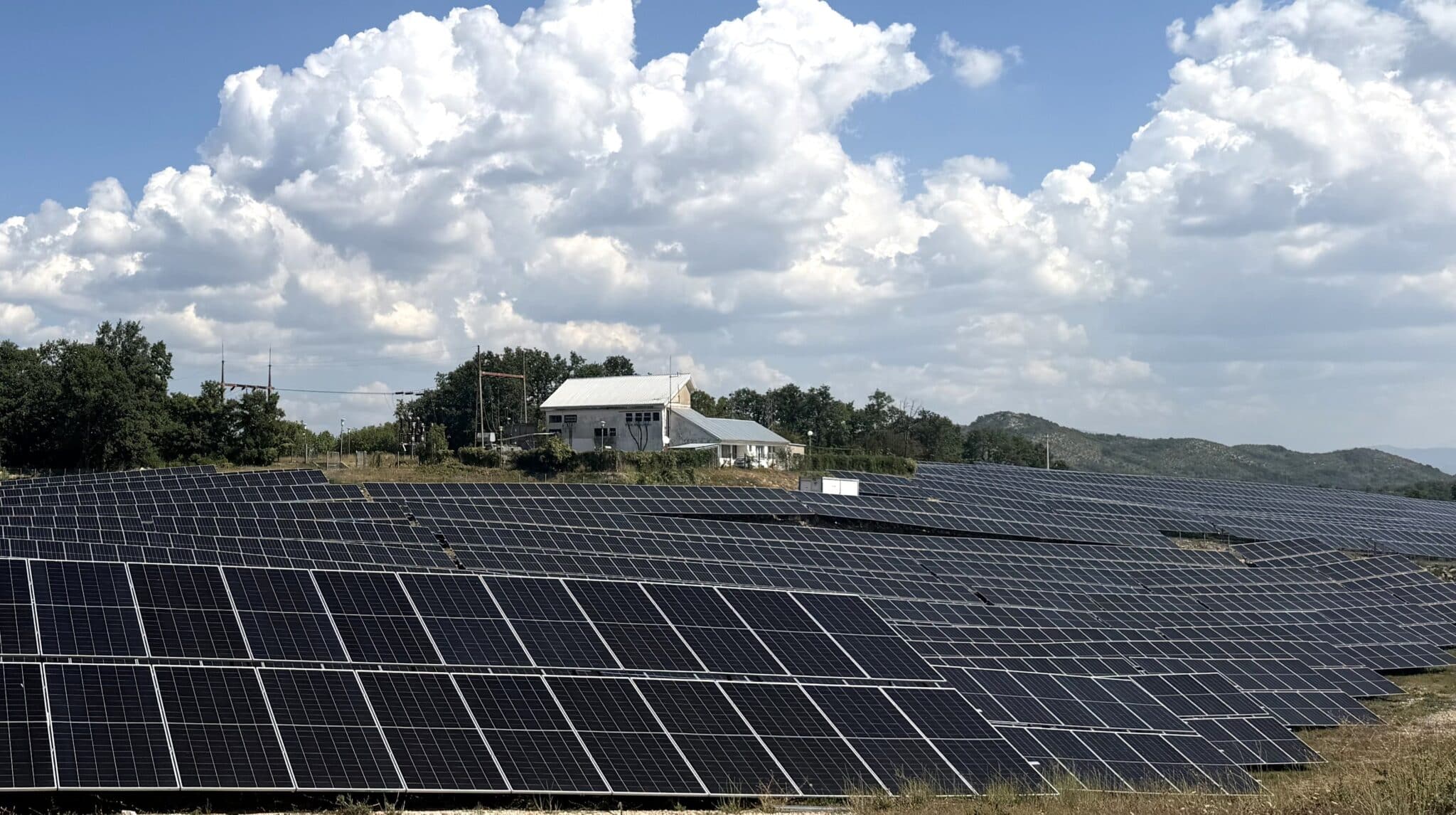
A BIRN analysis shows Montenegro’s government and Environmental Protection Agency are waving through solar power projects despite warnings of damage to potential conservation areas and endangered species. Montenegro’s government and Environmental Protection Agency have approved solar power projects in areas earmarked for inclusion in the protected Natura 2000 network and inhabited by critically endangered species, despite being warned of the potential damage to biodiversity, a BIRN investigation has found. Experts say the projects may threaten plant and animal life and cause permanent loss of habitats. BIRN analysed more than 40 sets of urban and technical requirements, UTUs, issued by the government since 2023, as well as more than 10 environmental impact assessments, EIAs. The findings show that commercial solar plants are planned in areas proposed for inclusion in Europe’s Natura 2000 network and inhabited by species on the Red List of the International Union for Conservation of Nature, IUCN. The IUCN’s Red List is a key benchmark for assessing extinction risks and guiding conservation policy. The Environmental Protection Agency approved the solar power sites even when the EIAs warned of potentially significant damage to biodiversity. Investors were instructed to build the plants in line with mitigation measures set out in the assessments. Natura 2000 is Europe’s largest network of protected areas, created to ensure the long-term survival of the continent’s most valuable and threatened species and habitats. Montenegro’s proposed sites, adopted by the government in June, covers 44 per cent of the country. “The key issue is not only whether a project is formally located inside a protected area, but whether the site contains important habitats, species, ecological corridors or ecosystem functions that could be significantly affected,” said Oliver Avramoski, director of the IUCN Regional Office for Eastern Europe and Central Asia. “In line with IUCN guidance, the location of renewable energy infrastructure is one of the most important factors in determining its biodiversity impact.” Risks made clear Image from the website of a company involved ub the planned Predis solar power plant in Cevo, near Cetinje. Photo: Simes Inzenjering. In ratifying the Paris Agreement in 2017, Montenegro committed to cutting greenhouse gas emissions by 55 per cent by 2030 and raising the share of renewables to 50 per cent of gross final energy consumption. Renewables accounted for 41 per cent in 2024, while solar plants generated 4.51 per cent of Montenegro’s electricity in 2025. Documents analysed by BIRN show that since March 2023 the Montenegrin government has issued private investors with more than 40 sets of urban and technical requirements for solar power plants. The Ministry of Spatial Planning, Urbanism and State Property has meanwhile issued construction permits for six projects. The government issues the urban and technical requirements after consulting relevant institutions. Investors may then be required to prepare an EIA assessing the project’s potential environmental impact and setting out measures to prevent or reduce damage. For projects under state jurisdiction, the Environmental Protection Agency approves the EIA, while local authorities decide on municipal projects, based on the findings of an assessment commission. Once the final design has been prepared and reviewed, the investor can apply for a construction permit. BIRN found that the company Obnovljivi Izvori Energije received a construction permit for the Predis solar power plant in Cevo, near Cetinje, even though its EIA warned that the project could permanently destroy black hornbeam and manna ash scrub, as well as two proposed Natura 2000 habitats. The assessment argued that the habitats were widespread and that their eradication at the project site “would not have significant negative consequences for their distribution or survival”. Likewise, MEnergy received a construction permit for a 385-megawatt solar plant on the border between Cetinje and Niksic, even though four prospective Natura 2000 habitats and 70 species on the IUCN Red List were recorded at the site. The EIA says the project will have a major negative impact on habitats and plant and animal species, while noting that the biodiversity is not unique to the area. “Some habitats will be destroyed, others degraded,” the assessment reads. “The composition of existing plant and animal communities will change.” Avramoski said areas containing proposed Natura 2000 habitats, endemic species and IUCN Red List species require particular caution. “The fact that an area is not yet formally protected does not mean that it is ecologically low- value or automatically suitable for development,” he said. “At the same time, the presence of important biodiversity values does not automatically mean that every project is impossible.” But, he added, such projects must undergo “rigorous, transparent and science-based assessment”. “Where significant impacts cannot be avoided or adequately mitigated, the project should be redesigned, relocated, or not proceed in its proposed form.” Government speeds up permitting Montenegrin government session in Podgorica. Photo: Government of Montenegro. Amendments to Montenegro’s Law on the Use of Energy from Renewable Sources, adopted by parliament on July 31, introduce faster permitting procedures. The changes allow the state to designate in advance areas suitable for solar, wind and hydropower development – so-called renewable acceleration areas – where projects would be treated as of overriding public interest and go through simplified procedures. The civic initiative Save Brezna has warned that the amendments do not clearly protect settlements, private property, farmland, water resources, forests, Emerald sites or the future Natura 2000 network. It also warned that “overriding public interest” status could become a “blank cheque for private profit”. “For citizens, this means that if your land, village or mountain is once marked as an ‘acceleration area’, a project can go through a shortened procedure, while you will be left to argue afterwards that a transmission line, substation, road, batteries or solar park is changing your life and the value of your property,” the initiative said. The Montenegrin Ecologists Society and CEE Bankwatch Network have also criticised a new six-month deadline for assessing projects that may have significant effects on nature, as well as restrictions on opportunities to supplement project documentation. The law also speeds up screening decisions on whether a full environmental assessment is required. Authorities will have up to 45 days to decide, or 30 days for smaller projects and upgrades. Energy analyst Almir Muhamedbovic said environmental impact assessments should remain a requirement and local communities should be actively involved in discussing them. “Although investors often claim that solar plants have no impact on the environment, major landslides in Bosnia and Herzegovina show otherwise,” Muhamedbovic told BIRN. “Heavy rainfall can be particularly dangerous around large solar parks, where panels make it harder for water to be absorbed into the soil. This can create torrents that may trigger erosion and landslides.” Forest at risk in Ulcinj A future solar plant location in the River Zeta Nature Park. Photo: BIRN. The Environmental Protection Agency did not respond to questions sent to its official email address, but Darko Saveljic, an ornithologist employed in the Nature Protection Sector at the Agency did comment for BIRN, saying that the impact of solar power plants depends above all on where they are built. “How environmentally friendly they are depends on where they are placed,” Saveljic said. “It is always easier for investors to put them on flat farmland or fields rather than rocky terrain. But in such cases solar is not eco-friendly.” He said the Agency had received several applications involving agricultural land, which accounts for only a small share of Montenegro’s territory. “Investors wanted to turn these areas into solar plants without seeing any problem with that,” he said. Investor Predrag Mirjanic plans one such project on agricultural land inside the protected Zeta River Nature Park. Danilovgrad’s Secretariat for Urban Planning and Environmental Protection refused to approve the EIA because of the potential impact on the protected area. It twice ordered the investor to revise the assessment. The Secretariat’s decision said parts of the EIA were contradictory and contained major shortcomings in the description and assessment of biodiversity impacts. It noted that the section dealing with damage to plant and animal species mentioned the removal of topsoil but failed to assess the consequences for flora and fauna, particularly species of national and international importance. The investor also failed to define specific measures to reduce impacts on important species, the Secretariat said. After Mirjanic approached the Environmental Protection Agency, the Agency ruled on March 19 that the project did not require a full EIA. It concluded that the proposed mitigation measures meant the project would not have a significant negative environmental impact. An EIA is mandatory for power plants with a capacity of 300 MW or more. For smaller plants, the Environmental Protection Agency or the relevant municipal authority decides whether one is required. When requesting such a screening decision, investors must submit descriptions of the site, the project and its potential environmental impacts. The competent authority must explain the reasons for deciding whether an EIA is necessary. An investor cannot begin construction or obtain operating approval without an approved EIA, or a decision that no EIA is required. Following an appeal by Saveljic, the Ministry of Ecology, Sustainable Development and Northern Development annulled the Agency’s decision on May 14 and sent the case back for reconsideration. The Zeta River is identified in Montenegro’s Guidelines for Integrating Biodiversity into Spatial Planning as a Key Biodiversity Area, KBA, and an internationally important bird area, IBA. A ministry document maps nine Natura 2000 habitat types and records 167 species of conservation importance in the area. Avramoski said renewable energy development and biodiversity conservation should be reconciled through strategic spatial planning before individual projects are approved. Renewable expansion, he added, must be science-based and adapted to the needs of nature. “This means identifying suitable ‘go-to’ areas for renewable energy development, as well as ‘no-go’ or high-risk areas where development would create unacceptable biodiversity impacts,” Avramoski said. “Montenegro has significant potential for renewable energy, but this potential should be developed in a way that protects the country’s exceptional natural heritage.” This article was produced with support from Internews’ Earth Journalism Network.
Montenegro Greenlighting Solar Plants Despite Warnings of Biodiversity Damage
Full Article
Original Source
Read the full article at Balkaninsight →KhanList aggregates and links to publicly available news content. We do not host full articles from third-party sources. Always verify important information with original sources.