
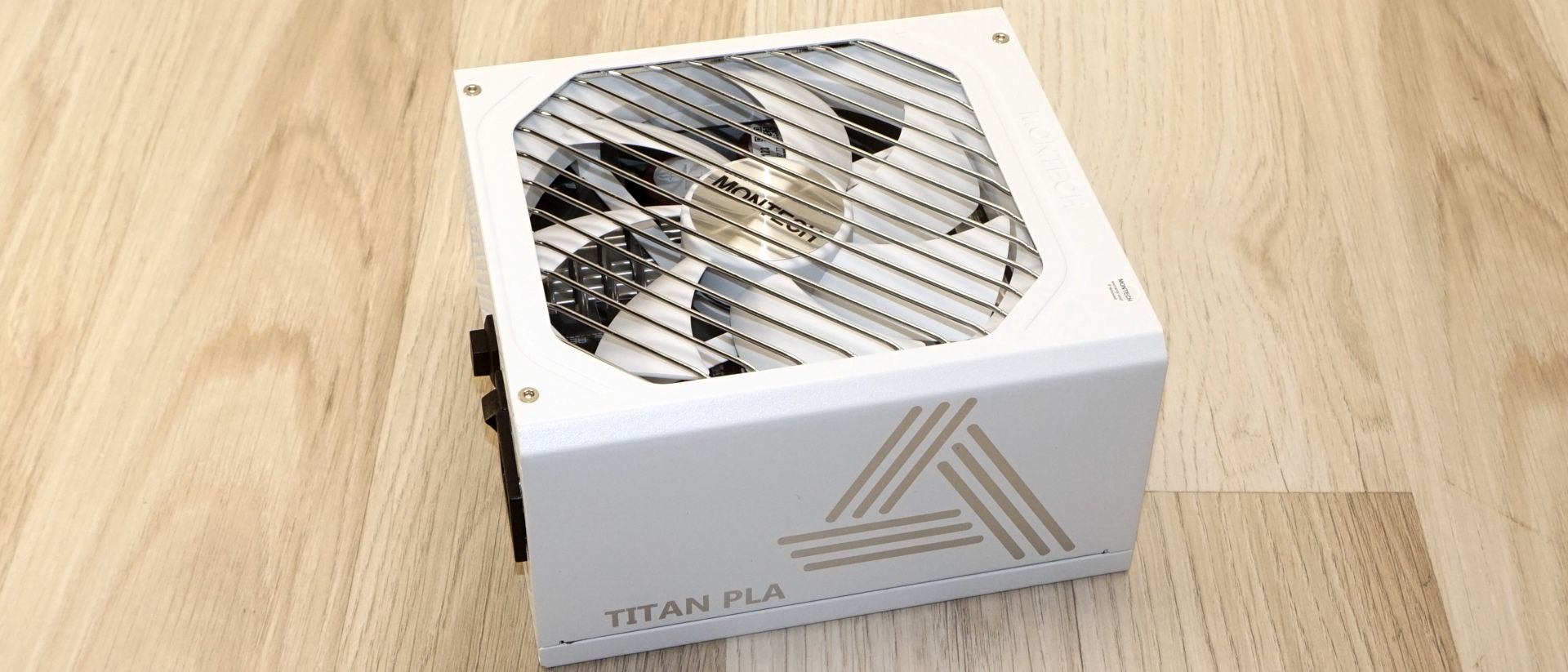
Tom's Hardware Verdict The Montech Titan PLA 750W delivers exactly what its Seasonic pedigree promises: precise voltage regulation, outstanding ripple suppression, and thermal management that holds composure even under elevated ambient temperatures. The retail price at full MSRP is placing it at a disadvantage against the competition, but at a sale price it is one of the more complete and technically accomplished 750W offerings available today. Pros +Seasonic platform +Genuine Platinum efficiency +Outstanding voltage regulation +Excellent ripple suppression +Full-bridge LLC topology +Great quality oarts +10-year warranty +Distinctive white dhassis +ATX 3.1 / PCIe 5.1 compliant Cons -Costly at full price Why you can trust Tom's Hardware Our expert reviewers spend hours testing and comparing products and services so you can choose the best for you. Find out more about how we test. Montech is a Taiwanese PC hardware brand with deeper roots than its relatively recent public profile suggests. Founded in 2016 by engineers with over three decades of experience in Taiwan's PC industry, the company entered the Western market in 2019 with a value-focused positioning built around PC cases. Those cases sold well, and the catalog expanded quickly into power supplies, air coolers, liquid coolers, fans, and mechanical keyboards. The ambition from the beginning was to become a full-spectrum component brand rather than a niche case maker, and the PSU division is now central to that effort.The earlier Century series established Montech's credentials in the mainstream segment, but the Titan PLA line represents a substantially higher level of commitment. Rather than sourcing from a mid-tier OEM and competing on price alone, Montech contracted Seasonic. That is not a trivial decision. Seasonic manufactures some of the best power supplies today and is widely regarded as perhaps the most consistently reliable OEM in the consumer PSU industry, responsible for technically accomplished designs under both its own brand and as the manufacturer behind multiple third-party lines. Montech prints the Seasonic name directly on the Titan PLA packaging, which communicates more about the product's engineering pedigree than any marketing copy could.Specifications and Design Swipe to scroll horizontally Montech Titan PLA 750W ATX 3.1 Power specifications ( Rated @ 50 °C ) RAIL +3.3V +5V +12V +5Vsb -12V MAX OUTPUT 20A 20A 62A 3A 0.3A Row 2 - Cell 0 100W 100W 744W 15W 3.6W TOTAL 750W Row 3 - Cell 2 Row 3 - Cell 3 Row 3 - Cell 4 Row 3 - Cell 5 AC INPUT 100 - 240 VAC, 50 - 60 Hz Row 4 - Cell 2 Row 4 - Cell 3 Row 4 - Cell 4 Row 4 - Cell 5 MSRP $160 Row 5 - Cell 2 Row 5 - Cell 3 Row 5 - Cell 4 Row 5 - Cell 5 In the BoxThe Titan PLA 750W ships in a large, sturdy cardboard box with a restrained and effective visual theme - a black and polished metal aesthetic with a photograph of the unit printed on the front. The Seasonic OEM designation is printed openly on the packaging. For anyone with even a passing familiarity with the PSU market, that detail is more persuasive than any graphic design choice.Latest Videos FromTom's Hardware (Image credit: Tom's Hardware)Inside the box, the PSU sits in a synthetic pouch surrounded by foam inserts. The accessory bundle is unexpectedly generous. We found mounting screws, an AC power cable, basic cable ties, five quality reusable cable straps, a set of cable combs, and an ATX jump-start adapter for testing. Few companies at any price point include all of that. (Image credit: Tom's Hardware)The cables are immediately distinctive. Bright white wiring runs throughout, paired with black connectors across the board. The wires feature an embossed braiding across their full length, giving them a slightly textured, uniform appearance that holds up well in windowed builds. The single 12V-2x6 connector is rated at 600W, which is the full ATX 3.1 specification requirement and not a given on a 750W unit. There are two 6+2 pin PCI Express connectors, which covers the most common configurations at this wattage tier but leaves no margin for extremes. It is a practical limitation worth noting before purchase. (Image credit: Tom's Hardware) Swipe to scroll horizontally Montech Titan PLA 750W ATX 3.1 Connector type Hardwired Modular ATX 24 Pin - 1 EPS 4+4 Pin - - EPS 8 Pin - 2 PCI-E 5.0 - 1 PCI-E 8 Pin - 2 SATA - 8+2 Molex - 4 Floppy - - External AppearanceAt 160mm length, the Titan PLA 750W is marginally longer than the ATX design guide considers standard. Any quality modern tower case will accommodate it without difficulty, but it is worth verifying clearance in compact enclosures before ordering. (Image credit: Tom's Hardware)The chassis finish is satin white, excellently applied. A diagonally wired, chromed fan finger guard covers the intake, and chrome decorative elements extend to both side panels. The result is refined without being ostentatious. The top panel is home to a black electrical specification and certification sticker.Stay On the Cutting Edge: Get the Tom's Hardware NewsletterGet Tom's Hardware's best news and in-depth reviews, straight to your inbox. Image 1 of 2 (Image credit: Tom's Hardware) The front panel houses the standard power switch, AC receptacle, a small decorative plate, and a toggle switch for the hybrid fan mode. The rear modular connector bank is organized logically, with a subtle black legend identifying each port type. The ports are keyed anyhow, and inserting cables into the wrong connector is practically impossible. Image 1 of 2 (Image credit: Tom's Hardware) Internal DesignCooling relies on a Hong Hua HA13525H12F-Z 135mm fan with a fluid dynamic bearing (FDB) engine, rated to a maximum of 2300 RPM. That ceiling is high for a 750W unit and this unit should not need it, although the headroom is appreciated. FDB fans are a reasonable choice at a premium tier, balancing acoustic performance with long-term bearing reliability. (Image credit: Tom's Hardware)As noted, well, everywhere around the packaging and promotional material of this unit, the OEM is Seasonic. Founded in Taiwan in 1975, Seasonic has a vast reputation in the PC market. The company serves simultaneously as a retail brand and as the manufacturer behind several third-party labels, with past collaborators including Antec, NZXT, and XFX. The Vertex platform, launched in late 2022 as Seasonic's response to the ATX 3.0 and PCIe 5.0 standards, underpins the entire Titan PLA line. The Montech collaboration reportedly required 18 months of development before reaching production, and the unit was first revealed publicly at Computex 2024. Image 1 of 2 (Image credit: Tom's Hardware) The filtering stage comprises four Y capacitors, two X capacitors, and two filtering inductors, which is a complete and adequate configuration. Two rectifying bridges sit on a dedicated heatsink immediately after the filtration stage. (Image credit: Tom's Hardware)The APFC stage uses two Infineon 6R190P6 MOSFETs and a CREE diode mounted on the unit's largest heatsink, with passive components consisting of a large encased inductor and two Nippon Chemi-Con 330 μF bulk capacitors. The primary inversion stage is where this design distinguishes itself most clearly from the competition, featuring four Infineon 6R230P6 MOSFETs arranged in a full-bridge LLC converter topology. Full-bridge LLC is a configuration far more commonly reserved for units above 1000W. Image 1 of 2 (Image credit: Tom's Hardware) On the secondary side, four Nexperia PSMN1R4-40YLD MOSFETs generate the 12V rail via synchronous rectification. The tall secondary-side heatsinks are not in direct thermal contact with the MOSFETs, an unusual arrangement for top-mounted chips, though the thermal results indicate it presents no operational limitation. The 3.3V and 5V rails are derived from DC-to-DC converters on a vertical daughterboard, standard practice in any design of this caliber. (Image credit: Tom's Hardware)Secondary-side capacitors are almost entirely Nippon Chemi-Con, with a small number of Rubycon electrolytics. Both are Japanese manufacturers with long, consistent track records in the PC enthusiast community for durability and electrical stability. The component selection throughout reflects engineering priorities, not cost reduction. (Image credit: Tom's Hardware)Cold Test Results (25°C Ambient)Cold Test Results (25°C Ambient)For the testing of PSUs, we are using high-precision electronic loads with a maximum power draw of 2700 Watts, a Rigol DS5042M 40 MHz oscilloscope, an Extech 380803 power analyzer, two high-precision UNI-T UT-325 digital thermometers, an Extech HD600 SPL meter, a self-designed hotbox, and various other bits and parts. Image 1 of 5 (Image credit: Tom's Hardware) At 115 VAC, the Titan PLA 750W averaged 91.1% efficiency across the nominal load range. At 230 VAC, that figure climbed to 92.6%. Both results comfortably clear the Platinum certification thresholds under both Cybenetics and CLEAResult's 80Plus methodology. Efficiency stability is a particular strength here, as the curve holds level across most of the range, peaks near 50% load, and performs well even at low loads.Fan behavior under cold conditions is excellent. The hybrid mode keeps the fan stationary at low loads and engages the fan once load surpasses roughly 30%, which is earlier than several competing designs allow. Audibility, however, remains minimal across most of the load range. There is a brief speed step approaching maximum output, but the fan does not approach its 2300 RPM ceiling under cold conditions. Internal temperatures are well controlled throughout.Hot Test Results (~45°C Ambient)Hot Test Results (~45°C Ambient)Under elevated ambient temperatures, average efficiency at 115 VAC falls to 89.8%, and 91.3% at 230 VAC. The degradation of more than 1% on average is measurable and slightly above the typical expectation, but no signs of thermal instability or output stress appeared at any load point during sustained testing. The platform handles thermal stress composedly. Image 1 of 5 (Image credit: Tom's Hardware) Fan behavior expectedly shifts under heat but not as intensely as we are used to. Engagement drops to around 20% load, and the speed ramp is steeper than under cold conditions. The more noteworthy finding is that the fan barely exceeds the speeds it reached during cold testing, even at 100% output. That speaks directly to how well the thermal management architecture performs paired with a relatively stable efficiency design. Internal operating temperatures remain genuinely low across the entire load range.PSU Quality and Bottom LinePower Supply QualityThe electrical results are exceptional, with the unit delivering spectacular power quality. Voltage regulation sits at 0.5% on the 12V rail and 0.2% on both the 5V and 3.3V rails. Those figures are outstanding by any standard. Ripple suppression is equally clean, just 26 mV maximum on the 12V rail and 20 mV on both the 5V and 3.3V rails. These are numbers we infrequently get from top-tier products.During our thorough assessment, we evaluate the essential protection features of every power supply unit we review, including Over Current Protection (OCP), Over Voltage Protection (OVP), Over Power Protection (OPP), and Short Circuit Protection (SCP).All protection mechanisms, including OCP, OVP, OPP, and SCP, were verified and triggered correctly during testing. The OCP thresholds, however, are set very high: 158% on the 3.3V rail, 160% on the 5V rail, and 146% on the 12V rail. OPP triggered at 146% of rated output during hot testing. The unit sustained power delivery well beyond its 750W nameplate rating for significant time periods before shutting down. Rather than this being an issue and considering the platform, parts, and their ratings, it would seem that this unit deliberately carries substantially more headroom than the nameplate implies. The protection circuitry functions correctly - the thresholds simply reflect what this hardware is actually capable of. Swipe to scroll horizontally Main Output Load (Watts) 152.14 W Row 0 - Cell 2 379.66 W Row 0 - Cell 4 568.61 W Row 0 - Cell 6 757.1 W Row 0 - Cell 8 Load (Percent) 20.29% Row 1 - Cell 2 50.62% Row 1 - Cell 4 75.82% Row 1 - Cell 6 100.95% Row 1 - Cell 8 Row 2 - Cell 0 Amperes Volts Amperes Volts Amperes Volts Amperes Volts 3.3 V 1.81 3.41 4.53 3.41 6.8 3.41 9.07 3.41 5 V 1.81 5.13 4.53 5.13 6.8 5.11 9.07 5.11 12 V 11.25 12.15 28.11 12.13 42.17 12.11 56.23 12.09 Swipe to scroll horizontally Line Regulation Voltage Ripple (mV) Row 1 - Cell 0 (20% to 100% load) 20% Load 50% Load 75% Load 100% Load CL1 12V CL2 3.3V + 5V 3.3V 0.2% 16 12 16 20 16 18 5V 0.2% 16 16 18 20 16 20 12V 0.5% 12 18 22 26 26 18 Bottom LineAt the $160 MSRP, the Titan PLA 750W sits at the upper boundary of what the 750W segment will typically support. The competition at that price is real. At the $130 sale price it regularly appears at, the value calculation changes considerably. The electrical performance, component selection, and Seasonic engineering together produce a unit that easily competes technically against products priced $30 to $50 higher from comparable brands. (Image credit: Tom's Hardware)Taken as a whole, the performance profile of the Titan PLA 750W is difficult to fault. Voltage regulation figures comfortably outclass the majority of the competition at any wattage. Ripple suppression stays at or below 26 mV across all three rails under any load condition tested, including sustained full-load runs under elevated ambient temperatures. The efficiency figures meet the Platinum certification threshold with margin to spare and remain stable across the entire load range rather than peaking sharply at optimal points. Hot testing introduces a degradation which is measurable but entirely manageable, and critically, the unit shows no signs of thermal stress or output instability at any point during sustained high-load operation. The fan management is competent and audibility remains low for the overwhelming majority of real-world operating conditions. These are benchmark-level results and reflect the underlying platform more than any cosmetic or marketing consideration.The advanced platform design and exceptional quality silicon used by Montech and Seasonic are what stands out about this series. The nearly exclusive use of Nippon Chemi-Con and Rubycon capacitors throughout the secondary stage reinforces that this product was not engineered down to a cost target. (Image credit: Tom's Hardware)Two 6+2 pin PCI Express connectors cover the most common use cases at this wattage, but the count could become a constraint for some builders. It is the most concrete criticism that can be leveled at an otherwise well-considered overall design. The 12V-2x6 connector is rated at 600W, the white cable aesthetic is genuinely distinctive and well executed, and the chassis finish is among the cleanest examples seen at this price point. The chrome accents could register as excessive depending on personal preference, but the underlying build quality is not in question.The 10-year warranty is among the longest available in the consumer PSU market and reflects the confidence a Seasonic top-tier platform warrants. For a unit that will typically remain in service for about five years before the next significant system build, that commitment is not a marketing footnote but a meaningful feature that factors directly into total cost of ownership. Warranty length in the PSU segment correlates more reliably with platform quality than almost any other single specification, and a decade of coverage communicates something concrete about how Seasonic and Montech expect this hardware to age. The Titan PLA 750W is a product built by people who knew exactly which OEM to call, and the results confirm that the decision was correct.MORE: Best Power SuppliesMORE: How We Test Power SuppliesMORE: All Power Supply Content Dr. E. Fylladitakis has been passionate about PCs since the 8088 era, beginning his PC gaming journey with classics like Metal Mutant and Battle Chess. Not long after, he built his first PC, a 486, and has been an enthusiast ever since. In the early 2000’s, he delved deeply into overclocking Duron and Pentium 4 processors, liquid cooling, and phase-change cooling technologies. While he has an extensive and broad engineering education, Dr. Fylladitakis specializes in electrical and energy engineering, with numerous articles published in scientific journals, some contributing to novel cooling technologies and power electronics. He has been a hardware reviewer at AnandTech for nearly a decade. Outside of his professional pursuits, he enjoys immersing himself in a good philosophy book and unwinding through PC games.
Montech Titan PLA 750W power supply review: A powerful and stunning all-white Seasonic-built Platinum unit
Full Article
Original Source
Read the full article at Tomshardware →KhanList aggregates and links to publicly available news content. We do not host full articles from third-party sources. Always verify important information with original sources.