
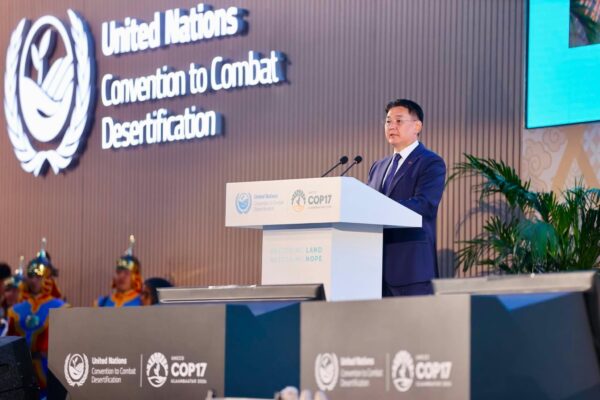
The 17th Conference of the Parties to the U.N Convention to Combat Desertification (UNCCD COP17) was convened in Ulaanbaatar from August 17-28, bringing together 196 country representatives plus the European Union to negotiate action-based measures on several climate challenges facing the world today. This year’s COP17 included segments on finance, water, land and people, and food systems. Parties agreed on a new initiative that includes $1.3 billion in financing, but failed to approve a new financial mechanism to combat drought. On August 17, the opening ceremony was attended by Mongolian President Khurelsukh Ukhnaa, U.N. Deputy Secretary-General Amina J. Mohammed, Executive Secretary of the UNCCD Dr. Yasmin Fouad, Saudi Arabia’s Deputy Minister of Environment, Water and Agriculture (and president of UNCCD COP16) Dr. Osama Ibrahim Fakiha, and Mongolia’s Minister of Foreign Affairs Batmunkh Battsetseg. The global climate gathering also included a visit by South Korea’s former president, Moon Jae-in, and business leaders from Rio Tinto, Trade Development, Oyu Tolgoi, Asian Development Bank, Global Green Growth Institute, and more. Welcoming the guests and opening the COP17 gathering, Mongolian Prime Minister Uchral Nyam-Osor stated: “The greatest change we want to see from COP17 is a shift from talk to action, from targets to implementation, and from commitments to measurable results.” As Fouad, the UNCCD executive secretary, put it in an interview with The Diplomat before the gathering: “COP17 comes at a pivotal moment for global action on land… I believe countries will come to Mongolia with a shared understanding that the challenge is no longer understanding the problem – we know what is at stake. The priority now is implementation.” In the last two weeks, the Mongolian government, civil society, and environmental organizations cooperated with global financial institutions, policymakers, businesses, and environmental scientists to advance solutions to emerging issues facing not just Mongolia but the globe, including desertification, drought, and land degradation. Building on the progress made at COP16 in Riyadh, governments at COP17 aimed to negotiate practical tools, partnerships, and financing mechanisms needed to help countries turn existing plans into action. According to the UNCCD, more than 70 countries have now developed national drought plans, compared with only three in 2013 – reflecting growing recognition that drought must be managed proactively rather than only once it becomes a humanitarian and economic crisis. Desertification, land degradation, and climate change are all interconnected and demand integrated solutions. In Mongolia, the challenge includes extreme climate fluctuations, such as dzud and drought, as well as loss of water, water pollution due to mining activities, as well as mismanagement of rangelands and pastoralism. The combination of these issues in turn becomes additional hindrance to the country’s development. The last two days of COP17 were designated for all 197 parties to come to some sort of an agreement on a mechanism to combat drought. The Asian Development Bank Partnership estimated $355 billion is needed every year to combat land degradation and drought, yet current investment stands at only around $77 billion, leaving an annual financing gap of $278 billion. Unfortunately, on August 28, last day of the COP17, parties failed to come to an agreement and passed the issue to the next COP gathering. One of the main disagreements was whether to establish a new drought protocol initiated by the African Group. The bloc of developed countries – including the European Union, Australia, and the United Kingdom – opposed the establishment of a new drought protocol, preferring to utilize previously agreed multilateral frameworks such as Global Environment Facility and to avoid overlapping agreements. While drought – and a financial mechanism to combat drought – posed a challenge for the 197 parties to negotiate, rangeland, pastoralism, and water deserve equal attention. One of the most important segments of COP17 was the High-Level Ministerial Meeting and Finance Day, where delegates, multilateral banks, and participating organizations announce strategic commitments and financial mechanisms focusing on specific issues such as land restoration, rangeland preservation, and invigorating environmentally friendly, green growth. At the High-Level Ministerial Meeting, Mongolia officially launched the global “Rangelands Flagship Initiative,” which focus on sustainable management and restoration of global pasture lands. The initiative was viewed as one of the most important outcomes of the climate gathering. It will bring together 45 projects across 23 countries, amounting to $1.3 billion in funding, making it the largest investment in the rangelands sector in the history of the UNCCD Convention. The financial commitments will be assessed by the implementation of individual projects. Participating governments are expected to consider a new policy framework on rangelands and pastoralists designed to increase long-term investment in sustainable rangeland management and strengthen pastoral livelihoods. The initiative also mentioned the establishment of an Eurasian Center for Climate-Resilient Rangelands in Mongolia. On August 24, Business for Land Forum and Finance Day brought together government, businesses, and investors looking to invest in regenerative landscapes. The Business Council of Mongolia and the UNCCD signed a Memorandum of Understanding (MoU) to establish a Business4Land (B4L) platform and Mongolia Hub. The MoU “aims to link consumption, production, and finance through environmental and social standards, as well as financial products focused on preserving natural capital.” Moreover, Mongolia also signed a Host Country Agreement (HCA) with Global Green Growth Institute to strengthen the legal and institutional framework for climate financing and augmenting investment environments for green projects. The director of the Protected Areas Policy Department at Mongolia’s Ministry of Environment and Climate Change, Uranchimeg Tserendorj, stated that for the last 32 years, Mongolia’s Law on Protected Areas has protected land all around the country. The legal framework has allowed the country to protect “20.8 percent of land,” Uranchimeg said. Mongolia is also seeking a deeper action-based cooperation with both UNCCD and the Ramsar Convention on Wetlands. Mongolia’s Environment and Climate Change Minister Sandag-Ochir Tsend met Ramsar Convention Secretary General Dr. Musonda Mumba, “proposing closer cooperation between the Ramsar Convention and U.N. Convention to Combat Desertification (UNCCD) during Mongolia’s COP17 presidency.” At COP17, mining giants such as Rio Tinto announced their strategy to contribute to Mongolia’s fight against desertification, water pollution, and restoration of forestry by planting 5,000 hectares of forest, investing in renewable energy for company usage, as well as introducing new technology to replenish groundwater. According to the environmental manager of Oyu Tolgoi, one of Mongolia’s largest mining companies, the firm began paying water pollution fees in 2026, a regular quarterly payment of 150-200 million Mongolian tugrik (roughly $42,000 to $55,000). These practices meant to set an example for other mining giants operating in the country. In the last two weeks, global partners gathered in Ulaanbaatar, Mongolia to discuss and negotiate an issue that has long been a focus for climate advocates. Mongolia’s hosting of the UNCCD COP17 is viewed as a step up in its global engagement and contribution and commitment to climate change. Considering the country’s own struggle with wetland loss, drought, rangeland and pastoral management, the platform urged global businesses, government, and civil society to take actions to help contribute solve these challenges. Although the convention did not reach an agreement on solving drought, it has made progress in promoting and implementing global partnership in climate issues.
Mongolia Hosts COP17, Urging Global Partners to Action on Climate Issues
Full Article
Original Source
Read the full article at Thediplomat →KhanList aggregates and links to publicly available news content. We do not host full articles from third-party sources. Always verify important information with original sources.