
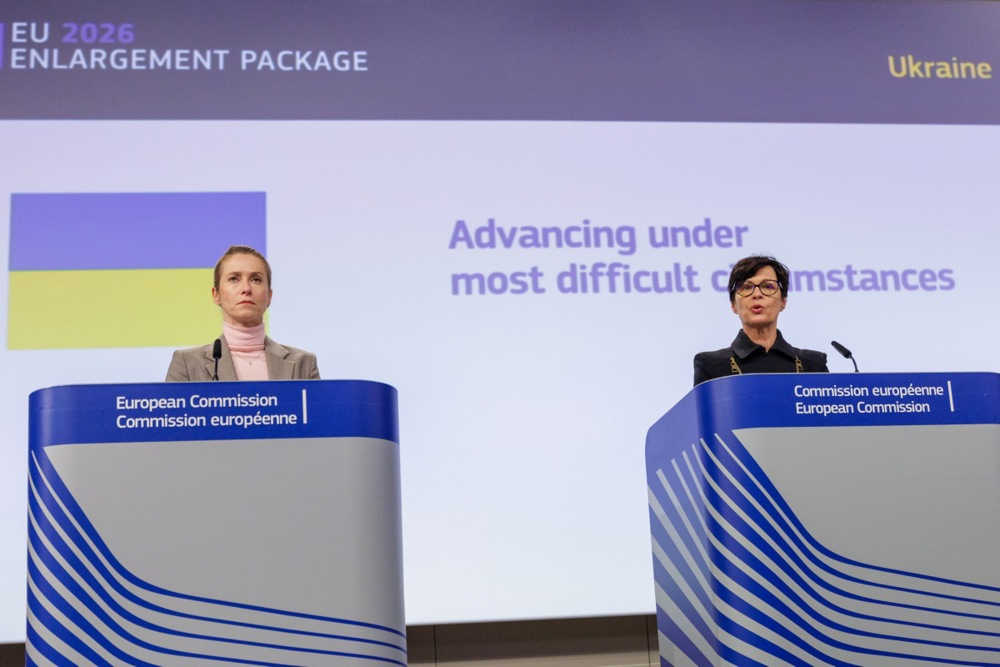
The European Commission has held up Moldova as an example for other EU-aspirant states to follow, both in terms of internal reforms and resilience to Russian interference, while also praising Albania, Montenegro, and Ukraine. Enlargement commissioner Marta Kos told press in Brussels, on Wednesday (4 November) that, out of the four frontrunners, Albania, Moldova, and Montenegro were “on track” for EU accession by 2030, despite anti-government riots in Tirana this year. But she added that Moldova was “the best performer” showing “strong determination” to implement reforms. Albania started EU accession talks in 2022, Montenegro in 2012, while Moldova and Ukraine began theirs in 2024. The EU has long praised Kyiv for advancing reforms while at the same time fighting off Russia’s war machine. But Chișinău’s progress also took place against a backdrop of growing hybrid attacks from Russia, such as drones entering the country’s airspace, cyberattacks, and Moldovan citizens recruited to perform sabotage. It has also been forced to deal with disinformation campaigns originating from Moscow and the buying of an estimated 100,000 votes in its 2024 presidential elections in favour of an anti-EU candidate. “For the first time, we have opponents who are interfering in our accession process,” said Kaja Kallas, the EU foreign affairs chief, speaking alongside Kos on Wednesday. Moldova has collaborated with EU countries to push back against Russian interference and its experiences also helped “refine the EU’s toolbox for countering hybrid threats,” according to a commission progress report on its enlargement progress out on Wednesday. But despite these efforts, hackers still gained access to citizens’ personal data from government databases on Tuesday (3 November). The prime minister, Vasile Tofan, suspects the attack was run by a state actor. Russian military forces have also controlled the Transnistria region in eastern Moldova since 1992, but this would “not become an obstacle” to the country’s EU admission, Kallas told Moldova’s prime minister in May. For its part, Ukraine also hopes to join the EU by 2028, but the commission said this was an "ambitious" target, given the size of the country. Michael Gahler, a German centre-right MEP dealing with Ukraine, told EUobserver the 2028 was “achievable”, if “necessary reforms continue at pace”. But he added that it was yet to open EU talks on integrating its massive agricultural sector into the single market, which would be “one of the most complex chapters in Ukraine's accession negotiations.” Meanwhile, accession talks with Georgia, Serbia, and Turkey had been de facto frozen due to democratic backsliding, the commission reports noted. But in Serbia, where the opposition won parliamentary elections on 25 October, it was “time for a fresh start,” Kos said. Talks with Bosnia and North Macedonia were also limping along due to internal political divisions in Sarajevo and North Macedonia's bilateral dispute with Bulgaria over languages and history, with little sign of progress in either file. When candidate countries wrap up their EU negotiations, each of the 27 member states still need to ratify their accession, in a final hurdle. And in France, where anti-immigrant and anti-enlargement feeling was on the rise, this meant either a referendum or a three-fifths supermajority in a parliament vote.
Moldova seen as ‘best performer’ on EU-accession reforms, despite onslaught of Russian sabotage
Full Article
Original Source
Read the full article at Euobserver →KhanList aggregates and links to publicly available news content. We do not host full articles from third-party sources. Always verify important information with original sources.