
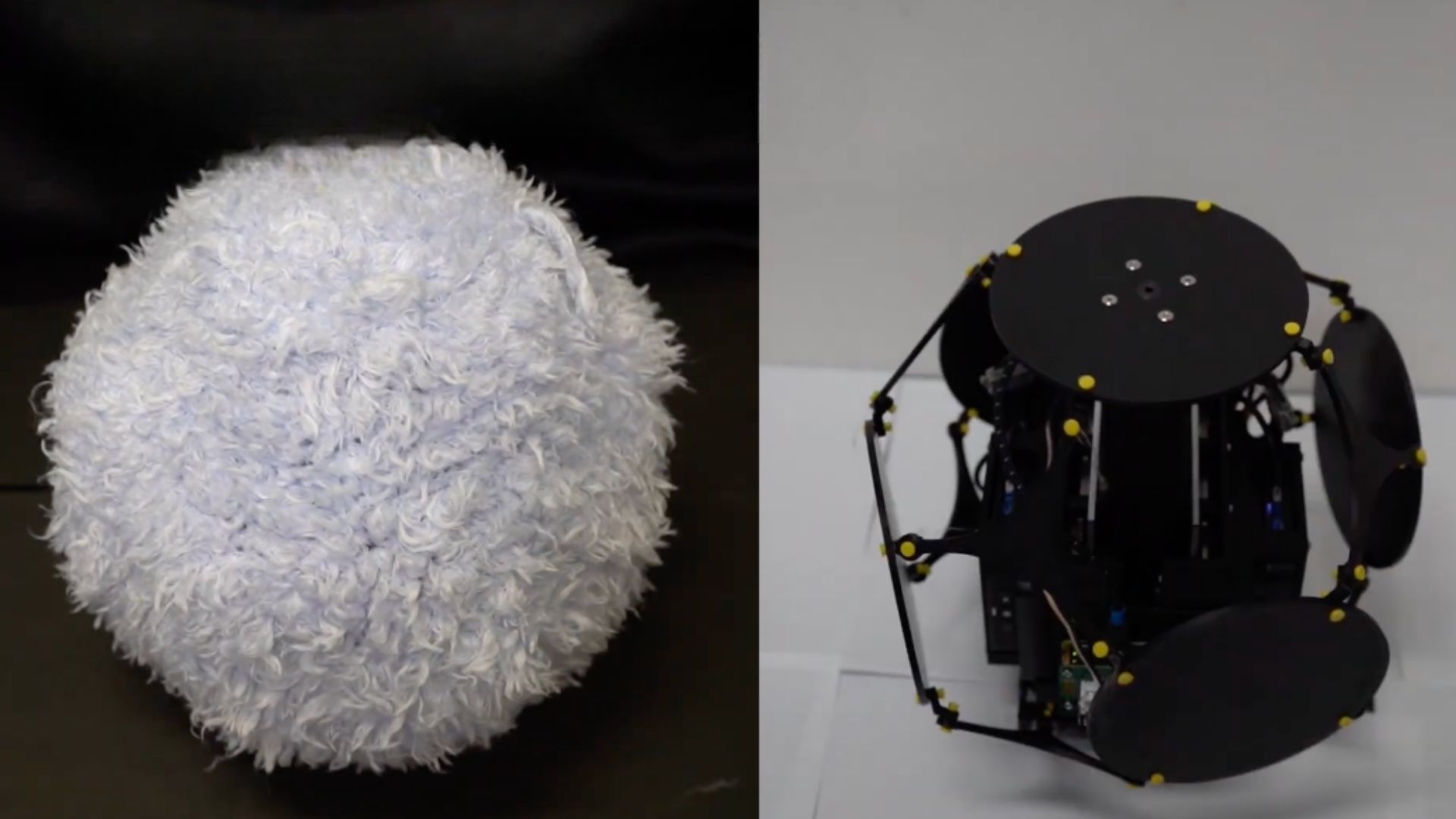
A small, fluffy robot that changes its entire body shape may seem more lifelike to people, according to a new study by researchers in Japan. The research team from The University of Electro-Communications (UEC) and Sony Corporation developed a spherical mobile robot called MOFU (MOrphing Fluffy Unit) to investigate how whole-body expansion and contraction affect a person’s perception of a robot’s “animacy,” the extent to which it appears alive or lifelike. The study, published in PLOS ONE, suggests that changing a robot’s overall volume could become another way for machines to communicate and express themselves without relying on faces or conventional articulated movements. A robot that changes its entire shape MOFU uses a geometric mechanism known as a Jitterbug structure, in which multiple sections move together to alter the robot’s overall shape. A single motor-driven linear mechanism lets the robot’s height change from about 210 to 280 millimeters as it expands and contracts. It can also move using differential two-wheel drive, allowing it to travel straight or rotate. The researchers deliberately gave MOFU a soft, fluffy exterior and an abstract spherical appearance rather than making it resemble a particular animal. Direct-drive motors and other low-noise components also reduce mechanical sounds, while an internal battery lets the robot operate without a cable. The design was inspired in part by how living organisms change their overall volume. Breathing is an obvious example, but volumetric movements can also appear in animal displays, such as a frigatebird inflating its throat pouch or a peacock spreading its feathers. The researchers wanted to determine whether this type of movement could similarly make an artificial machine appear more alive. Testing whether movement makes a difference MOFU’s expansion and contraction naturally causes some rotation around its vertical axis. To isolate the effects of each movement, the researchers used its wheels to cancel out that rotation, creating an expansion-and-contraction-only motion. They also produced rotation-only movements for comparison. The team then conducted three online video experiments with 498 participants after excluding incomplete or invalid responses. Participants watched 20-second videos of MOFU and rated its animacy using six items from the Japanese version of the Animacy subscale of the Godspeed Questionnaire Series, with each item rated on a five-point scale. In the first experiment, both expansion-contraction and rotational movement increased perceived animacy compared with conditions in which the respective movement was absent. The researchers found no clear difference between expansion-contraction-only and rotation-only conditions. A second experiment examined whether using two robots instead of one would change the effect. It found no clear difference in perceived animacy between one and two expanding and contracting MOFUs. In the two-robot tests, however, conditions involving movement generally received higher animacy ratings than completely stationary robots. The third experiment added MOFU’s expansion, contraction, and rotation to locomotion. Participants rated the moving robot as more animate than one that only traveled around. The researchers caution, however, that this experiment had fewer participants than originally planned and needs to be repeated with an adequate sample size. Making robots feel more expressive The findings suggest that changing a robot’s overall body volume may itself influence how alive people perceive it to be. The researchers say future experiments should compare expansion-contraction directly with other forms of robotic movement and investigate how changing the speed, amplitude, and timing of the movement affects perception. There are also limitations to the current study. Because participants watched videos online, the researchers did not examine how MOFU’s softness, sound, or physical presence might affect people’s responses. In-person studies in the future could therefore explore whether whole-body movement influences not only perceived animacy but also feelings such as comfort, warmth, eeriness, and willingness to approach. Such capabilities could eventually be useful for robots designed to interact closely with people, particularly in healthcare and welfare environments where quiet, expressive, and space-efficient machines could be valuable.Get the latest in engineering, tech, space & science - delivered daily to your inbox.Kaif Shaikh is a journalist and writer passionate about turning complex information into clear, impactful stories. His writing covers technology, sustainability, geopolitics, and occasionally fiction. A graduate in Journalism and Mass Communication, his work has appeared in the Times of India and beyond. After a near-fatal experience, Kaif began seeing both stories and silences differently. Outside work, he juggles far too many projects and passions, but always makes time to read, reflect, and hold onto the thread of wonder.
MOFU: Tiny fur-bot expands and contracts like it’s breathing to seem more alive
Full Article
Original Source
Read the full article at Interestingengineering →KhanList aggregates and links to publicly available news content. We do not host full articles from third-party sources. Always verify important information with original sources.