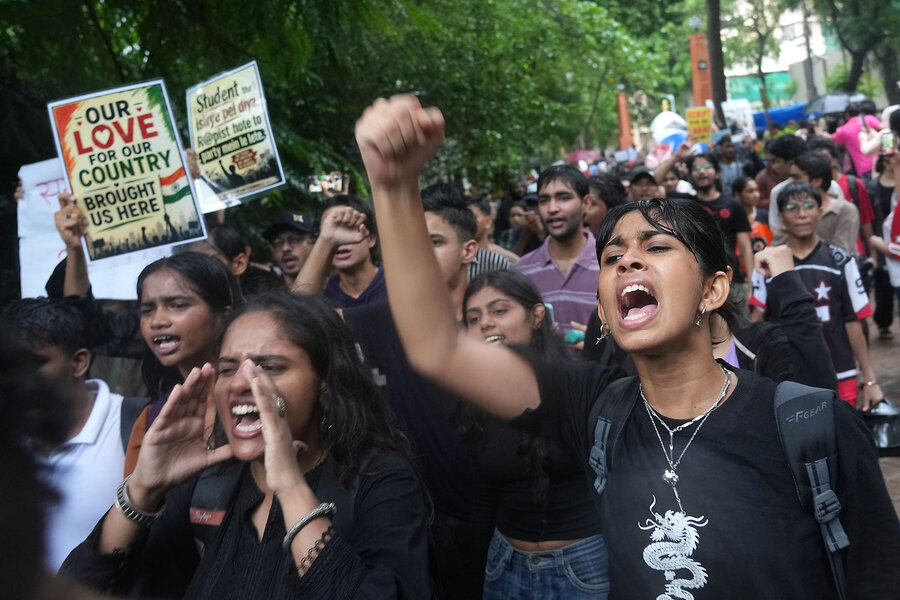
Indian Prime Minister Narendra Modi broke weeks of silence over mass protests on Thursday, promising swift justice for repeated exam paper leaks that have eroded Indians’ confidence in their education system and fueled youth outrage. But his promise seems to be doing little to quell the unrest swelling in the capital and beyond.Thousands of students remained camped out in central Delhi late Thursday night, joined by opposition party leaders and activists from the Cockroach Janta Party, the group at the center of recent protests.The CJP – which takes its name from a jibe made by India’s chief justice, comparing unemployed youth to “cockroaches,” along with the name of the ruling Bharatiya Janata Party – began in May as online satire. Then, 2 million students who sat for India’s competitive medical entrance exam saw their results scrapped after authorities found that questions had been leaked. The debacle, which came on the heels of similar higher-education scandals, was linked to roughly a dozen student suicides, and a retest in June did little to calm public outrage. Why We Wrote This Long-simmering frustrations with corruption and youth unemployment have bubbled over into India’s streets. And it is arguably the biggest test yet for Prime Minister Narendra Modi’s government. The CJP helped channel that anger into the streets. Now, it’s officially calling for nationwide protests.In the group’s most ambitious mobilization yet, it urged student unions across India to hold protests Friday, amplifying the CJP’s central demand: the resignation of Education Minister Dharmendra Pradhan.In a post on social platform X Thursday morning, Mr. Modi had warned that “those who try to harm the future of our youth will not be spared,” but made no mention of Mr. Pradhan.The CJP’s call to expand peaceful demonstrations comes three days after police charged and tear-gassed thousands of protesters marching toward Parliament, injuring more than 100 people. Dozens of protesters were detained, some forcefully bundled into police buses. Anushree Fadnavis/Reuters Abhijeet Dipke, head of the Cockroach Janta Party (CJP), gestures to CJP supporters during a sit-in protest demanding the resignation of Indian Education Minister Dharmendra Pradhan, in New Delhi, June 20, 2026. But back at Jantar Mantar, a historic protest site in central Delhi, the mood Thursday was defiant.Some people sang verses by revolutionary poets, while others chanted, “Cockroach Zindabad,” meaning “Long live the cockroach.” Placards reading “Save Education, Save the Future” dotted the perimeter, and faraway supporters sent plates of rice and chicken and other provisions via food delivery apps.“Seeing so many people around has ignited hope,” says Ankit Sarthi, who is preparing for India’s civil service exams. “This is now about more than fixing the education system. We want to remind our government that they have to be accountable.”Tanisha Bose, a Delhi University graduate student, agrees that the movement is growing, both in scale and scope. “There is deep rot in our country’s system overall,” she says, and these protests are “a message to Modi.”Authorities again cut mobile internet access around the protest site Wednesday, with no public suspension order issued, in apparent violation of Indian law, according to the Internet Freedom Foundation.
Modi’s greatest challenge yet? Delhi struggles to contain student unrest.
Full Article
Original Source
Read the full article at Csmonitor →KhanList aggregates and links to publicly available news content. We do not host full articles from third-party sources. Always verify important information with original sources.