
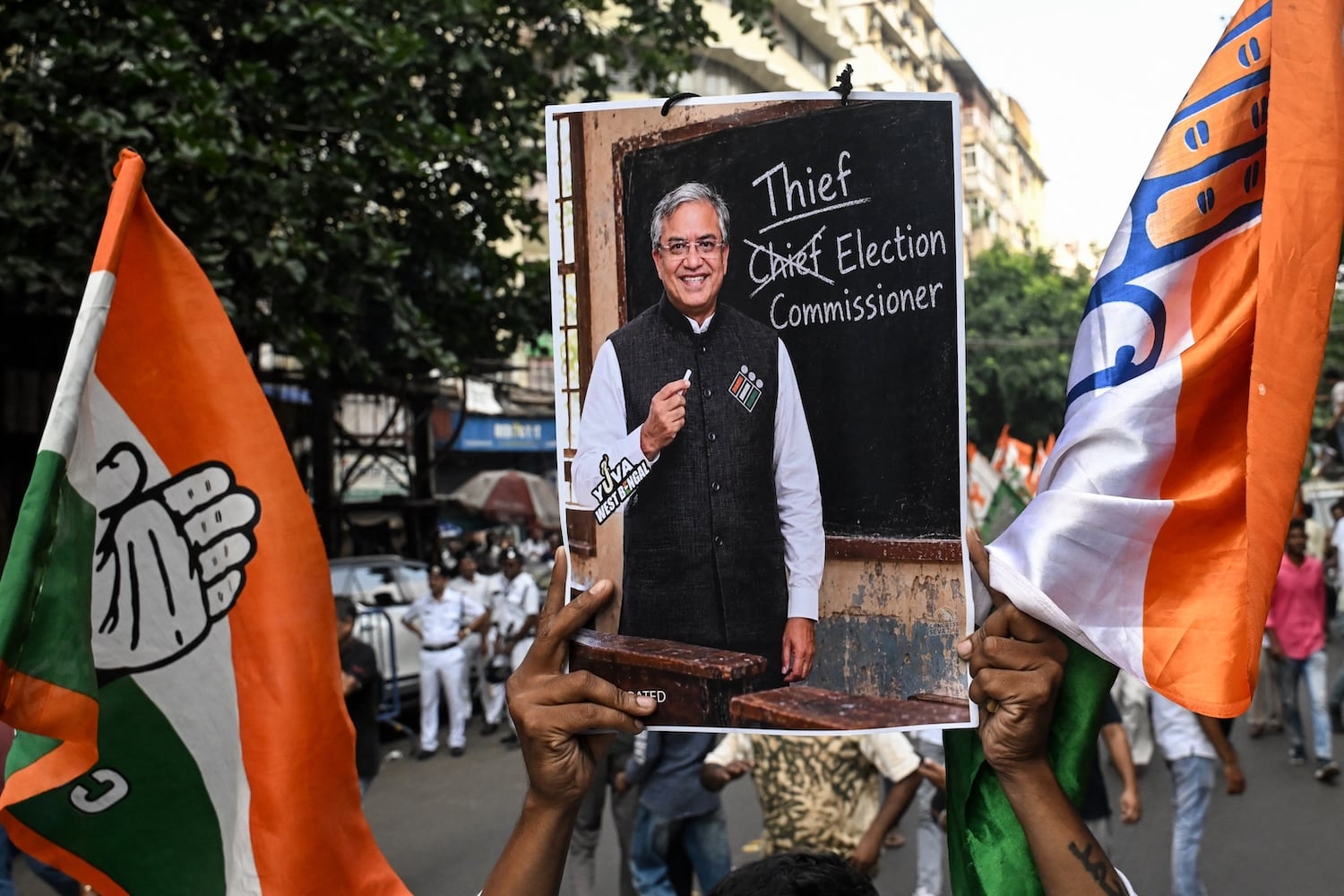
In 1951-52, independent India held its first free and fair election. As the country’s first chief election commissioner, Sukumar Sen—a civil servant who trained as a mathematician—was responsible for overseeing the voter rolls and ensuring the integrity of the vote. The task he faced was daunting: The Indian electorate at the time was composed of 176 million citizens, 85 percent of whom were illiterate. Some members of India’s Constituent Assembly, which drafted the new constitution, had opposed granting universal adult suffrage, asserting that illiteracy and poverty meant that people would fall under the sway of dubious political appeals. In the end, the leadership under Prime Minister Jawaharlal Nehru challenged that belief and granted every Indian citizen over the age of 21 the right to vote. In 1951-52, independent India held its first free and fair election. As the country’s first chief election commissioner, Sukumar Sen—a civil servant who trained as a mathematician—was responsible for overseeing the voter rolls and ensuring the integrity of the vote. The task he faced was daunting: The Indian electorate at the time was composed of 176 million citizens, 85 percent of whom were illiterate. Some members of India’s Constituent Assembly, which drafted the new constitution, had opposed granting universal adult suffrage, asserting that illiteracy and poverty meant that people would fall under the sway of dubious political appeals. In the end, the leadership under Prime Minister Jawaharlal Nehru challenged that belief and granted every Indian citizen over the age of 21 the right to vote. More than 60 percent of those eligible voted in India’s first election, and the votes that followed in the next few decades were widely seen as free and fair. But beginning in the 1980s, as the electorate became more politically aware and less predictable, charges of voter fraud from parties across the ideological spectrum became rampant. Literacy was increasing—and with it, voter participation at all levels. Parties could no longer count on predictable political outcomes, leading them to resort to some chicanery. Former Cabinet Secretary T.N. Seshan took office as chief election commissioner in 1990 and lost no time in restoring faith in India’s electoral integrity. To his credit, Seshan implemented existing laws with vigor and without partiality; he enforced rules intensely and helped lead to a decline in election violence. However, Seshan soon learned that there were limits to the powers of the office. The Indian National Congress government in power at the time had introduced a new system granting decision-making power to two senior deputies in addition to the chief election commissioner. When Seshan sought to assert his will over his two colleagues, the Indian Supreme Court quickly reined him in, ruling that the principle of unanimity had to be upheld and the chief election commissioner could not act unilaterally. That principle may now be at risk. Last week, an explosive investigation by the Indian Express alleged that India’s current chief election commissioner, Gyanesh Kumar, had blatantly violated the unanimity norm. The newspaper revealed a series of irregularities that transpired over 10 months. Among them, it reported that Kumar added new names to India’s voter rolls while deleting others—all without consulting his two deputies. On 14 different occasions, the deputies lodged formal written complaints but were ignored. They each separately wrote to the cabinet secretary, the top bureaucrat in the Indian civil service, raising their concerns, to no avail. In fairness, there had previously been differences in views among the three commissioners. However, the scope and the degree of dissent and its apparent suppression appear unprecedented. This alleged impropriety took place amid a reform process initiated by the Election Commission of India last year. Known as the Special Intensive Revision (SIR), the process involves culling electoral rolls across the country—ostensibly designed to remove individuals who are ineligible to vote. The first phase of the SIR started in the state of Bihar in June 2025; phase two covered nine more states and three union territories; and the third phase will conclude in December. The process has caused controversy in state elections, particularly in Bihar, Tamil Nadu, and West Bengal. The SIR struck more than 9 million names from the rolls in West Bengal ahead of its elections in May; allegations of the inappropriate removal of eligible voters were rife. Ultimately, Prime Minister Narendra Modi’s Bharatiya Janata Party (BJP) ousted the All India Trinamool Congress party, which had led the state legislature for 15 years. Proponents for the revision of the electoral rolls, including the BJP, argue that it addresses significant numbers of illegal immigrants on the lists. From the outset, civil society activists accused the SIR process of actually being designed to strike off minority voters, especially Muslims, who are disproportionately poor and often unable to provide sufficient proof of citizenship to adjudication tribunals as they try to challenge their removal from the rolls. The Express investigation unsurprisingly ignited a spate of public protests from different quarters. The Congress party, India’s principal opposition party, has demanded that the charges be investigated by the Supreme Court and that the chief election commissioner should be immediately asked to resign. But these demands are no longer limited to Congress. Significantly, the Cockroach Janta Party quickly entered the fray. The movement—initially a satirical party—launched nationwide protests over the summer that highlighted the deep-seated grievances of India’s aspirational youth. Those demonstrations, triggered by a national exam paper leak, led to the resignation of Education Minister Dharmendra Pradhan in July under steadily growing public pressure. Last week, the Cockroach movement issued an ultimatum for Kumar’s resignation by Sept. 26—which was not met—and threatening to initiate a protest in Mumbai on Oct. 2 that would coincide with the birthday of Mohandas Gandhi. As with its previous protests, the Cockroach movement’s demands are specific. First, it calls for both Kumar’s resignation and an independent investigation into the allegations of impropriety. Second, it insists that the current electoral rolls—the product of the SIR—be reinstated as they were in January 2025. Finally, it seeks the repeal of a 2023 law that deals with the appointment of election commissioners. The BJP, corralling its wagons against this new wave of protest, insists that no malfeasance took place under Kumar’s tenure and that the charges leveled against him are “baseless.” But such a defiant stance might not enable the party to stave off discontent. Now in his third term, Modi was widely seen as invincible until the Cockroach protests this year. Though the prime minister remains very popular, if widespread and sustained demonstrations push him to remove the chief election commissioner, it would further dent this image. The Cockroach movement, emboldened by its success in forcing the resignation of Pradhan, seems to have convinced an otherwise disorganized opposition that Modi may no longer be quite the juggernaut that they feared. Further, that the Express undertook and published such a bold investigation suggests that elements of the country’s press may be regaining some of its former spirit. It is an open question if the Cockroach Janta Party and the rest of India’s political opposition can relentlessly sustain major protests over this electoral scandal. The Cockroach movement, after all, is not organized so much as it represents the mass frustrations of many young Indians. Under the leadership of Rahul Gandhi, the Congress party does not seem to have the political acumen or the institutional skills to keep the pressure on Modi. Further, given the sheer complexity of the election commission issue, its resolution is likely to involve a major independent investigation and subsequent legal adjudication. The Modi government might simply remove Kumar as a concession and find a way to delay addressing the more trying questions that the opposition has highlighted. The sheer groundswell of public dissent nonetheless suggests that the BJP’s apparently impregnable firewall could be breached. If the Congress party and the Cockroach movement can truly coalesce and also galvanize regional political parties around these grievances, the BJP’s dominance may face a challenge that it has not encountered since it assumed national office in 2014. How these protests unfold in the coming weeks—and how Modi’s government responds—will be telling.
Modi Faces Protest Threat Over Election Commission Scandal
Full Article
Original Source
Read the full article at Foreignpolicy →KhanList aggregates and links to publicly available news content. We do not host full articles from third-party sources. Always verify important information with original sources.