
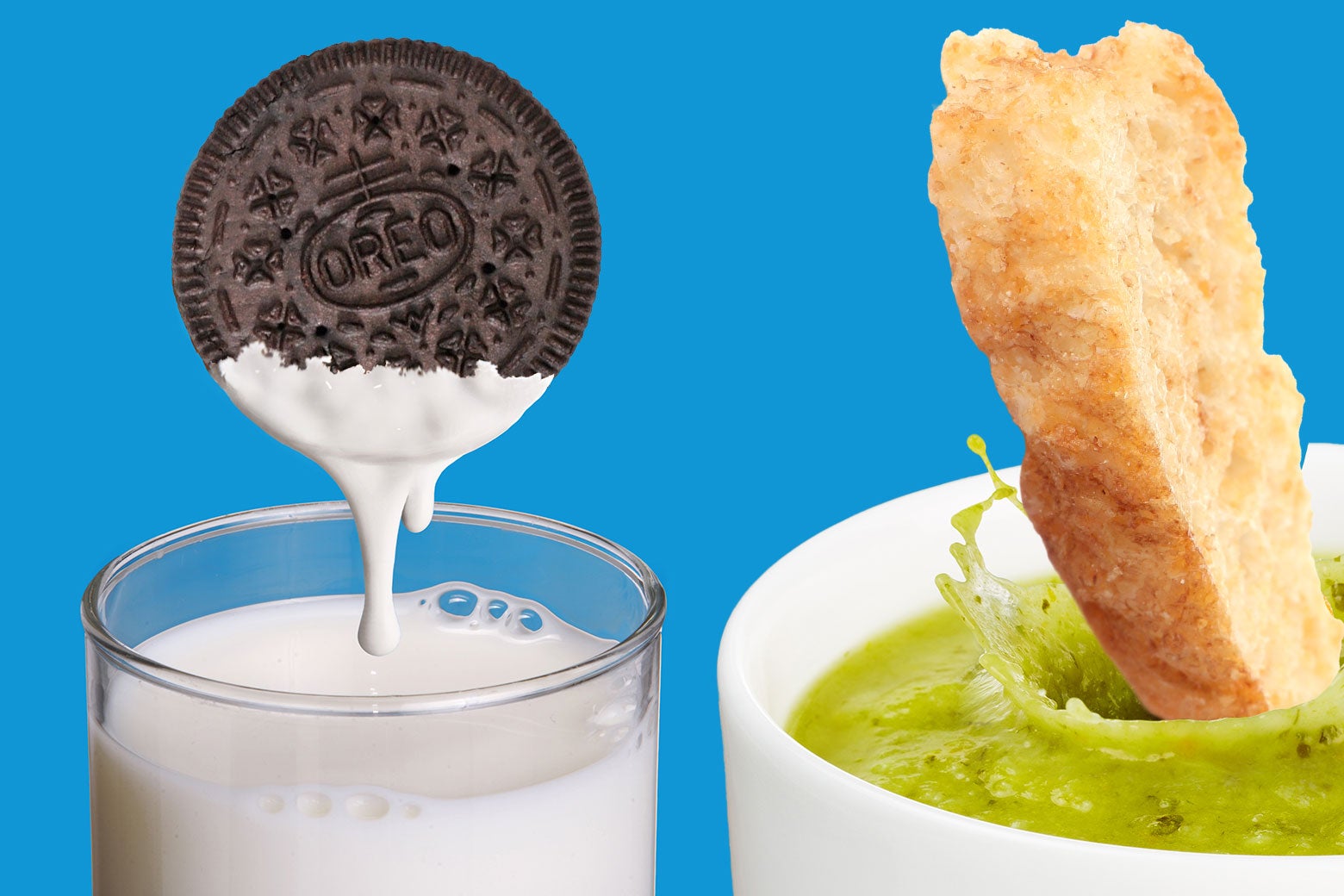
Food Bring Back the Sop! For our ancestors, mixing one’s food and drink was a normal—and delicious—part of life. But only the humble Oreo remains. Where did we go wrong? Photo illustration by Slate. Photos by Liudmila Chernetska/Getty Images Plus, CS0523183/iStock/Getty Images Plus, and ~UserGI15966731/Getty Images Plus. Sign up for the Slatest to get the most insightful analysis, criticism, and advice out there, delivered to your inbox daily. I haven’t dipped an Oreo in milk for at least a decade. Is it because I’m a joyless stiff who hates soggy biscuits? Certainly not! It just doesn’t feel like the adult thing to do. Milky fingers and the residual quagmire of disintegrated chocolate cookies at the bottom of the glass feel puerile. Despite Nabisco’s century-old “Twist, Lick, Dunk” campaign that has driven the Oreo to become the world’s most popular cookie, I hardly ever buy Oreos or, for that matter, milk. Society allows children the joy of combining foods and drinks, but as we age, we are expected to keep our solids and liquids separate. The direct manipulation of foods is akin to play, and (tsk-tsk) we all know not to play with our food. It’s an interesting duplicity, where the overzealous impulse to keep your peas and potatoes in opposite corners of the plate is a hallmark of youthful pickiness, but the sophistication of the dinner table also disallows a polite diner from dipping her bread in her pinot noir. But I decry the sociological puritanism that makes us keep our foods at fork’s length and our drinks at the end of the straw—may they never mix. To this, I say, “Phooey! Bring back the sop!” Don’t mind if I dunk. The sop affords the drinker a level of control over his culinary experience. “I might just dip my toe in, or I might get properly soggy!” One bite is of a dry biscuit; another is tinctured with a spot of malty black tea. For the devout sopper, bread is a divinely edible sponge, the coin surface of the Oreo is an engineering marvel that channels rivulets of milk, and the tea biscuit is the Goldilocks combination of sturdiness and absorbance. More than this, the sop is an ancient and time-honored culinary tradition. At times, the seemingly humble sop is elevated to a sacred rite. But the etiquette and mores of Western dining have dredged moats around our meals, creating distance between foods and drinks and, I think, creating distance between our fellow diners and ourselves. When sociologists describe the cultural concept of dining together, they use the term commensality. Modern dining—partly through its material culture of utensils—has made eating and drinking less commensal. To indulge more deeply in the textural and communal world of our cuisine, we should not shy away from the sop. Consider the mental anguish with which we are confronted when viewing Tim Robinson’s I Think You Should Leave skit about “Sloppy Steaks.” In it, the comedian—always a pariah to even the most basic social norms—sits at a steakhouse with his Entourage-coded friends. When the waiter brings over a round of steaks, he implores the sleazy-looking patrons, “No sloppy steaks, guys, please.” The men act as if they will behave, but as soon as the helpless waiter leaves, they proceed to fiendishly pour glasses of water over the slabs of meat, sawing into them like a pack of wolves. The effect of this absurdist comedy hinges on our collective repulsion at the depiction of food and drink mingling so grotesquely. A waterlogged porterhouse is deeply offensive to our societal standards of decency. I’m not here as a Sloppy Steak apologist, to be sure. But there are occasions when food and drink should mingle. Take the Genoan tradition that bathes focaccia in cappuccino or the conquistador’s combination of churros and hot chocolate. From British biscuits and tea to Italian espresso and biscotti, the sop is a tasty part of some of the world’s favorite drinks. The Catholic Church has even elevated the sop into a sacrament. Intinction is one of four liturgically legitimate ways Catholic priests can administer the Holy Eucharist: the unleavened bread, transubstantiated into the body of Christ; the sacramental wine, into his blood. During intinction, the priest dips the wafer in the wine and places it directly in the churchgoer’s mouth. It’s a powerfully intimate act made more significant by the mingling of bread and wine (or body and blood). It is an incarnation of vivacity both corporeal and spiritual. In each of us, the foods and drinks we consume combine and give us life. It’s OK to let them interact. This marriage of bread and wine, in particular, was ubiquitous in the ancient Mediterranean world. It was the everyday breakfast of the Romans. “Wine, as Homer noted, was one of the chief components of breakfast,” writes Mark Grant in Roman Cookery: Ancient Recipes for Modern Kitchens. “In fact, the Greek word for breakfast, akratisma, was supposedly derived from akratos, meaning ‘unmixed wine,’ because the meal was often no more than bread dipped in wine.” Alberto Grandi, author of La Cucina Italiana Non Esiste and a professor of food history at the University of Parma, wrote me via email, “In the ancient world—think of authors like Pliny the Elder or Columella—bread was indeed frequently combined with liquids (wine, oil, sauces), but mostly for practical reasons: to soften it, to make it more palatable, or simply to avoid wasting food. Bread was not just an accompaniment; it was often the meal itself.” The bread and its inevitable sopping were the meal itself. Modern diners in America might be surprised to hear that we inherited this Roman tradition, though it has become unrecognizable. Our modern word for supper is directly related to the word soup. The oldest link in the Oxford English Dictionary’s etymology for sup points to the “post-classical Latin suppa, sop, piece of bread soaked in liquid (6th cent.).” The sop, then, is the progenitor of the early evening meal we consume today, even if we aren’t dipping our bread in any of our drinks. The Italian and French still sop to a certain degree with their respective traditions of fare la scarpetta and saucer, which both refer to the act of using bread to clean up excess sauce at the end of a meal. “Scarpetta is less a ritual than a gesture rooted in scarcity: a way to collect and consume what would otherwise be left behind,” Grandi commented. “In that sense, it belongs to a long history of frugality rather than to a codified culinary tradition. Only later—especially in the twentieth century, when abundance replaced necessity—did it become reinterpreted as a sign of authenticity, even conviviality.” So when did we stop this culinary mingling? And why? The sop was a standard practice in the ancient Mediterranean world, but, like so many other fine practices, it began to die in the Dark Ages. Plagued by, well, the bubonic plague, among sundry other lethal factors, the medieval European slowly became savvy to some of the dangers of messy eating, particularly when diners were sopping into the same communal bowl of wine. It was during these gloomy centuries that double-dipping became taboo. At the tail end of it all, Europeans finally got around to using the fork around the 16th century. Norbert Elias wrote one of the foundational texts in the sociology of food, The Civilizing Process, Vol. I: The History of Manners. In the 1939 book, we find the German sociologist analyzing how medieval elites began to govern the sop with table manners and etiquette, due not only to hygiene but to powerful mechanisms of social shame. One medieval English etiquette book prescribed, “If you have dipped bread into the wine, drink it up or pour the rest away.” Another commented, “Some people bite a slice and then dunk it in the dish in a coarse way; refined people reject such bad manners.” The sop was becoming boorish and unwieldy for courtiers in elite dining rooms. Where modern Italians might feel increased conviviality (or commensality) when sopping up sauce after a leisurely meal with la scarpetta, Elias saw the development of medieval manners as building an “invisible wall of affects which seem now to rise between one human body and another, repelling and separating, the wall which is often perceptible today at the mere approach of something that has been in contact with the mouth or hands of someone else.” So who killed the sop? The feudal lord, in the castle, with the fork. Here in the U.S., we inherit much of the European etiquette that Elias described; accordingly, we feel a certain level of disgust at the dunking and drooling that comes along with any good sop. Of course, Elias’ work has been critiqued for its Eurocentrism and its linear description of the “civilizing” process. Elsewhere in the world, we find joyful and convivial eating traditions that still readily use the hand to mingle sauces and starches, liquids and solids (even if they have their own etiquettes surrounding hygiene, manners, and saliva). “The irony is that what began as an act of necessity is now often celebrated as an expression of identity—and sometimes even elevated to a gastronomic ritual,” Grandi concludes, of the Italian fare la scarpetta. In America, the Oreo is the only mainstream vestige of the great legacy of the sop. Twist, Lick, Dunk. I say let’s liberally apply Nabisco’s marketing genius to our bread and wine, our coffee and doughnuts, our edible garnishes and cocktails. Share, Tear, and Douse. Pick, Pull, and Plunge. Whatever it is, we won’t be plagued by some old medieval manners. Don’t let them stop the sop! Food History Drink
Modern Manners Have Ruined One of Life’s Greatest Culinary Pleasures. It’s Time We Fight Back.
Full Article
Original Source
Read the full article at Slate →KhanList aggregates and links to publicly available news content. We do not host full articles from third-party sources. Always verify important information with original sources.