
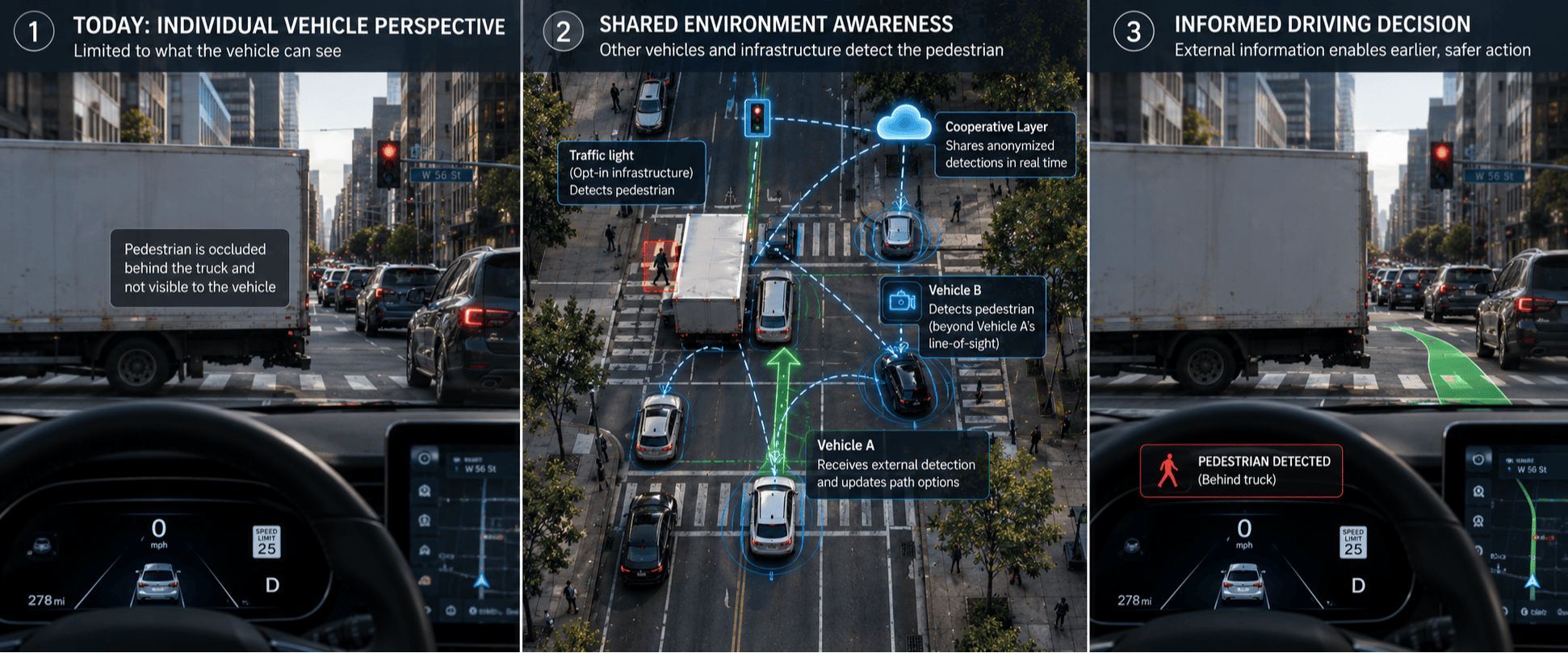
Introduction: The Problem Is Larger Than the VehicleThe development of autonomous vehicles has largely focused on making the individual vehicle more intelligent. Better cameras, better radar, better lidar, larger neural networks, better maps, more training data, and increasingly sophisticated systems for interpreting the environment around the vehicle have collectively pushed autonomous driving substantially forward. There is, however, a more fundamental architectural problem that additional compute alone cannot solve: the modern autonomous vehicle is still, for the most part, attempting to understand a shared environment from an individual perspective.A vehicle observes the world around it, attempts to identify what those observations represent, predicts what the objects it can observe are likely to do, and then determines how it should respond. In many ways, we have recreated the fundamental limitations of a human driver inside a substantially more capable computational system. The machine may have cameras facing in every direction. It may have radar, lidar, ultrasonic sensors, GPS, high-definition maps, and neural networks capable of processing enormous quantities of information in real time. It may react considerably faster than a person. It is nevertheless primarily reasoning from what that particular vehicle can perceive.This creates an interesting contradiction. Roads are inherently shared environments. Every vehicle, pedestrian, cyclist, traffic signal, construction zone, emergency vehicle, and piece of transportation infrastructure exists within the same physical system. Their actions affect one another continuously. Yet we are attempting to automate this shared environment by creating thousands or millions of independently intelligent participants, each reconstructing approximately the same environment for itself. The alternative is to stop treating autonomous driving exclusively as a vehicle problem. It is an ecosystem problem.How Autonomous Vehicles Generally Work TodayAlthough implementations differ considerably between manufacturers, autonomous driving systems generally follow a recognizable architectural pattern. The vehicle begins with sensors. Cameras provide visual information. Radar measures objects and relative velocity. Lidar, where used, provides detailed spatial information. Ultrasonic sensors can provide short-range awareness, while GPS, inertial measurement systems, maps, and other positioning technologies help establish where the vehicle exists within the environment.These inputs feed a perception system. The vehicle attempts to determine what exists around it: another vehicle, a pedestrian, the edge of the road, a traffic signal, or something occupying the lane ahead. Those observations then become inputs for prediction. It is not enough to know that another car exists; the autonomous system needs to estimate what that car is likely to do next. Is it maintaining speed, braking, changing lanes, turning, or behaving unusually? Planning follows prediction. The vehicle determines an appropriate path and action based upon its interpretation of the environment, after which the control system translates those decisions into steering, acceleration, and braking. In simplified form, the architecture is Sensors -> Perception -> Prediction -> Planning -> Control.This architecture is extraordinarily powerful, and increasingly sophisticated implementations can incorporate maps, historical information, V2X signals, cloud services, and other external data. But its fundamental center of gravity remains the individual vehicle. The vehicle constructs its understanding of the world primarily from its own perspective and then determines what it should do. That is the architectural limitation.Existing Communication Is Not Yet Collective PerceptionThe concept of vehicles communicating with one another is not new, nor should a cooperative autonomy architecture be presented as though it begins from a blank slate. V2V and V2X research, DSRC, C-V2X, roadside units, and standards efforts around exchanging vehicle and sensor information have existed for years. More recent work on cooperative perception goes considerably further, including mechanisms for vehicles to exchange information about objects detected by their own sensors. In that sense, the important question is not whether vehicles can communicate. They can. The more interesting question is why, after years of development, that communication has not become a ubiquitous external perception layer available to autonomous systems across manufacturers.This progression is already visible in standards work intended to move beyond basic vehicle-state messages toward the exchange of perceived objects and sensor-derived information. European work on Collective Perception Messages and corresponding sensor-data-sharing efforts in the United States demonstrate that the underlying concept of communicating what another vehicle perceives is itself established. The distinction proposed here is therefore not the invention of vehicle-to-vehicle perception sharing. It is treating that information as a manufacturer-neutral external evidence layer that different autonomous systems can independently consume, validate, and weight without requiring their internal perception architectures to become standardized. Part of the answer is that communication and collective perception are not the same problem. A vehicle receiving a traffic-signal state, emergency warning, position report, or even another vehicle's object detection has acquired additional information, but that does not automatically make the information usable as part of its own understanding of the environment. Different manufacturers use different sensors, coordinate systems, object taxonomies, confidence models, perception architectures, update frequencies, and definitions of uncertainty. A confidence value of 0.9 generated by one company's model cannot simply be assumed to mean the same thing as 0.9 produced by another. The difficult interoperability problem is therefore not merely transmitting messages between vehicles; it is establishing a common external representation through which independently developed systems can interpret those messages without requiring the companies themselves to standardize their internal autonomous-driving stacks.This also explains why deployment cannot depend upon reaching some critical mass before the architecture becomes useful. A cooperative vehicle must remain a fully functional autonomous vehicle when nobody around it participates. The existing local perception stack remains authoritative for operating the vehicle, while cooperative information is an additional source of evidence. During early deployment, infrastructure and a small number of participating vehicles may provide occasional additional observations. As adoption increases, the density and usefulness of that information increases with it. The system therefore needs to produce incremental value rather than requiring a binary transition from isolated autonomy to collective autonomy. This is effectively what the transitional state in the preceding diagram represents: local autonomy first, limited external awareness second, and progressively deeper cooperative perception as participation and infrastructure mature.The First-Person ProblemImagine three vehicles approaching an intersection. Vehicle A can see a pedestrian. Vehicles B and C cannot. Perhaps a truck physically blocks their view, the pedestrian is emerging from behind a building, or the geometry of the intersection simply means that one vehicle has information that the others do not. From the perspective of Vehicle A, the pedestrian exists. From the immediate sensory perspective of Vehicles B and C, the pedestrian may effectively not exist yet. The physical reality, however, is identical for all three vehicles.This distinction becomes increasingly important as we attempt to progress from driver assistance toward genuine autonomous transportation. A sufficiently sophisticated autonomous vehicle can become extremely good at interpreting what it observes. What it cannot do is directly observe information that physically cannot reach its sensors. A larger neural network does not allow a camera to see through a truck. More compute does not eliminate an occluded intersection. Better object detection cannot identify an object for which the vehicle has received no observational information. The system can predict that a hidden hazard might exist and behave conservatively because of that uncertainty, which is valuable, but that is not the same thing as knowing that another participant in the environment has actually detected one.This is why one important class of limitations in purely vehicle-centric autonomy is architectural rather than computational. Cooperative perception does not solve the wider problem of autonomous driving. A vehicle must still reason about intent, unusual behavior, uncertain predictions, changing road conditions, and the enormous number of long-tail situations that make autonomous driving difficult. Communication does not make those problems disappear. What it can address is narrower but fundamental: no amount of computation can directly recover an observation that never reached the vehicle's sensors. Better inference can reason about what may exist beyond perception; another observer can provide evidence of what actually exists there.Humans already compensate for this problem through communication. We use brake lights, turn signals, horns, road signs, traffic lights, gestures, emergency sirens, and countless informal behavioral signals. Transportation is already a communication system; it is simply an extraordinarily low-bandwidth one. Autonomous vehicles create the opportunity to change that. Instead of every vehicle independently reconstructing the same environment, vehicles can begin contributing to a shared understanding of it.Why Not Simply Make the Vehicle Good Enough?There is a reasonable counterargument to this entire premise: perhaps none of this is necessary. Sensors will continue to improve, neural networks will become more capable, maps more detailed, and autonomous systems better at reasoning under uncertainty. A sufficiently capable vehicle can also behave conservatively when it cannot see. If a parked truck blocks the view of a crosswalk, the vehicle does not necessarily need another vehicle to tell it that a pedestrian may be present; it can reduce speed and plan around the possibility that one is.In many situations, that may be enough. Cooperative perception should not be presented as a prerequisite for autonomous driving, nor as a substitute for making individual vehicles better. A vehicle that requires surrounding participants to tell it how to drive would introduce a dependency considerably more dangerous than the limitation it is intended to solve. Local perception and independent decision-making therefore remain necessary regardless of how capable the surrounding ecosystem becomes.The distinction is between inference and observation. An isolated vehicle can infer that something may exist behind an obstruction. Another observer in a different physical position may already know that something does. The first system is managing uncertainty; the second has information capable of reducing it. This does not make the external observation automatically correct, nor does it mean the receiving vehicle should surrender its judgment to it. It means the vehicle has another piece of evidence that could not have been produced from its own physical perspective.There is also a practical cost to resolving every unknown through conservatism. Treating every occluded crosswalk, vehicle, intersection, or roadside obstruction as though it may conceal an immediate hazard is safe in principle but can produce hesitation, unnecessary braking, reduced traffic flow, and behavior that becomes increasingly inefficient in dense environments. Cooperative perception offers another option: not eliminating uncertainty, but converting some portion of otherwise unobservable uncertainty into externally observable evidence. The case for cooperation is therefore not that isolated autonomy is impossible. It is that an autonomous system can make better-informed decisions when its informational horizon is allowed to extend beyond the physical position of its own sensors.From Autonomous Vehicles to a Cooperative Autonomy EcosystemThe alternative architecture does not eliminate local autonomy; it makes local autonomy better. Every vehicle should continue operating its own sensors, perception models, neural networks, prediction systems, planning stack, and safety mechanisms. A communications failure should not suddenly make a vehicle incapable of driving. The difference is that its own perception no longer needs to represent the entirety of its available knowledge.Consider the same intersection again. Vehicle A detects the pedestrian. Rather than that observation remaining exclusively inside Vehicle A's perception system, an authenticated representation of the observation can become available to the surrounding ecosystem: a pedestrian has been detected at a particular position, moving in a particular direction, at a particular time, with a stated confidence. Vehicles B and C do not necessarily need Vehicle A's camera feed. They do not need access to Vehicle A's proprietary neural network, and Vehicle A does not need access to theirs. They need access to the relevant output of the observation.Vehicle B can then combine two fundamentally different classes of information: what it perceives locally and what trusted participants around it perceive. This changes autonomous driving from isolated perception into cooperative perception. A traffic signal can report its actual state rather than forcing every vehicle to independently infer it visually. A vehicle braking suddenly can communicate both its physical behavior and, where appropriate, the event responsible for it. A vehicle with visibility around a corner can provide information to another vehicle without that visibility. Roadside infrastructure can contribute observations, while emergency vehicles can communicate their presence and intended trajectory before they become visible or audible. The result is not one enormous centralized autonomous-driving AI. It is a distributed ecosystem in which independent systems can contribute to and consume a common representation of the transportation environment.Passive and Active Participation: Safety Without Universal TrackingAny architecture of this kind immediately raises a legitimate question: what about privacy? A cooperative transportation ecosystem should not require every person walking down a street to continuously identify themselves to every vehicle around them. More importantly, it does not need to. There is an important distinction between passive perception and active participation.A pedestrian who has not opted into the system remains part of the physical environment. Vehicles already need to detect that pedestrian using cameras, radar, lidar, or other sensors just as they do today. The cooperative system can share the existence of that observation without needing to share the person's identity. The relevant information is that a pedestrian is at a particular location and moving in a particular direction, not who that individual is. That is passive reporting: the person is represented because they physically exist within the environment and are relevant to safety, but they are not required to transmit anything themselves.Active participation would be different. A pedestrian, cyclist, manually driven vehicle, or other road user could choose to allow a device to participate directly in the ecosystem. A phone, vehicle, bicycle computer, wearable, or future dedicated device could announce a privacy-preserving representation of its presence and movement. This becomes particularly valuable where ordinary perception performs poorly. A cyclist obscured by a bus might still be able to communicate that a cyclist is approaching the intersection. A pedestrian emerging from behind a parked vehicle could become known to approaching autonomous systems before cameras have line-of-sight. The distinction allows us to preserve an important principle: safety awareness can be universal without requiring universal personal tracking. Passive participants are perceived as anonymous objects relevant to the physical environment; active participants voluntarily contribute additional information. Identity should only be introduced where there is a legitimate reason for identity to matter.A Common Framework Without a Common Autonomous-Driving SystemPerhaps the most important advantage of this architecture is that cooperation does not require every manufacturer to use the same autonomous-driving technology. And nor should they, or be expected to. Different companies will continue developing different perception systems, neural networks, sensor configurations, maps, planning architectures, and safety philosophies. The cooperative layer should exist outside those proprietary systems. Think of it as a common interface to the transportation environment.One manufacturer's system might consume cooperative observations and incorporate them directly into its neural perception architecture. Another might use them within a probabilistic sensor-fusion system. Another might treat external observations as an independent safety channel, while another might use them primarily for trajectory prediction. The ecosystem does not need to dictate how those companies build their autonomous systems. It needs to provide a standardized framework through which those systems can securely exchange relevant information.Each company retains control over its models, decision-making, and the confidence it assigns to externally supplied information. What becomes standardized is the language through which these systems describe the shared physical world: object detections, positions, velocities, predicted trajectories, hazards, intent, infrastructure state, confidence and uncertainty, time, and trust. This becomes a substantially more achievable interoperability target than attempting to standardize autonomous intelligence itself.The Economics and Governance of CooperationTechnical interoperability alone does not create an ecosystem. Participation also has to make economic sense. A manufacturer contributing observations incurs costs in communications, engineering, certification, cybersecurity, and potentially liability, while some of the resulting information may benefit competing autonomous systems. An architecture that depends upon manufacturers sharing information primarily for the public good is therefore unlikely to be a sufficient deployment model. Cooperation has to provide direct value to the participants providing it.Some of that value comes from safety, but safety is not the only argument. Once vehicles can exchange both observations and appropriately constrained representations of intent, whereby similar or the same framework can support more efficient merging, earlier awareness of emergency vehicles, coordinated responses to temporary road hazards, smoother intersection behavior, and better management of traffic disturbances that propagate from one vehicle to another. Cooperative perception answers the question of what another participant can observe; cooperative maneuvering begins to answer what that participant intends to do. These capabilities can improve ordinary driving behavior rather than producing value only during rare safety-critical events.This also changes the adoption problem. The ecosystem does not need universal participation before it becomes useful, but the value available to participants should increase as participation grows. A manufacturer may initially receive information from infrastructure and a relatively small number of compatible vehicles, while greater adoption increases the density of observations, the frequency of corroboration, and eventually the possibility of coordinated behavior. The incentive becomes not simply to contribute data for competitors, but to gain access to an increasingly useful external source of information that would be expensive or physically impossible for the manufacturer's own vehicles to reproduce independently.That exchange does not necessarily need to be unrestricted. Richer participation could depend upon compliance with common technical and security requirements, certification, or reciprocal contribution, while basic safety messages could remain broadly available. The exact economic model is a governance question rather than something the communications protocol itself should dictate, but the free-rider problem cannot be ignored. A sustainable ecosystem needs a reason for participants to contribute as well as consume.Infrastructure creates a related question of ownership. Roadside sensors, traffic systems, credential services, communications infrastructure, and mapping services may be operated by different combinations of municipalities, transportation authorities, private companies, and national governments. There is no obvious reason that a single organization should own the entire cooperative layer, and concentrating that authority in one company would undermine much of the manufacturer-neutral premise. A more plausible structure is federated: common interfaces and minimum requirements, multiple infrastructure and service operators, and autonomous systems that remain independently responsible for how they use the resulting information.Governance therefore becomes part of interoperability. Someone has to define minimum message requirements, certify compliant implementations, revoke compromised participants, determine how credentials operate across jurisdictions, and establish responsibility when shared information contributes to a harmful decision. Those functions do not require a single global operator, but they do require rules that survive the boundary between manufacturers and eventually between countries. The same principle that applies technically should apply institutionally: standardize what must cross the boundary while allowing the systems on either side of it to remain independent.Collective Awareness Without Collective ControlThere is also an important boundary here. Cooperative autonomy should not mean that surrounding vehicles collectively control another vehicle. Information is not authority. If ten vehicles report that the road ahead is clear while one vehicle detects an obstacle, the system should not simply decide that ten votes beat one. The outlier may be the only vehicle capable of seeing the obstacle. This is why confidence, provenance, time, sensor quality, and behavioral consistency become essential parts of the architecture. Shared observations become additional evidence, while the receiving autonomous system remains responsible for deciding what that evidence means.This also creates another interesting capability: anomaly detection across vehicles. If surrounding vehicles and infrastructure describe one environmental state while a particular autonomous vehicle begins behaving radically differently, the discrepancy itself becomes information. Perhaps that vehicle sees something nobody else sees. Perhaps its sensors are malfunctioning, its localization is wrong, or its model has encountered an edge case. The appropriate response is not necessarily for the ecosystem to command the vehicle to behave differently. Instead, the cooperative system can tell the vehicle that its interpretation or behavior is inconsistent with the surrounding environment and should be re-evaluated.For a manually driven vehicle, that same framework might produce a warning or recommendation. For an autonomous vehicle, it could trigger additional perception, increase uncertainty, alter planning margins, or invoke whatever safety behavior its manufacturer considers appropriate. Again, the ecosystem provides information. The individual system retains control.Making information available, however, is considerably easier than making it safe to trust. The word authenticated is not sufficient by itself. Authentication can establish that a message originated from a particular credential or authorized participant; it cannot establish that the participant's sensors are functioning correctly, that its software has not been compromised, or that the observation it reports is actually true. A compromised vehicle capable of reporting nonexistent pedestrians or obstacles could potentially cause surrounding autonomous vehicles to brake unnecessarily. Multiple malicious identities could attempt to manufacture an artificial consensus, while a defective sensor could propagate incorrect observations through otherwise legitimate participants. A cooperative architecture that blindly trusts the network could therefore become less safe than the isolated architecture it is intended to improve.For that reason, the cooperative layer should communicate evidence rather than truth. An observation should carry sufficient context to evaluate it: when it was generated, where it originated, how recently it was observed, what type of sensor or participant produced it, the uncertainty associated with it, and where possible whether independent observations corroborate or contradict it. Receiving vehicles should remain responsible for determining how much influence that evidence receives. Critically, disagreement must not automatically be interpreted as error. The entire purpose of cooperative perception is partly to allow one participant to know something that another cannot see, meaning that the only vehicle reporting an obstacle may be precisely the vehicle whose observation matters most. Consensus can strengthen evidence, but it cannot become a substitute for perception.Evidence evaluation can therefore combine cryptographic identity with physical plausibility rather than relying upon either alone. A reported observation can be tested against physically possible motion, map geometry, its consistency over time, overlapping local perception where available, and observations originating from independent positions or sensor classes. Repeatedly implausible or compromised participants can have their credentials restricted or revoked, while temporary identifiers can prevent the trust mechanism itself from becoming an unnecessary persistent identity system. None of these mechanisms makes a message inherently trustworthy. Their purpose is to make trust conditional, testable, and revocable rather than binary.Time is equally important. A pedestrian position is not simply correct or incorrect; it is an observation made at a particular moment. At road speeds, information can become irrelevant within fractions of a second. Messages therefore require timestamps, bounded lifetimes, uncertainty that expands as observations age, and explicit rules under which stale information is discarded rather than continuously propagated. Safety-critical behavior cannot depend upon continuous network availability. If communication is delayed, unavailable, contradictory, or fails validation, the vehicle must degrade toward its own local perception rather than lose the ability to operate. Cooperative perception should expand the vehicle's informational horizon, not become a remote dependency required for basic control.There should therefore be no single universal definition of acceptable latency. A traffic-signal state, a pedestrian entering the roadway, a vehicle reporting sudden braking, and another vehicle reporting congestion hundreds of meters ahead operate on fundamentally different physical time horizons. The useful lifetime of shared information should be determined by the event, relative motion, distance, uncertainty, and intended use of the message rather than by treating every cooperative observation as equally time-sensitive. The same principle limits unnecessary bandwidth: information should be distributed according to its geographic and temporal relevance rather than indiscriminately broadcast throughout the wider ecosystem.Trust also cannot be reduced to a universal numerical confidence score. Manufacturers will calibrate their systems differently, and forcing proprietary neural networks to produce semantically identical confidence values is probably neither realistic nor desirable. A more useful common layer would standardize externally verifiable properties—provenance, observation age, spatial uncertainty, sensor class, corroboration, consistency over time, and cryptographic identity—while allowing each receiving system to translate those properties into its own internal confidence model. This preserves the principle established earlier in this paper: interoperability should occur at the boundary between autonomous systems rather than requiring those systems themselves to become identical.The same restraint is necessary when discussing privacy. Removing a person's name does not make continuously transmitted position data anonymous. A sufficiently precise sequence of locations and timestamps can potentially become identifying when accumulated over time. Passive observations should therefore be minimized to what nearby systems actually require for immediate safety and should expire rapidly rather than becoming a permanent record of movement. Active participants could use temporary or rotating identifiers rather than persistent identities, with transmission similarly limited by geography, time, and purpose. The objective is not to claim that cooperative perception eliminates the privacy problem; it is to design the system so that recognizing the existence and trajectory of a road user does not unnecessarily become a mechanism for recording that person's history.This distinction also helps resolve what might otherwise appear to be a contradiction between a distributed ecosystem and the cloud or trust layer shown in the proposed architecture. The cloud should not be understood as the machine through which every safety-critical observation must travel. Immediate cooperative perception is fundamentally local: nearby vehicles and infrastructure exchange information with timing appropriate to the physical environment. Wider infrastructure can distribute credentials, standards, software information, map updates, revocation information, or longer-lived contextual data, but a vehicle should not need a round trip through a centralized server before reacting to a pedestrian detected by the car beside it. The architecture can therefore use centralized services without making centralized services the real-time authority over the road.Finally, none of these problems is purely technical. If Vehicle A reports an obstacle, Vehicle B acts upon that report, and the report proves incorrect, responsibility cannot be left undefined between two manufacturers and a communications provider. Certification, minimum performance requirements, message retention policies, software responsibility, infrastructure ownership, and liability will have to develop alongside the technical protocol. This is one reason deployment has been slower than the apparent simplicity of “cars communicating with each other” would suggest. The difficult part is not creating a radio link between two vehicles. It is creating a framework in which independently designed safety-critical machines can exchange imperfect information, determine when that information deserves to influence their behavior, and do so without surrendering either local autonomy or accountability.Autonomy as an EcosystemThe objective of autonomous driving has traditionally been to create a vehicle capable of understanding the world well enough to drive itself. I think that definition eventually becomes too narrow. The larger objective should be to create a transportation environment in which machines can develop meaningful situational awareness of the system in which they operate. That requires excellent local perception, increasingly capable neural networks, reliable sensors, maps, planning systems, and enormous amounts of engineering. But eventually it also requires communication.A road is not experienced by one vehicle. An intersection does not have one perspective. A pedestrian does not exist only after every approaching camera independently detects them. The environment already contains the information required to make autonomous transportation substantially safer and more intelligent. The problem is that the information is fragmented across every participant observing it. The next step is not simply teaching each vehicle to see better. It is allowing the ecosystem to see together.
Modern Cooperative Autonomous Driving Ecosystem
Full Article
Original Source
Read the full article at Hackernoon →KhanList aggregates and links to publicly available news content. We do not host full articles from third-party sources. Always verify important information with original sources.