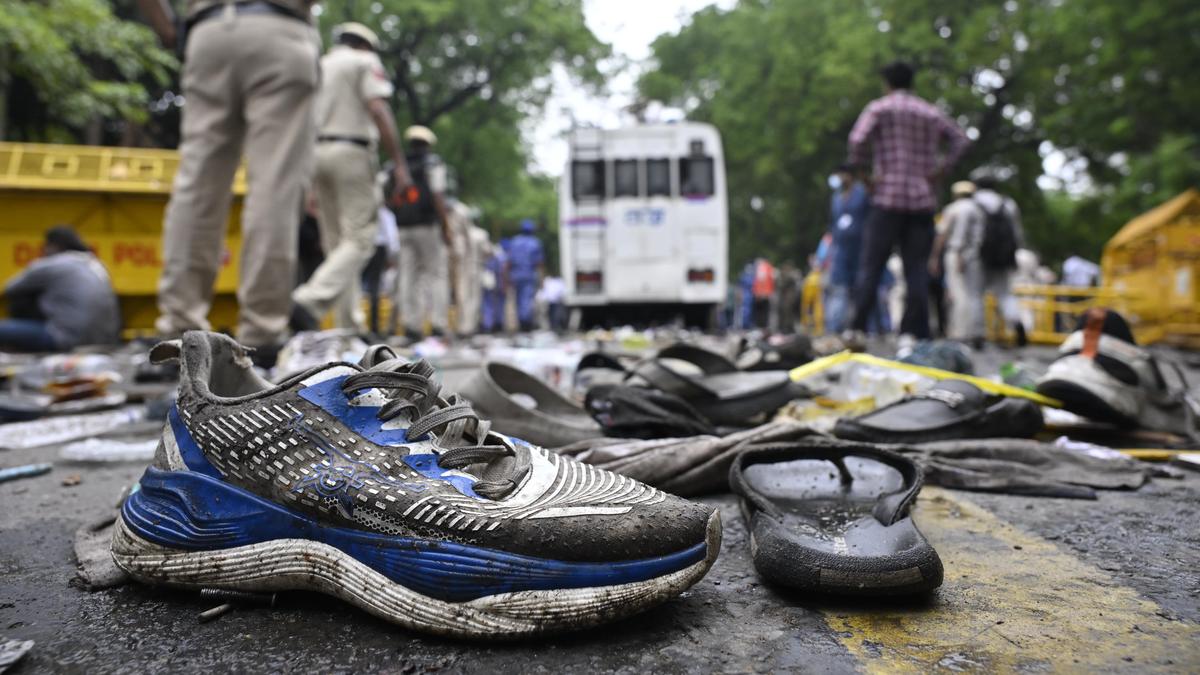
Scene after supporters of the Cockroach Janta Party (CJP) were dispersed by the police during the protest march demanding the resignation of Education Minister Dharmendra Pradhan over alleged NEET exam irregularities, at Sansad Marg, near Parliament Street Police Station in New Delhi. | Photo Credit: Shiv Kumar Pushpakar In the first widespread communications blackout in Delhi since the farmers’ agitation in 2021, mobile internet was switched off throughout Central Delhi, even as demonstrators poured into Jantar Mantar and security forces were dispersing them with force. The shutdown impeded the flow of visuals from the area, including by media at the scene. Protesters and journalists alike resorted to nearby establishments’ WiFi hotspots.Also read | CJP protest in Delhi updates on July 20Mobile internet shutdowns are an extraordinary step in controlling unrest and are overall on the decline in the last two years. The government’s decision to shut down mobile internet till the evening drew condemnation from the Internet Freedom Foundation (IFF) and the Software Freedom Law Centre, India (SFLC).Mobile internet was also shut down for a two-hour period last Saturday (July 18, 2026) morning when activist Sonam Wangchuk was forcibly hospitalised by plainclothes police officers.An industry source told The Hindu that 150 sites across Central Delhi were ordered to have internet access cut off; the order was first issued till noon and subsequently extended till 6 p.m. “Such a measure is not only disproportionate but also strikes at the heart of the fundamental right to freedom of speech and expression, including the right to peacefully protest and to access information online, all recognized under Article 19(1)(a) of the Constitution of India,” SFLC said in a statement.IFF criticised the lack of publication of a shutdown order, required by the Telecommunications (Temporary Suspension of Services) Rules, 2024. A copy of the orders, issued by the Ministry of Home Affairs, obtained later in the day by The Hindu, cited “public safety and averting public emergency” as reasons.“Residents of the capital do not know which authority directed the shutdown, on what grounds, over which precise areas, for which services, or for what duration,” IFF added. “An unpublished order is an unaccountable order. It cannot be challenged before a court, and the judicial review guaranteed by the Supreme Court becomes illusory.”The shutdown lasted until 6pm, significantly deferring videos of the crackdown on protesters. Civil society groups have long criticised internet shutdowns for concealing human rights violations while they are happening. Shutdowns contribute “to the propagation of misinformation without any means for verification and hinders the accountability process for human rights violations,” IFF had said in 2023.Internet shutdowns have been trending downwards since 2021, at least by the number of distinct shutdowns ordered. 100 shutdowns were ordered in 2021, and 54 last year, according to SFLC’s internet shutdowns tracker. Including Monday’s (July 20, 2026) shutdown in Delhi, the number of shutdowns in India so far stands at 24 this year. Published - July 20, 2026 09:50 pm IST
Mobile net shutdown slows dissemination of visuals from central Delhi protest
Full Article
Original Source
Read the full article at Thehindu →KhanList aggregates and links to publicly available news content. We do not host full articles from third-party sources. Always verify important information with original sources.