
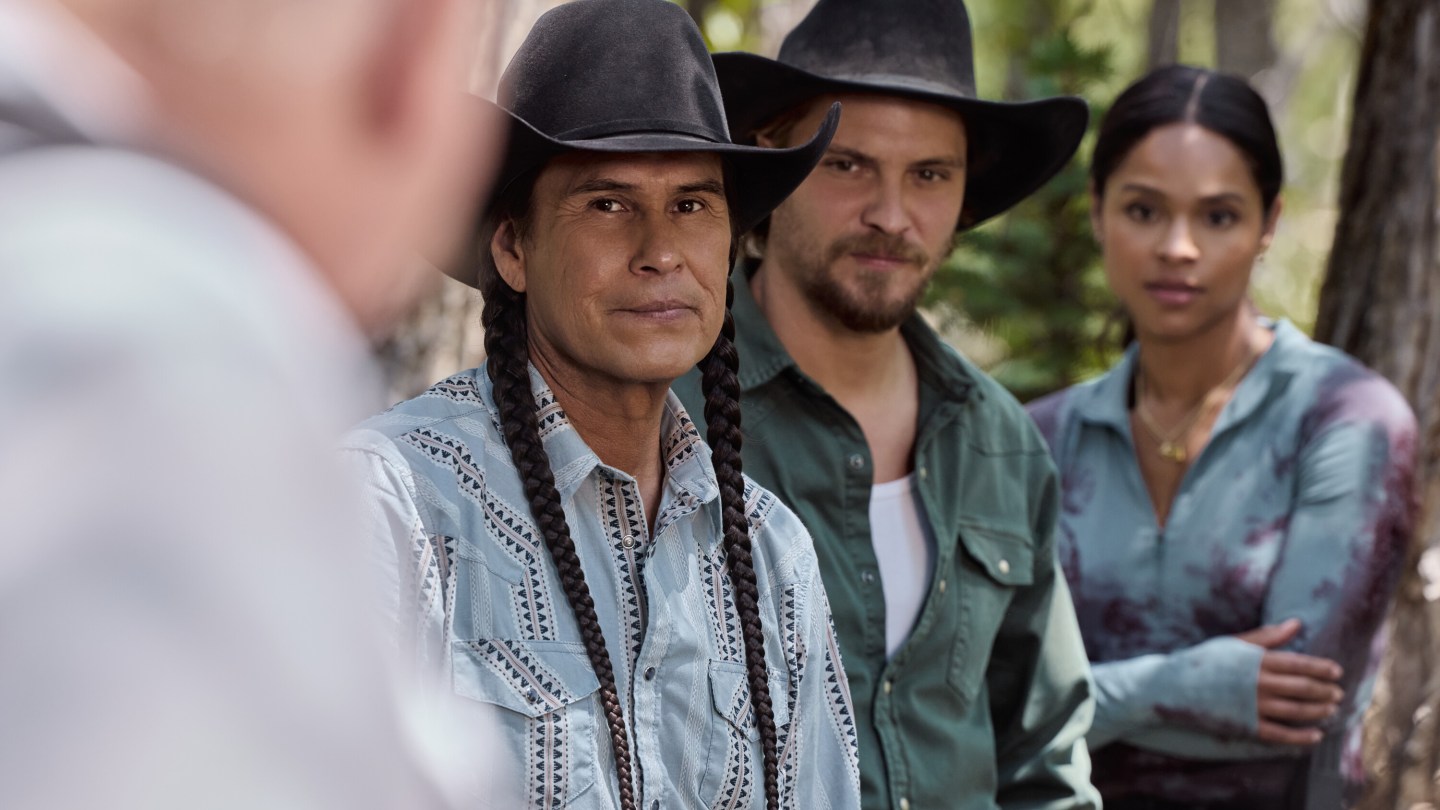
Logo text Mo Brings Plenty, his family and community have been rocked by the untimely death of Mo’s nephew, 1923 actor Cole Brings Plenty. The 27-year-old was found dead in April 2024 after he had been reported missing. His death came between seasons one and two of the Yellowstone prequel, sparking his recasting (with Jeremy Gauna), a final season that honored his memory and now, an entire episode of Marshals inspired by what happened. In Sunday’s episode of Yellowstone‘s hit CBS spinoff following Kayce Dutton (Luke Grimes), titled “Roughstock,” Mo, an enrolled member of the Lakota Nations who plays the right-hand man to Broken Rock Tribe chief Thomas Rainwater (Gil Birmingham) in both Yellowstone and Marshals, searches on horseback with Kayce (Grimes) for Mo’s missing nephew (played by Will Strongheart), only to eventually find him dead, and a police department refusing to investigate the death. The storyline is ripped from what Mo believes happened to his real nephew. In Cole’s case, the Lawrence Police Department in Kansas found no foul play involved, ruling that Cole acted alone and took his own life. Mo hasn’t stopped pushing a different narrative ever since. “For his murder to go uninvestigated, and for it to be written off as ‘no foul play,’ because they didn’t want to invest anything into it? It’s heartbreaking,” he had told The Hollywood Reporter back in March. “We’re not letting it go.” Now that the episode has aired, Mo, who also works behind the scenes as the show’s American Indian Affairs coordinator, talks again with THR below about the bravery of the Paramount Taylor Sheridan series and Marshals showrunner Spencer Hudnut to spotlight Cole’s story on television, the emotions around reliving the tragedy of his nephew’s death, and the justice he hopes the episode can help bring to murdered and missing Indigenous people. “This is for the injustice that occurs to American Indian people and the victims who are truly victims, who are being being labeled otherwise and not being taken seriously,” he says. *** This must be heavy for you, so thank you for speaking with me about the making of this episode inspired by your late nephew. Did you approach (showrunner) Spencer Hudnut about doing this, or did Spencer approach you? It all began when my brother, Joe, Cole’s father, and I were sharing the experience of what we were going through. Spencer mentioned something about it being up to us. Saying, “I know it’s gonna be deep, and it’s hard. But it’s up to you.” We said, we have to do it. Not just for the sake of remembrance or in honoring Cole, but for all the other cases, all the other families whose cases of their loved ones not being looked at or being taken seriously and just thrown away. It was very important. And I knew it was going to be doable because the cast and crew are an amazing group of people. They all understood and had the knowledge of what we’ve experienced and gone through. Did you have to pitch this to the studio or network to get them on board? I think that was on Spencer. Mad respect for Spencer; even doing so, is very important. Did you talk to Taylor Sheridan about how to handle putting this storyline into the show? No. I knew exactly what I wanted to do. My biggest thing was that I wanted to relay the true emotions and spirit of it all, even the frustrating moments. Because it’s a roller coaster ride, and it still is today. It’s still fresh in our minds, my family’s minds, especially my brother Joel. He struggled. It was truly, truly a great loss for us. Spencer wrote this episode. Did you collaborate? Yes, he wrote it, and Spencer and the writing team are a great group of amazing, beautiful human beings. My brother and I went to the writers room early on, before the season even started, to spend a day with them. We talked about different things that go on within tribal councils, the political side of what goes on on a reservation, the non-political side of it and then, of course, we shared our experience of not talking about the MMIW (Missing and Murdered Indigenous Women) and MMIP (Missing and Murdered Indigenous People), but actually conveying what it’s really like to have that experience. There are hundreds and hundreds of families who have their loved ones… murdered and missing; the disappearance of loved ones just being written off as nothing. From my previous conversations with you, this episode is very close to what you believe happened to your nephew in real life. What was it like for you to film this beat by beat, playing an uncle who loses his nephew? [Note: In the end of the episode, Kayce’s team pushes for the police to investigate the death, opening up the storyline to continue.] It was about doing justice. But it was also good to have Luke Grimes there, and Gil Birmingham, and the crew; individuals who understood and knew. Will [Strongheart], who portrayed [Mo’s onscreen nephew] Troy, was very familiar. He came to Cole’s funeral; they all knew what we were going through, especially for me. So it was easy to fall back into that space, because I knew there were others who would be there to help me if I needed it. But at the forefront of my mind was the injustice that occurs to American Indian people and the victims who are truly victims who are being being labeled otherwise and not being taken seriously. Mo’s late nephew, Cole Brings Plenty, hree as Pete Plenty Clouds in the Yellowstone prequel series 1923, season one. Emerson Miller/Paramount+ This is a big platform: Marshals is a mega-hit for Paramount. You will shine a light on this happening everywhere, but do you hope it moves the needle specifically with your nephew’s case? Unfortunately, the way I see it, if a police department doesn’t want to investigate something then there’s a connection. Bottom line, hands down. Outside of that, what I hope this episode achieves is that it will drive people who are non-Native, who are unfamiliar, to go down this journey. We mentioned MMIW, MMIP, in the past — murdered and missing Indian women and people. But to actually have a storyline that will hopefully have the audience see it through Mo’s, Kayce’s, Rainwater’s eyes? Just to be able to actually see what is going on. The positive side in this story is that law enforcement actually does get involved — the marshals, but not the police. There’s a line where the sheriff said, “Ah, this happens all the time.” I’m glad Spencer included that line because that’s really, honestly, what a lot of families hear from law enforcement when when their loved ones are found. After we spoke the last time, the Lawrence Police Department responded to our interview with a statement. Did you see what they said? [“The entire case contains clear evidence that there was no foul play involved in Cole’s death and that Cole acted alone.”] Oh, yeah, of course. Out of respect for my family, I encouraged my brother, Joe, to seal the records. Little did we know that it was going to give them an out. Nonetheless, I’m hoping that this episode is going to drive people to reach out to their Congress people, their senators, their governors, and say, “Hey, look, enough. Here’s the original inhabitants of this country, and here’s our treatment to them.” But yet we speak about other nationalities in foreign countries, so we’re basically flying over mission fields to get to mission fields. We want to be the savior there, but we’re not doing it here. That’s the thing that upsets me the most, and the fact that we are tax paying people as well. First responders get their funding through tax dollars. We are forced to pay taxes, and the will of justice does not turn for us? Shame on America for that. I’m being honest. And if that’s the case, then we shouldn’t have to pay taxes. If there’s no equality and justice being served for our loved ones who are truly victimized? What occurred in Cole’s case, there were allegations. And they let go the people they should have interviewed to get the true answers. If the police department really doesn’t want to investigate, then to me, that’s every bit of proof that there’s something to hide. This episode included a ceremonial burial. You have worked behind the scenes to bring authenticity to this franchise for years as the American Indian Affairs coordinator. What did you especially want to show here as Mo was laying his nephew to rest? The sacred fire… the true celebration and understanding of life. When we look at life from a spiritual perspective, it is continuous. There is no end. So that was important, because we incorporate a lot of that understanding or tradition or ceremony into our everyday lives, whether we’re assisting a family that lost a loved one or, or even ourselves, losing relatives. The spirit is forever. One of the biggest parts of that ceremony scene was the horse. Because we’ve always had horses here in this country long before the Spanish brought theirs. The Lakota people, we have songs and ceremonies specifically for the horse that are thousands upon thousands of years old, so to have that incorporated was very important to me. To share that bit of knowledge and understanding that our people have always had, that the horse symbolizes the spiritual realm. So when Mo sees that horse, he knows his nephew made it home. Is there anything you want to say about Cole in his memory? If people truly believe there’s a higher power, then they have to stand up for what’s right. Regardless of what it is. My nephew, Cole, has always done that. He was a lover of life. He always gave a helping hand. He never judged anyone for who they were, what nationality, what their faith was. If someone needed help, he was there. And to turn that type of light out in a community, in this world… for us, he was the next one to carry on our traditions and knowledge. To strip us of that and do nothing about it? If people truly believe in a higher power, they better understand and know that it is the higher power who loves diversity. Because the higher power made it so from the very beginning. And if you can’t support that diversity here, this world, on this planet, then who are you to believe you’ll be welcome there? In Marshals, the death of Mo’s nephew sounds like an ongoing story that will open up the show to explore more reservation stories, which is something Spencer Hednut said is baked into the series. There are many stories very similar to this. Different situations and circumstances, but the outcome’s always the same. I wanted to get this message out but I had to utilize our own story, my family’s own experience. I’m hoping down the road this will give us the ability for us to be able to share more; other things that are occurring. Not always the negative things. There are positive things as well, and I want to share those too. I’m hoping people will go ahead and support stories about Indian country. Do you feel like this was a brave thing by the show, the network, the studio to allow you to tell such a personal story? I’m thankful to the network for giving us the opportunity. I’m thankful to the Spencer. I’m thankful that they’ve allowed us to be able to share this experience and bring it to light through the episodes. It does take great courage, because a lot of people don’t understand cultural diversity. They don’t fully understand that we as American Indian people are tax paying people, too. Like I said, we pay bills just like everyone else. We have to work for everything that we have. I’m thankful to the network and to Spencer and to the rest of the writers who supported the whole storyline. *** Marshals releases new episodes Sundays at 8 p.m. on CBS and Paramount+.
Mo Brings Plenty Hopes Real-Life Inspired ‘Marshals’ Episode Brings Justice to Late Nephew
Full Article
Original Source
Read the full article at Hollywoodreporter →KhanList aggregates and links to publicly available news content. We do not host full articles from third-party sources. Always verify important information with original sources.