
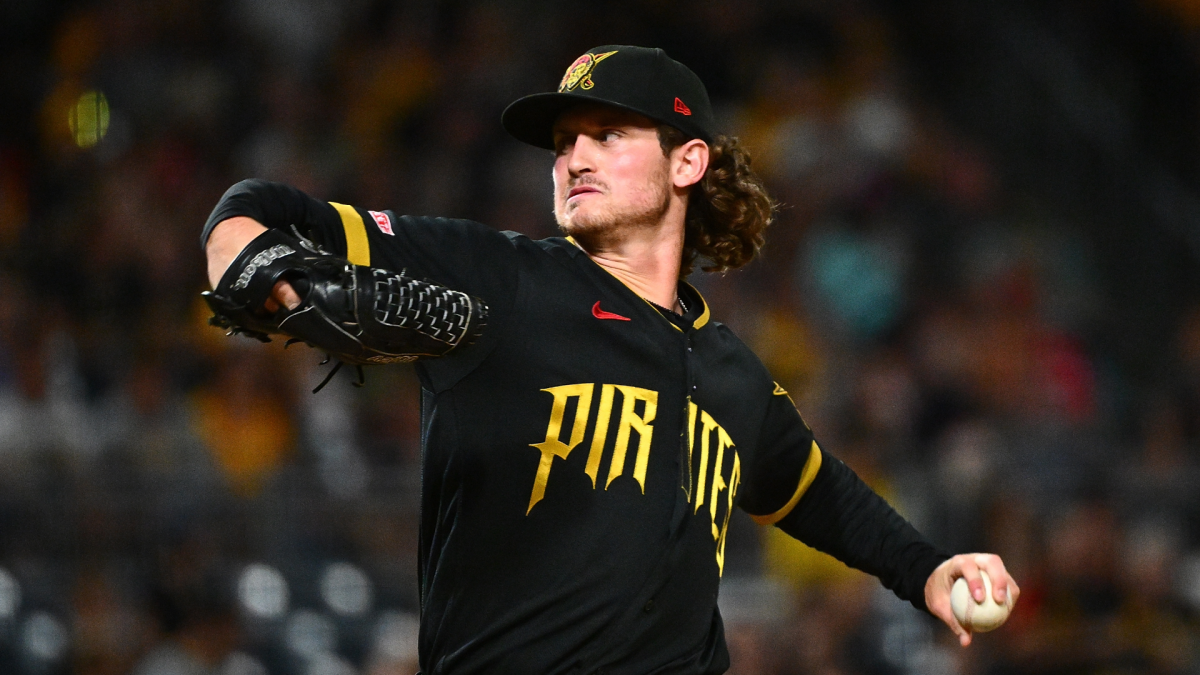
As playoff races heat up, here's what's going on around the league in September Sep 9, 2026 at 9:16 am ET • 7 min read Only two weeks and four days remain in MLB's regular season. No postseason berths have been clinched yet (though that will start happening soon) and at least four of the six division races are very much undecided. There are also the awards races. You can't call any of them yet. There is not much regular season baseball remaining but there is still plenty on the line. Here now are three trends worth keeping an eye on as the regular season winds down. The Cubs' all-world defense Most teams have an identity. The Yankees are the Bronx Bombers. They're going to home run you into submission. The Brewers are small ball short kings who will do to you the opposite of what the Yankees do to teams. The Phillies have a powerhouse rotation. The Padres have an impenetrable bullpen. Good teams have a strength and lean into it.For the Cubs, that strength is their defense, which is the best in baseball and one of the best in recent memory. Really, it's one of the best ever. Both Baseball Info Solutions' defensive runs saved (DRS) and Statcast's outs above average (OAA) have Chicago as the best defensive team in the game by an enormous margin. The numbers going into Tuesday's games: DRSOAA1. Cubs: +107 1. Cubs: +65 2. Rays: +75 2. Diamondbacks: +39 3. Red Sox: +52 3. Cardinals: +30 4. Braves: +48 4. Rangers: +19 5. Dodgers: +42 5. Dodgers: +19 The eye test and the numbers agree Pete Crow-Armstrong is the best defensive player in baseball at any position. He's a dynamo in center field. Crow-Armstrong leads all players with +25 OAA. Remove him and the Cubs are still at an MLB-leading +40 OAA as a team. The Cubs have the best defense in baseball, and then the best defensive player in baseball on top of that. Statcast's OAA data goes back to 2016 and Chicago's +65 OAA is already the best on record. DRS goes back to 2003 and the Cubs' +107 is fifth best on record, and within shouting distance of No. 1 (2018 D-backs at +126). If you prefer regular old fielding percentage, the Cubs are at .990, one stinkin' point behind several teams for the best in the Expansion Era (since 1961). The Cubs are built around their defense. It's why they signed Alex Bregman to play third, extended second baseman Nico Hoerner, and traded away several young players who don't exactly stand out with their glovework (Moisés Ballesteros, Owen Caissie, etc.). If anything, the Cubs might be leaning too far into their defense. This is a bit of a problem: TEAM STRIKEOUT RATE 30. Rockies: 17.4% 29. D-backs: 18.3% 28. Royals: 19.2% 27. Giants: 19.8% 26. Nationals: 20.1% 25. Cubs: 20.6% (MLB average: 22.1%) The Cubs have a great defense, but the best defense is not allowing a ball in play at all. Look at the teams near the Cubs on that leaderboard. Other than the D-backs, who are battling for the third wild-card spot, none will make the postseason, and if the D-backs don't make it, the Cubs will be the only postseason team with a bottom 12 strikeout rate. That's not ideal. Fortunately, no team in recent memory turns batted balls into outs as well as the Cubs, and there is a domino effect to a great defense. It's more outs and fewer baserunners, first and foremost, plus it's also fewer (stressful) pitches for your pitchers, less work for the bullpen, etc. The Cubs could use more strikeouts, no doubt. It's almost impossible to be better defensively though. "Just as a whole group now in 2026, it's almost unique in the way it's so good from every position," shortstop Dansby Swanson told MLB.com about the team's defense last month. "... We have a lot of great individual defenders, but collectively as a group, we've played great defense, whether it's positioning, throwing to the right bases, turning double plays, knocking balls down to keep runs from scoring. There's more than just what's in the stats." Mason Montgomery's rise into bullpen ace Barring a miracle, the Pirates are going to miss the playoffs for the 11th straight season, which is a letdown after an active offseason (Brandon Lowe, Ryan O'Hearn) and busy trade deadline (Lake Bachar, Camilo Doval, Luke Weaver). The good news is that, other than Lowe, just about everyone they've brought in this year will remain with the team next year. That includes lefty Mason Montgomery, who came over with Lowe (and Jake Mangum) in a three-team trade that sent Mike Burrows to the Astros and prospects to the Rays. Since July 1, Montgomery has been the best reliever in baseball by FanGraphs WAR: Mason Montgomery: 1.4 WARJosh Hader: 1.4 WARBrent Headrick: 1.3 WARMason Miller: 1.2 WARTanner Scott: 1.1 WARSince July 1, Montgomery has allowed two runs (both in the same game) in 27 innings spanning 28 appearances. He's struck out 46 of the 100 batters he's faced in those 28 appearances while walking only five unintentionally. It's about as dominant a stretch as any reliever other than Miller will have this season. July 1 is not a cherry-picked date. It coincides with Montgomery more or less shelving his four-seam fastball and replacing it with a new sinker. Like his four-seamer, the sinker resides in the upper 90s (it's maxed out at 101.5 mph), and Montgomery has had more success landing the sinker for strikes than he did his four-seamer. He is bullying hitters with this new pitch: Montgomery's sinkerMLB sinker averageSwing-and-miss rate 36.2% 13.6% Barrel rate (what's this?) 4.5% 6.2% Slugging percentage .219 .413 Hitters whiff almost three times as often against Montgomery's sinker as they do the average sinker, and when they do put his sinker in play, they do nothing with it. They don't hit it hard and they don't slug. Montgomery's sinker is one of the most dominant pitches in the sport and he didn't begin throwing it with any regularity until the calendar flipped to July. "Mentally, I feel good about throwing it," Montgomery told MLB.com last month. Pitching coach Billy Murphy added: "When you have someone who throws that hard, the big goal is to get in the strike zone. We thought that the pitch would just be something that he could throw naturally, and that's exactly what it has done. I think it's just freed him up." Montgomery's potential has always been obvious (he was one of our breakout picks last year). He throws very hard, he gets right on top of hitters with seven feet of extension, and his release point is lower than you'd expect for a pitcher his size (6-foot-2) and with that much extension. It's power stuff with a bit of an unusual look, and it's usually only a matter of time until those guys find success. In Montgomery's case, he needed a new pitch to unlock the next level of performance. The sinker is his go-to pitch now. He throws it roughly 60% of the time now after not having it all in June. Lowe's 29 homers have made the trade a big win for the Pirates. Montgomery turning into a high-leverage relief ace has made it a slam dunk, especially since the Pirates control him through 2030. Andrew Fischer pursuing minor-league home run history The Brewers have baseball's best record and also one of the best farm systems in the game. Both Baseball America and MLB Pipeline ranked Milwaukee's system the third best in baseball after the trade deadline, meaning even after the Brewers parted with several prospects to acquire Dustin May, Bo Naylor, JoJo Romero, and Antonio Senzatela. Third baseman Andrew Fischer is not Milwaukee's best prospect (that's Jesús Made) or even their second-best prospect (that's Luis Peña), but the No. 20 overall pick in last year's draft is having one of the greatest power-hitting seasons in minor league baseball history. Fischer went into play Tuesday with 46 -- 46! -- home runs, easily the most in the minors. Here are the minor league home run leaders: LevelsPAHRAndrew Fischer, Brewers High-A, Double-A 531 46 Lazaro Montes, Mariners Double-A, Triple-A 542 38 Jesús Báez, Cardinals High-A, Double-A 478 37 Easton Shelton, Dodgers Low-A 486 37 Caleb Bonemer, White Sox High-A, Double-A 569 36 Fischer's 46 homers are the most by a minor leaguer since Ryan Howard hit 46 in 2004. Minor-league record-keeping is spotty prior to the Draft Era (since 1965), but only three players on record have hit 50 homers in a minor-league season: Bill McNulty (55 in 1974), Gorman Thomas (51 in 1974), and Ron Kittle (50 in 1982). Thomas and Kittle had long and productive MLB careers. The Double-A regular season ends this coming weekend, giving Fischer just a few more days to join the 50-homers-in-the-minors club. The Brewers could promote him to Triple-A and extend his season (the Triple-A season ends next weekend), but Milwaukee's Double-A team is going to the postseason. They may want Fischer in Double-A for the playoffs rather than to promote him. It should be noted that offense is way up in the minors. Baseball America dug into this recently and found that the minor-league baseball, which is machine-stitched (unlike the MLB ball) and used at Double-A and below, is flying compared to previous years. There's no conspiracy here. MLB isn't juicing offense in the low minors. The minor-league ball has definitely boosted offense, though. The minor-league ball has boosted Fischer's home run total, yes, but he's the only player in the minors threatening 50 homers. Even adjusting for this hitting environment, Fischer stands out as the top power hitter in the bush leagues and one of the best ever. This isn't out of nowhere either. Power was his calling card as a prospect at Tennessee, and it's playing in pro ball.
MLB trends: The Cubs capitalize, a Pirates ace emerges and a Brewers prospect chases history
Full Article
Original Source
Read the full article at Cbssports →KhanList aggregates and links to publicly available news content. We do not host full articles from third-party sources. Always verify important information with original sources.