
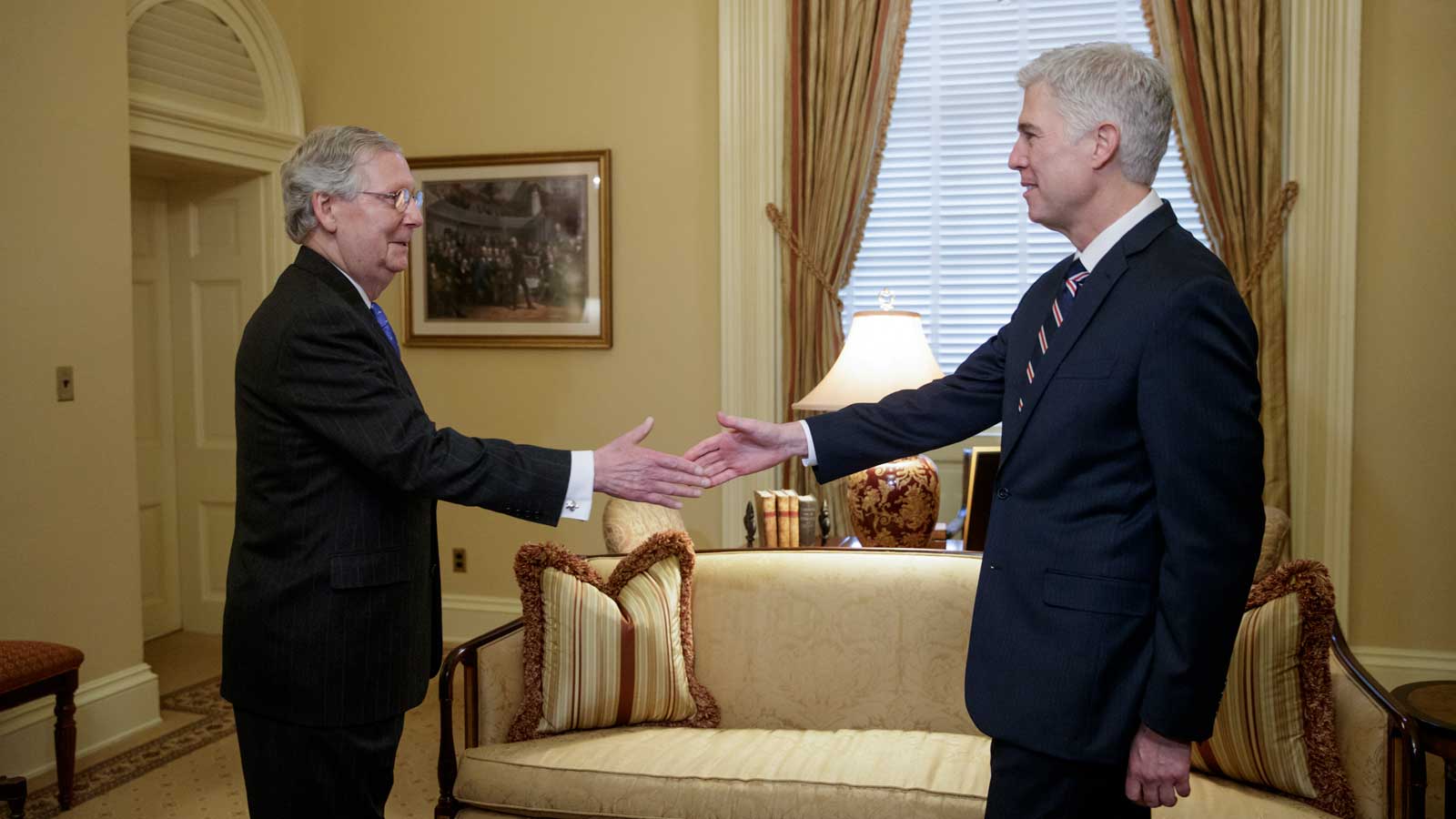
Outgoing Sen. Mitch McConnell was one of the most powerful figures ever to walk the halls of the U.S. Congress and was instrumental in steering the country’s climate policy. At virtually every opportunity, he chose to block efforts to address the problem. McConnell, a Republican from Kentucky, did not seek reelection and is set to retire from the Senate in January. At that point, he will have been the 10th-longest-serving senator in U.S. history. He was also the longest-serving Senate party leader in history. During his tenure, McConnell exerted his power to halt or overturn climate action in Congress, at the Supreme Court, and in the White House. Over a decades-long career, he joined a short list of individuals most responsible for stymying political efforts to address climate change. A Senate leader’s war against the president Over his 40-year tenure in the Senate, McConnell received over $4 million in donations from the oil and gas and coal industries – the fifth-most of any senator. He was chosen as the leader of Senate Republicans in 2007, shortly before President Barack Obama, a Democrat, won office with a 60-member filibuster-proof Senate majority and a Democratic-controlled House. At the time, observers thought it possible that Congress would pass bipartisan legislation to combat climate change. In 2008, Democratic House leader Nancy Pelosi and former Republican House leader Newt Gingrich had created an ad together in which Gingrich said, “We do agree: Our country must take action to address climate change.” The House soon passed a carbon cap-and-trade bill designed to tackle climate pollution. Eight Republicans voted in favor. But the Democrats were never able to put their filibuster-proof majority to work on climate legislation. Their majority was thinned by election recounts, legal challenges, member illnesses, the death of Democrat Robert Byrd, and a lost special election in January 2010. What’s more, several Senate Democrats did not support the cap-and-trade bill, so climate advocates needed support from perhaps half a dozen Senate Republicans. Some Republicans, most prominently the late Sen. Lindsey Graham, worked on a version of the cap-and-trade bill. But rather than support the legislation, McConnell had decided instead to declare war on Obama’s entire agenda, as reporter Ryan Lizza documented in a 2010 article. By working on a climate bill, Republican senators risked angering McConnell. The cap-and-trade bill died a quiet death, never having received a vote in the Senate. In 2019, McConnell acknowledged the reality of human-caused climate change. At the time, he said he preferred to solve the problem through technology and innovation. Yet he opposed legislation that climate advocates and researchers said would spur technological innovation, such as a price on carbon pollution and clean energy tax credits. The Senate finally passed sweeping climate legislation in 2022, when Democrats enacted the Inflation Reduction Act. McConnell vehemently opposed the bill. In 2025, McConnell helped to repeal many provisions of the Inflation Reduction Act when he supported the One Big Beautiful Bill Act, which passed the Senate by a single vote. McConnell’s conservative Supreme Court The senator expressed pride in his influence over the Supreme Court. Notably, he blocked Obama’s nomination of moderate Merrick Garland in 2016 to replace Justice Antonin Scalia. In a move that broke with norms and historical precedent, McConnell refused to allow the chamber to consider or vote on Garland’s nomination. “The most important decision I’ve made in my entire political career was not to fill the Supreme Court vacancy when Justice Scalia passed away,” McConnell recalled in 2024. Soon after taking office in January 2017, Trump nominated the conservative Neil Gorsuch to the court, and the Republican-controlled Senate approved him. The Senate under McConnell also approved the 2018 nomination of conservative Brett Kavanaugh and the 2020 nomination of conservative Amy Coney Barrett. The now right-wing court has consistently issued rulings that undermine climate and other environmental regulations. In the 2022 case West Virginia v. EPA, the court issued a 6-3 decision – with the three new conservative justices in the majority – ruling against the Obama administration’s 2016 Clean Power Plan to regulate climate pollution from power plants. They did so even though the proposed rule never went into effect and by then had already been repealed under the first Trump administration. In that case, the court also formalized what it called the “major questions doctrine,” which prohibits federal agencies from issuing new regulations that will have major economic or political influence unless Congress has specifically and explicitly delegated that authority. In the 2024 case Loper Bright Enterprises v. Raimondo, in another 6-3 partisan split, the court overturned the 40-year-old Chevron doctrine, a principle that federal judges should defer to a government agency’s reasonable interpretation of an ambiguous Congressional statute. Both decisions could enable the Supreme Court to block federal climate regulations in the future. A crucial vote to acquit In January 2021, the senator had an opportunity to prevent a second Trump administration. He chose not to take it. The House of Representatives had impeached Trump for inciting an insurrection at the Capitol a week earlier. “There’s no question that President Trump is practically and morally responsible for provoking the events of the day,” McConnell said at the time. But he declined to whip his caucus to remove Trump. Instead, McConnell and 42 other Republican senators voted to acquit him. Had Trump been impeached, he would have been constitutionally barred from ever again holding office. Instead, he was elected to a second term in 2024 and has presided over the most anti-climate-policy administration in U.S. history, which has included withdrawing from the Paris climate agreement for the second time and repealing virtually all federal climate policies. It proved to be a fitting capstone to McConnell’s lengthy career of sabotaging climate policy at every level of government. Republish our articles for free, online or in print, under a Creative Commons license.
Mitch McConnell’s climate legacy
Full Article
Original Source
Read the full article at Yaleclimateconnections →KhanList aggregates and links to publicly available news content. We do not host full articles from third-party sources. Always verify important information with original sources.