
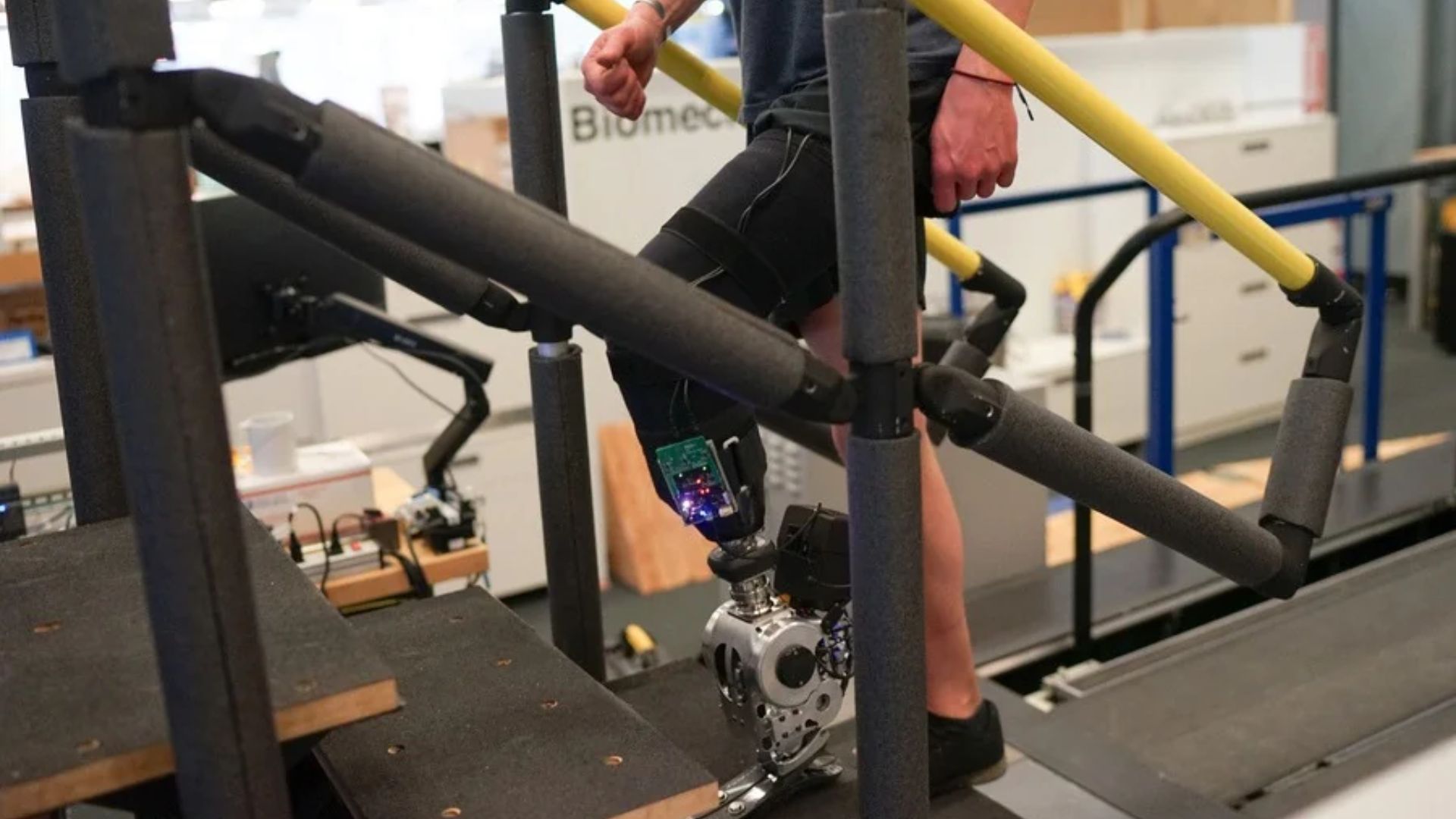
Researchers at the Massachusetts Institute of Technology (MIT) have shown a way to track muscle movements with tiny implanted magnets, potentially helping amputees control robotic prosthetic limbs more naturally. Tested on three below-knee amputees, this technique could overcome the limitations of current muscle-signal systems. The approach, called magnetomicrometry, measures changes in the distance between magnetic beads implanted in muscles. The researchers say these measurements provide more accurate and stable information about muscle movement than conventional surface electrodes. The findings, published in Nature Sensors, build on years of work developing interfaces that allow prosthetic devices to respond more like natural limbs. MIT’s system tracks muscle movement to guide prosthetic control. Credit: MIT Tracking muscle movement with magnets Most current muscle-controlled prosthetic systems use electromyography (EMG), which measures electrical activity associated with muscle contraction. Electrodes placed on the skin detect these signals, which software then translates into commands for a robotic limb. However, electrical activity does not directly reveal a muscle’s mechanical behavior, including its length, movement speed, and force-related properties. The signals can also become less reliable when muscles remain contracted, when sweat interferes with electrodes, or when sensors pick up activity from neighboring muscles. MIT’s magnet-based approach aims to overcome these limitations by measuring muscle movement directly. Researchers implant pairs of tiny magnets into a muscle and position external sensors over the skin. When the muscle contracts or stretches, the distance between the magnets changes. The system tracks these changes to calculate muscle length and velocity, enabling the prosthetic controller to direct limb movement. The magnets measure about 3 millimeters in diameter and are made from an alloy of neodymium, iron, and boron. They are coated with gold and parylene C, a polymer that improves biocompatibility. According to the researchers, the magnetic signals can be detected through tissue at depths of up to 6 centimeters. Testing the system in people with amputations The team tested the technique in three participants with below-knee amputations who had undergone an agonist-antagonist myoneural interface (AMI) procedure. This surgical approach reconnects opposing muscle groups so they can continue communicating dynamically within the residual limb. That connection helps preserve proprioception, the body’s ability to sense the position and movement of its limbs. Maintaining this feedback can help users control prosthetic devices more precisely. The participants received magnetic implants in up to four muscles associated with ankle movement. Researchers then compared magnetomicrometry with two established measurement methods: muscle-implanted electrodes and skin-surface electrodes. During the experiments, participants used their muscle movements to control a cursor on a screen. The researchers translated the signals from each measurement system into control commands, allowing them to compare how accurately and consistently the different interfaces supported the task. The experiments did not involve participants walking with a magnetically controlled prosthetic limb, however. Instead, the cursor task served as a test of the underlying control interface. Toward more natural prosthetic movement The work builds on earlier research by the MIT team, which demonstrated magnetomicrometry in animal models in 2021. The researchers have also developed prosthetic systems using implanted electrodes, including a robotic knee designed to improve control through more direct measurements of muscle activity. The magnetic approach could offer a less invasive alternative to implanting electrodes. Its potential applications include robotic ankle-foot prostheses that respond more naturally to the wearer’s intended movements. The researchers are now conducting a larger study to evaluate how effectively people can control prosthetic limbs using magnetic measurements. Further testing will be needed to establish the system’s safety, durability, and performance during everyday activities. If those studies prove successful, magnetomicrometry could help bridge the gap between the movements a person intends to make and the movements their prosthetic limb can reliably perform.Get the latest in engineering, tech, space & science - delivered daily to your inbox.Kaif Shaikh is a journalist and writer passionate about turning complex information into clear, impactful stories. His writing covers technology, sustainability, geopolitics, and occasionally fiction. A graduate in Journalism and Mass Communication, his work has appeared in the Times of India and beyond. After a near-fatal experience, Kaif began seeing both stories and silences differently. Outside work, he juggles far too many projects and passions, but always makes time to read, reflect, and hold onto the thread of wonder.
MIT uses tiny implanted magnets to improve control of robotic prosthetic limbs
Full Article
Original Source
Read the full article at Interestingengineering →KhanList aggregates and links to publicly available news content. We do not host full articles from third-party sources. Always verify important information with original sources.