
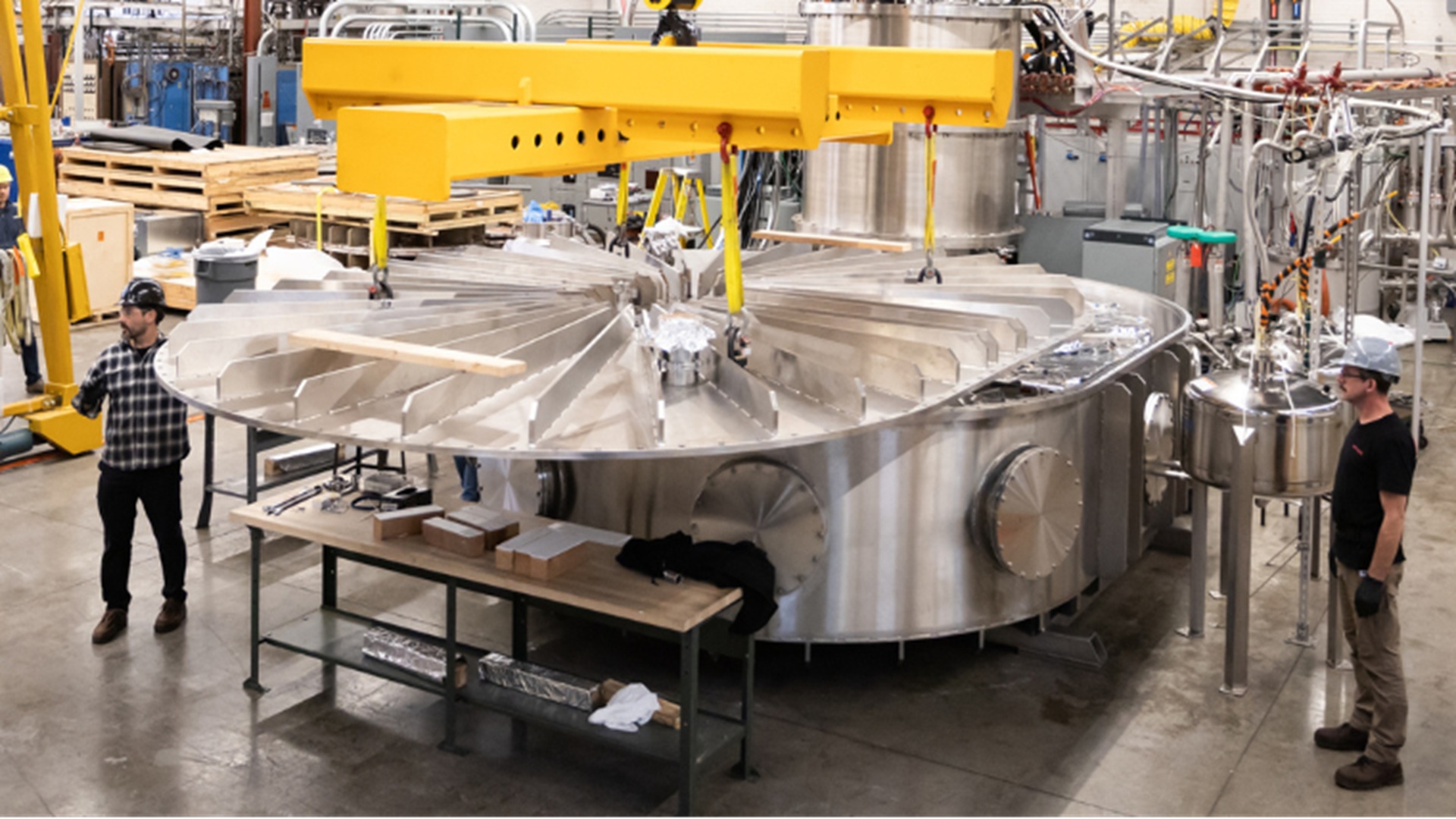
Key TakeawaysThea Energy’s Eos design uses 12 encircling coils and approximately 300 programmable shaping magnets.MIT will test an encircling coil at full magnetic field and mechanical force to assess its performance and reliability.The partners will also test the magnet’s resilience to help determine its reliability and support high plant availability.Thea Energy aims to commercialize its stellarator technology by 2035, with its Helios plant using the same planar-coil architecture. Thea Energy has partnered with the Massachusetts Institute of Technology (MIT) to test a full-scale superconducting magnet designed for its next-generation stellarator, marking another step in the company’s effort to develop a commercial fusion power plant by 2035. The collaboration will see Thea Energy and MIT’s Plasma Science and Fusion Center (PSFC) test a full-field, full-force planar encircling coil for the company’s Eos stellarator. The tests will assess whether the magnet can withstand the intense magnetic fields and mechanical forces expected during power-plant operation. The work will use MIT’s cryogenic testing facilities and its expertise in high-temperature superconducting (HTS) magnets. The partners will also examine the coil’s efficiency under power-plant-relevant conditions and develop predictive models to assess its performance. Stellarators use magnetic fields to confine superheated plasma, the electrically charged gas in which fusion reactions take place. Their magnets must maintain precise field configurations while withstanding substantial mechanical stresses. Traditional stellarator magnets have complex three-dimensional shapes, making them difficult and expensive to manufacture. Thea Energy is pursuing a different approach with a planar-coil architecture intended to simplify magnet production, construction and maintenance. Flat coils simplify construction The company’s Eos design uses 12 encircling coils alongside approximately 300 programmable shaping magnets. The encircling coils generate the magnetic field needed to confine the plasma, while the smaller shaping magnets fine-tune its configuration. The modular shaping magnets can be adjusted in strength and replaced individually to account for variations during assembly, as well as wear and tear during operation. Thea Energy says it has already built and validated these shaping coils at full scale. The encircling coil is the next major component being put through testing. Evaluating it at full magnetic field and full mechanical force is intended to establish whether the design can meet the demanding requirements of a commercial fusion system. The partners will also test the magnet’s resilience to help determine its reliability and support high plant availability. These factors are important because a commercial fusion facility would need to operate consistently rather than simply demonstrate that it can produce a fusion reaction. Testing supports commercial ambitions Thea Energy says the collaboration will help de-risk key engineering milestones on its path to commercial fusion by 2035. It follows the company’s work with national laboratories, academic institutions and industrial partners to develop its stellarator architecture. The company’s subsequent power-plant design, Helios, will use the same planar-coil approach, incorporating both encircling and shaping magnets. Thea Energy aims to use this shared architecture to reduce manufacturing complexity and make large-scale deployment more practical. The partnership also builds on a broader effort to use modelling and simulation to accelerate fusion development. Thea Energy has previously announced a collaboration involving NVIDIA, Synopsys, Argonne National Laboratory and Princeton Plasma Physics Laboratory to develop a digital twin of its Helios power plant. However, the MIT collaboration focuses on physical testing of the encircling magnet, providing data on how the component performs under demanding operating conditions. Thea Energy was spun out of Princeton University and Princeton Plasma Physics Laboratory in 2022 to commercialize its stellarator technology. Its latest collaboration with MIT aims to turn the simplified magnet architecture into a system capable of supporting a future fusion power plant.Get the latest in engineering, tech, space & science - delivered daily to your inbox.With over a decade-long career in journalism, Neetika Walter has worked with The Economic Times, ANI, and Hindustan Times, covering politics, business, technology, and the clean energy sector. Passionate about contemporary culture, books, poetry, and storytelling, she brings depth and insight to her writing. When she isn’t chasing stories, she’s likely lost in a book or enjoying the company of her dogs.
MIT tests flat superconducting magnet designed to simplify next-gen fusion reactors
Full Article
Original Source
Read the full article at Interestingengineering →KhanList aggregates and links to publicly available news content. We do not host full articles from third-party sources. Always verify important information with original sources.