
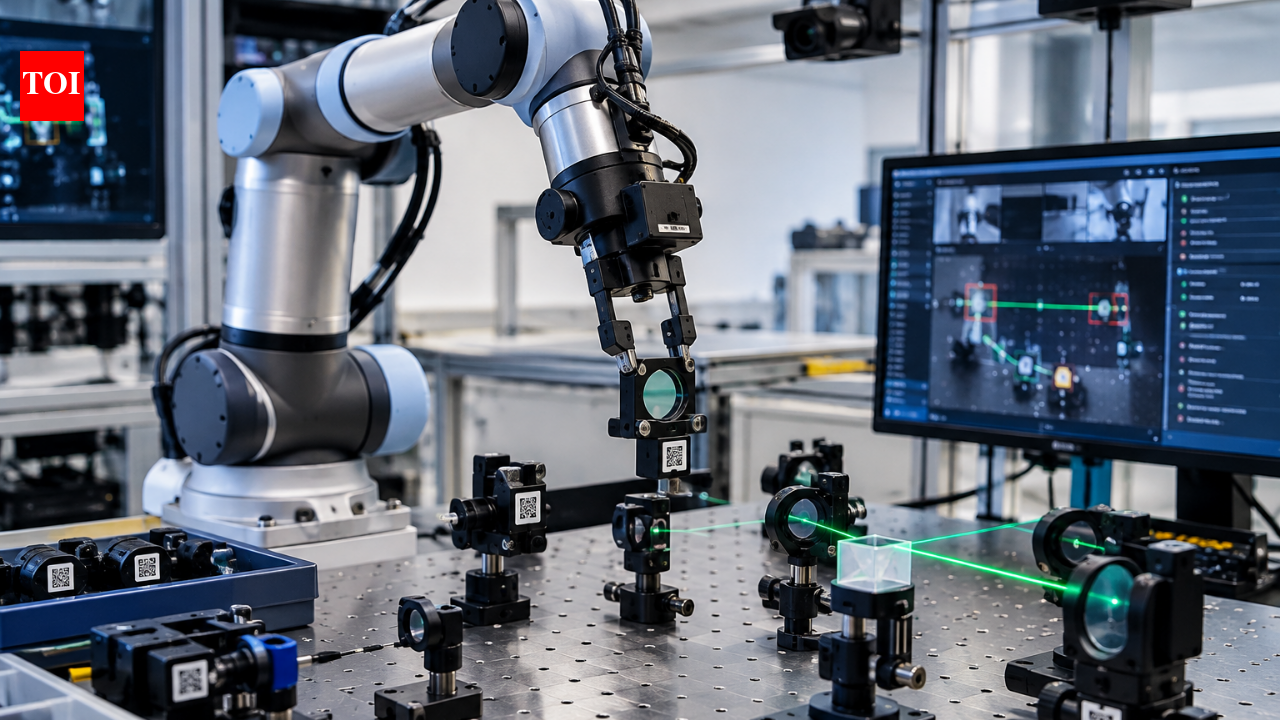
Representative Image (AI-generated)A robot has assembled a working tabletop laser cavity in less than 30 minutes, handling the precise alignment usually done manually. Massachusetts Institute of Technology's (MIT's) researchers have developed a reconfigurable robotic optics laboratory that can pick up and position mirrors, lenses and other components, fine-tune them with micron-scale precision and even correct the setup after it is disturbed. According to MIT News, the system successfully assembled a functioning tabletop laser cavity in 50 autonomous manoeuvres within 30 minutes. When researchers deliberately moved components, the robotic system automatically adjusted the setup to maintain the laser's intensity, demonstrating how an autonomous laboratory could continuously monitor and repair its own experiments.A robot takes over the painstaking part of opticsPrecision optics experiments often depend on carefully positioning lasers, mirrors, lenses and cameras. Even a small change in the angle or position of one component can affect the entire experiment, meaning researchers may have to repeatedly adjust and realign equipment.MIT's new system is designed to automate that process from beginning to end. Rather than simply controlling one motorised component, the robotic laboratory can start with optical components that are randomly placed on a tabletop, identify them, move them into position, align them and continuously fine-tune the experiment. It can also dismantle one configuration and build another. The researchers say manual optics experiments can take days or months depending on their complexity. Existing laboratories already use some automated tools, such as motorised systems for adjusting mirrors, but MIT's system combines those functions into a broader autonomous setup. Sachin Vaidya, a postdoctoral researcher at MIT's Research Laboratory of Electronics, said the team's goal was to create a system that could go from no setup to a completely aligned experiment using one automated platform. His comments were reported by MIT News.How the robotic optics lab worksAt the centre of the system is a robotic arm with seven movable joints. It operates on a metallic tabletop and handles optical components housed in specially designed 3D-printed mounts. Each housing carries a QR code containing information about the component inside, including whether it is a mirror or lens and details about its capabilities. Magnetic bases help hold the components securely once they have been placed on the tabletop. The team also developed a wireless fine-adjustment tool that attaches to standard optical mounts. The tool can turn adjustment knobs automatically, allowing the robot to change the angle of a mirror or make similarly precise corrections.Two cameras positioned above the experiment provide a bird's-eye view of the setup. Software then coordinates the different steps, including recognising components, deciding where they need to go, picking them up safely and avoiding collisions. This combination is important because optical experiments are sensitive to extremely small changes. The robot is not simply moving equipment from one location to another; it is also fine-tuning and correcting the experiment as it operates.The 50-manoeuvre laser testTo demonstrate what the system could do, the researchers chose a laser cavity, a component used in many optics experiments. A laser cavity consists of two mirrors positioned on either side of a crystal. Light travels back and forth between the mirrors and passes through the crystal, which amplifies its intensity. Eventually, enough intense light escapes from the system to form a laser. The researchers deliberately selected the laser cavity because it required substantial alignment and optical experience.The robot began with the components unassembled. It then autonomously arranged them into the required configuration and fine-tuned the system. The result was a functioning laser cavity after 50 manoeuvres in less than 30 minutes. That demonstration also showed another capability that could be important for future autonomous laboratories: recovery after disruption.It can correct itself after being disturbedOnce the laser cavity was operating, the researchers deliberately introduced physical disturbances, including randomly moving a component on the tabletop. Instead of requiring a person to inspect the system and manually restore the alignment, the robot detected the change and automatically adjusted the components to maintain the laser's intensity.That self-correction could be particularly useful because optics experiments can be affected by seemingly minor environmental changes. Vibrations or temperature variations can gradually shift components enough to degrade measurements. Vaidya told MIT News that an autonomous system could continuously monitor an experiment and repair its alignment before valuable data is lost.From laboratory experiment to remote scienceMIT researchers envision the system eventually becoming part of a much larger automated research environment. They are developing a cloud-based application that could allow researchers to interact with physical robotic optics laboratories remotely. In the envisioned system, a scientist could submit an experimental protocol or query online, with the robotic laboratory physically assembling and running the requested experiment.The researchers also envision automated systems that could fetch components from a nearby library, deliver them to the optics robot and allow the laboratory to repeatedly build, operate and dismantle different experiments. As MIT News reported, Marin Soljacic, MIT's Cecil and Ida Green Professor of Physics, said such robots could operate continuously without becoming tired or bored, potentially freeing researchers to spend more time developing theories and pursuing new ideas.Potential uses beyond lasersThe technology could eventually be useful far beyond a single laser demonstration. MIT researchers say autonomous optics laboratories could help accelerate testing involving cameras, displays, solar cells and augmented or virtual-reality devices. The team is already applying the robotic lab to research carbon-capture materials. By exposing these materials to light with specific properties, researchers can study how they absorb carbon dioxide. The broader idea is to turn optics from a largely hands-on laboratory process into something that can be assembled, monitored, adjusted and repeated automatically.For now, the MIT system remains a research demonstration, but its 50-manoeuvre laser experiment shows how robotic precision could change the way delicate optical experiments are performed. Instead of spending hours repeatedly adjusting mirrors and lenses, researchers could increasingly leave the alignment, monitoring and even recovery to machines.
MIT robot built a working laser cavity in under 30 minutes
Full Article
Original Source
Read the full article at Timesofindia →KhanList aggregates and links to publicly available news content. We do not host full articles from third-party sources. Always verify important information with original sources.