
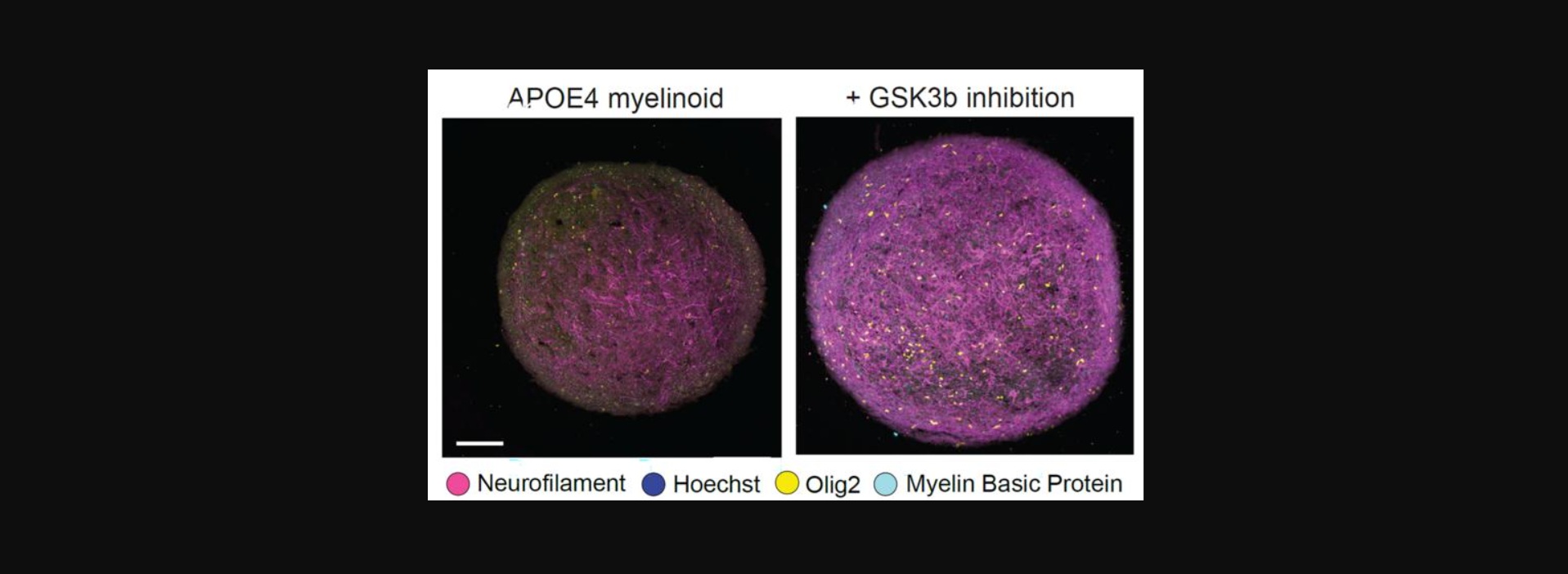
Experiments in human cells and mice suggest that restoring a disrupted molecular pathway could help reverse Alzheimer’s damage.(CN) — The most significant genetic risk factor for late-onset Alzheimer’s disease may interfere with the brain’s ability to insulate nerve cells, but researchers say restoring a molecular signaling pathway could help reverse the damage.In a study published Thursday in Cell Stem Cell, researchers at the Massachusetts Institute of Technology found that the APOE4 gene variant suppresses Wnt signaling in oligodendrocytes, cells that produce myelin, a fatty substance that insulates neurons and helps electrical signals travel efficiently through the brain.When Wnt signaling is disrupted, oligodendrocytes accumulate lipid droplets rather than properly using fats to build myelin, the researchers found. The resulting impairment in myelination can interfere with brain circuit function.The team, led by MIT neuroscientist Li-Huei Tsai, used CRISPR gene editing to screen protein-coding genes in human oligodendrocyte cultures carrying APOE4. They also analyzed human brain tissue collected after death and compared the results with samples carrying APOE3, a more neutral variant.Both approaches pointed to impaired Wnt signaling. Further experiments showed that APOE4-carrying oligodendrocytes had lower levels of beta-catenin, a protein that promotes Wnt signaling, and higher levels of GSK3b, a protein that suppresses it.The researchers then tested whether inhibiting GSK3b could restore the process. In human cell cultures, a chemical called CHIR99021 reduced lipid droplet accumulation in APOE4-carrying oligodendrocytes. Experiments using organoids containing oligodendrocytes and neurons also showed increased myelination and growth of neural axons after treatment.In mice genetically engineered to carry APOE4 and model Alzheimer’s-related tau pathology, treatment with the chemical reduced lipid droplets and increased myelination in the hippocampus, a brain region important for memory.The findings suggest that restoring Wnt signaling could be a potential avenue for future Alzheimer’s treatments. Tsai and lead author Leyla Akay said they plan to investigate further how Wnt signaling affects lipid metabolism and how GSK3b may be connected to tau phosphorylation, a hallmark of Alzheimer’s pathology.“This proof of principle of doing CRISPR screens for genetic modifiers of APOE4-associated lipid accumulation in a central nervous system cell type is very exciting,” said Tsai, who also directs MIT’s Aging Brain Initiative. “I think this type of screen not only provides new insights into cellular pathways contributing to lipid metabolism defects, but really also has the potential to provide new targets for drug development.”Categories / Health, ScienceSubscribe to our free newslettersOur weekly newsletter Closing Arguments offers the latest about ongoing trials, major litigation and rulings in courthouses around the U.S. and the world, while the monthly Under the Lights dishes the legal dirt from Hollywood, sports, Big Tech and the arts.Additional Reads
MIT discovery offers hope for future Alzheimer’s treatments
Full Article
Original Source
Read the full article at Courthousenews →KhanList aggregates and links to publicly available news content. We do not host full articles from third-party sources. Always verify important information with original sources.