
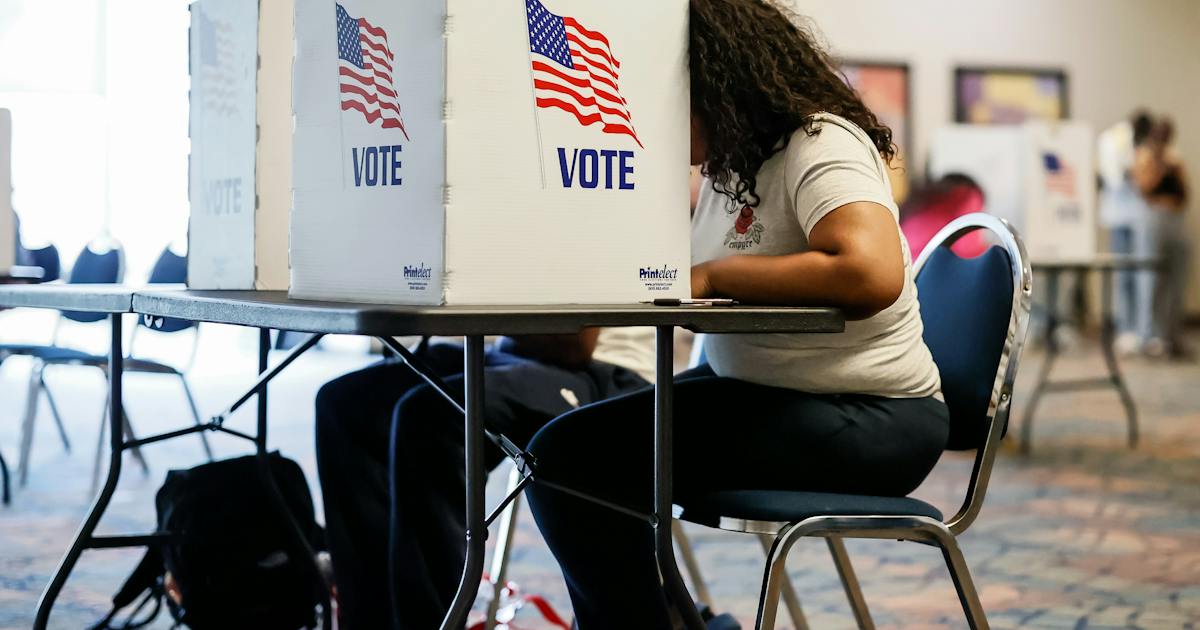
Many eligible voters were mistakenly kicked off of the rolls in Mississippi, preventing them from casting their votes normally and creating a backlog of affidavit ballots waiting to be verified and counted. That’s a large part of the reason that the U.S. is still waiting for the state’s election results in the razor-thin Senate race.Mississippi Today reports that several civil rights groups contacted Mississippi Secretary of State Michael Watson days before last week’s midterms, warning him that hundreds of thousands of voters needed to have their registrations reinstated. The voters were kicked off Mississippi’s rolls because Watson’s office sent bad data to local officials based on unverified information from credit agency Experian. On Election Day, at least tens of thousands of voters showed up at the polls to find that they couldn’t vote, because Watson’s office ignored the warnings. More than 230,000 voter registrations in Mississippi were deemed inactive by Watson, and now local election officials have to count and verify thousands of affidavit ballots, setting up a legal fight.In 2024, Watson signed a $50,000 contract with Experian to use the company’s unverified address data across the state—the first time that the state was using information outside of government data. But the data was error-ridden, and Mississippi Today discovered issues back in March, which went unaddressed.As a last-ditch effort, a coalition of civil rights groups including the NAACP Legal Defense Fund, ACLU of Mississippi, and the Southern Poverty Law Center wrote to Watson and Laura Henderson-Courtney, the senior attorney of the secretary of state’s elections division, four days before the midterms, asking Watson to reinstate anyone kicked off of the state’s voter rolls because of Experian’s data. They also asked him to tell local election workers to make sure inactive voters got affidavit ballots. The letter was ignored.“The ACLU, nor any other third party, have the authority to dictate applicable state and federal laws regarding elections in Mississippi,” Assistant Secretary of State Elizabeth Jonson told Mississippi Today in an email acknowledging that the office got the letter. “Per state law, the Statewide Election Management System (SEMS) is currently in a blackout period thus no systemic voter roll maintenance is allowed.”In a news conference on Tuesday, Scott Colom, the Democrat narrowly leading incumbent Senator Cindy Hyde-Smith in Mississippi’s Senate race, called out Watson for using the data and ignoring the warnings, including some from Experian itself. “Experian told [Watson] they were not reliable. And he did it anyway. So, I think that this chaos is a result of that decision. And it’s not me just saying it. The reporting about this has been great. Republicans and, you know, Republican counties, with election commissioners … are saying this was chaotic,” Colom said. “Our secretary of state, why did he use Experian when they told him it was unreliable?”Scott Colom slams Mississippi’s Republican Secretary of State Michael Watson for using credit agency data to remove Mississippians from the active voter rolls: “Experian told him they were not reliable. And he did it anyway. This chaos is a result of that decision.” pic.twitter.com/e6ECsKcgcK— News to Remember (@allchronology) November 11, 2026 More on election fallout:Even on Veterans Day, President Donald Trump couldn’t hide his total disrespect for U.S. military service members.Speaking at a wreath-laying ceremony at the tomb of an unknown soldier at Arlington National Cemetery Wednesday, Trump said they’d gathered to honor those whose ranks have formed a “mighty wall of flesh and blood, bravery and devotion that has defended our freedom for 250 years.”Trump refers to veterans as a “wall of flesh” at a Veterans Day memorial event pic.twitter.com/KxCdermClc— Headquarters (@HQNewsNow) November 11, 2026 It’s not typically considered appropriate, empathetic, or even humane for anyone, let alone the commander in chief of the U.S. military, to refer to his soldiers as a “wall of flesh.” They also don’t typically use their honorary addresses to make pointed political overtures against individuals who might “hurt or damage our country with bad, foolish, horrible ideology.”It’s no secret that Trump doesn’t respect the troops. He regularly downplays how many U.S. service members have lost their lives as a result of his eight-months-long “six week war” against Iran, even calling the conflict “small potatoes” compared to wars with many more casualties.Trump is no friend to veterans, either. His administration has gutted thousands of employees from the Veterans Administration, leaving our nation’s veterans struggling to access essential care. And, of course, who can forget when he called dead soldiers “losers” and “suckers”?Immigration and Customs Enforcement officials deliberately kept certain detainees out of a public database to make them harder to find.The New York Times reports that tens of thousands of people with final deportation orders have been hidden from the database since September, confirming earlier media reports. This policy change has made it almost impossible for lawyers and family members to find their loved ones’ locations, and ICE’s contractors were given a script to use on callers informing them that the detainees’ locations were no longer available.ICE’s detention system encompasses over 300 facilities and was already chaotic before the change. Detained immigrants are quickly sent from one facility to another, and if their lawyers don’t know where they are, legal help is severely hindered. It’s a boon to the Trump administration’s efforts to deport large numbers of immigrants quickly without the obstacles of habeas petitions and other forms of due process.If lawyers know where their clients are being held, they can fight their deportation orders and try to secure their release. But those options are almost wiped out after a person is deported, and if they’re missing from ICE’s system, they are almost doomed. Detainees could also be prevented from making phone calls or buying essential personal items like toiletries because someone on the outside can’t deposit money into their commissary account without knowing which facility they’re in.One immigrant that the Times highlights is University of San Francisco nurse and professor Ann Lawani, who was detained in her pajamas from her home in Lodi, California, on September 16. Even after calling her family from a holding facility that day, her attorney and siblings still couldn’t figure out where she was.“It was the worst time of my life, knowing she had been siphoned into an abyss and there was nothing I could do about it,” her brother, U.S. citizen Sam Lawani, told the Times.When her lawyer, Natalia Vieira Santanna, tried to file a habeas petition, she did so in California, Lawani’s last known location. But DHS tried to get her petition transferred to Louisiana, where they had moved her, which would have restarted Lawani’s case and required a new lawyer. Vieira opposed that effort, pointing out that Lawani’s location was kept secret, and the judge in the case agreed, finding that “no diligent attorney could have known” where Lawani was.The judge also blocked the federal government from deporting Lawani while her habeas petition was in progress, and ordered officials to explain why she shouldn’t be released. While she is in the country right now, Lawani’s location still isn’t in the public database, and other detainees have not been fortunate enough to have her resources and support. The Immigration and Customs Enforcement agent who fatally shot a Colombian man in Maine earlier this year had a history of making vehemently racist remarks.Four years before he joined ICE, David Brouillette ranted against his sister over her relationship with a 37-year-old Colombian Ph.D. student, with whom she had two children. “He can takes his non citizen ass back to his country and enjoy his third world luxuries,” Brouillette wrote in a 2021 email thread, which was shared with The New York Times by his sister, Elizabeth Emen. The emails were sent to Emen and other family members, and were confirmed by a friend whom Emen discussed the messages with and a family representative. “David had no basis for saying that my partner was undocumented,” Emen, a licensed therapist in Maryland, told the Times. “It was about how he saw him based on his race.”Johan Sebastián Durán Guerrero, age 25, who was shot and killed by Brouillette during a traffic stop in July, was in the United States legally, like Emen’s partner. ICE quietly admitted that it had a warrant for a different person and that Guerrero was never a target.In the emails, Brouillette claimed that his sister’s boyfriend’s “bloodline knows nothing about what it takes to earn and then CHERISH the freedom America offers.”“He does not emulate what it means to be an American” but “rather he emulates what it’s like to be entitled and think he has a seat” at a table “that has no room for his (or your ignorance),” Brouillette wrote.Brouillette’s family said that he never attempted to hide his sentiments about immigrants. His relatives previously revealed that he had a history of violent and abusive behavior, including attacks on the women and girls in his life. But after President Donald Trump’s sweeping mandate to increase the number of deportations, ICE relaxed its vetting process in order to enlist thousands of new so-called “homeland defenders,” which allowed many unqualified candidates—even some with criminal records—to join the federal agency’s ranks.“He is dangerous and should not have weapons,” Susan Bedard, Brouillette’s mother, told the Times. “Believe his victims, not him.”Secretary of State Marco Rubio has been going to college football games on the taxpayer’s dime.The Washington Post reports that Rubio almost never misses a University of Florida Gators football game, as his son Anthony is a walk-on running back for the team. Since taking office in 2025, Rubio has flown to at least 10 football games on government planes, including a military C-37 jet earlier this month, landing at Gainesville Regional Airport in the Sunshine State before being met by security officers in unmarked SUVs. Anthony Rubio, a senior, has only played in four games in four years.The elder Rubio, a UF alumnus, traveled to Gainesville’s airport on government aircraft at least 23 times as a Cabinet official, 15 of which the State Department classified as solely personal. The flights have cost taxpayers more than $1.2 million, according to a Post review of the Defense Department’s published costs. Former department officials told the newspaper that Rubio takes personal trips much more often than previous secretaries of state.Rubio is barred from taking commercial flights in his position for security reasons, just like the defense secretary, attorney general, and heads of the CIA and FBI. He is required to reimburse the government the cost of an economy-class plane ticket for every personal trip he takes. Those reimbursements are rarely made public and only cover a small part of the true cost of a government flight, according to the Post.When contacted by the newspaper, neither Rubio nor the State Department disclosed how much he has paid back to the government. In a statement, Rubio said, “I have and will continue to try and make it to as many events that are important to me personally and to my family as possible.”Assistant Secretary of State Dylan Johnson told the Post that Rubio takes military planes to “ensure continuity of operations, continuity of government and access to secure communications at all times. And he will continue to do so.”While Rubio’s government flight habits are less egregious than those of FBI Director Kash Patel, who tends to look for any exotic locale where he can party, they do raise questions about misusing taxpayer funds. As the country’s top diplomat, Rubio’s plane trips are supposed to mostly be to represent the U.S. and its interests overseas. According to the Post, he should be paying the government back anywhere from $18,000 to upward of $30,000 for his personal excursions to Florida alone.
Mississippi Results Drag On Thanks to Sudden “Inactive Registrations”
Full Article
Original Source
Read the full article at Newrepublic →KhanList aggregates and links to publicly available news content. We do not host full articles from third-party sources. Always verify important information with original sources.