
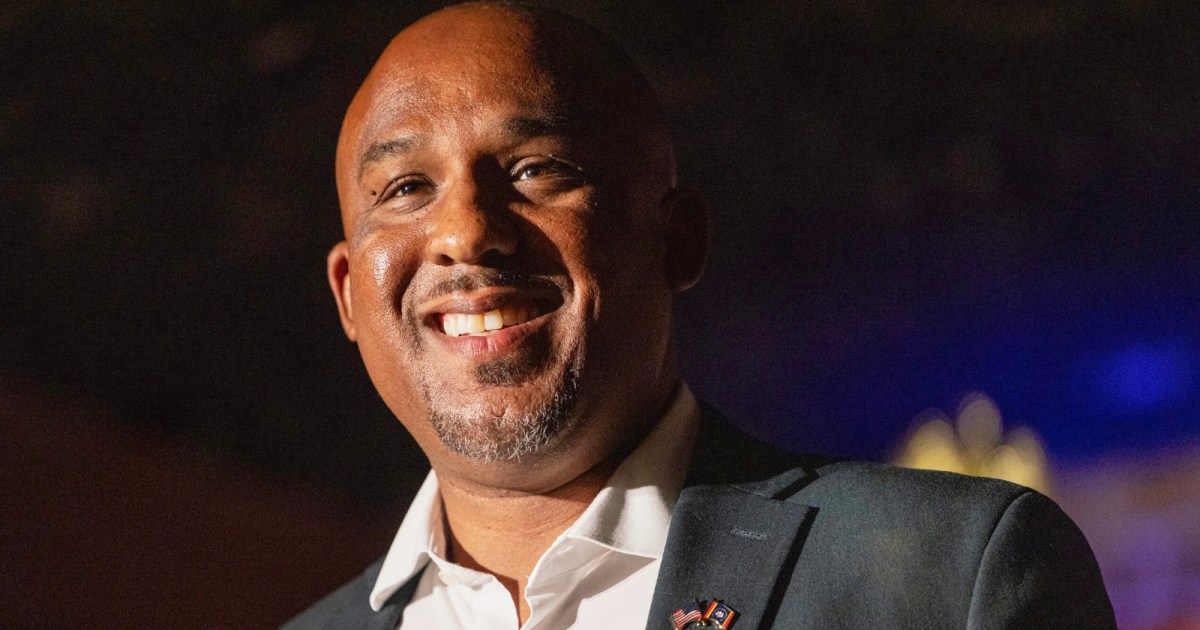
Mississippi Democratic Senate candidate Scott Colom speaks to supporters during his election watch party in Jackson, Mississippi, November 3, 2026.Eric Shelton/Mississippi Today/AP Get your news from a source that’s not owned and controlled by oligarchs. Sign up for the free Mother Jones Daily. For the closing ad of his US Senate campaign, Democrat Scott Colom stood in the driveway of the house that once belonged to Medgar Evers, the civil rights leader who was assassinated by a white supremacist in 1963 while holding T-shirts that said “Jim Crow Must Go.” “He was killed for helping Mississippians vote,” said Colom. “On Tuesday, use your vote and honor everyone who died for that right.” Medgar Evers was killed in his driveway because he refused to accept a Mississippi where some were denied the right to vote.He stood with thousands who marched, organized and sacrificed so future generations could have a voice. We owe it to them not to take that right for… pic.twitter.com/nEHTihVoIm— Scott Colom (@scott_colom) November 1, 2026 Now Colom, in a fitting tribute to Evers, has made history as the first Black US senator from Mississippi since Reconstruction. The longtime district attorney is also the first Black candidate to win any statewide office in Mississippi since Reconstruction. His shocking upset victory in a state where Donald Trump won by 23 points in 2024 is even more remarkable considering Mississippi’s history. This was the state where Jim Crow was the most violent and repressive. It was where Emmett Till was lynched, Evers was assassinated, and the young civil rights workers James Chaney, Andrew Goodman, and Michael Schwerner were murdered by the Ku Klux Klan. There were 581 documented lynchings during the Jim Crow era, more than any other state. “Just to mention Mississippi, to cross the state line from Alabama and go there, it just created all types of problems in my own mind,” the late congressman and civil rights activist John Lewis once said. “It seemed like when you just drove over the state line, something happened to the air, to the environment. It was a psychological thing… Alabama is bad; Alabama is hell. But to go to Mississippi at the time was worse than hell.” “Black voters recognized that the 2026 midterm election quite literally was an existential moment for our democracy. So you saw that play out where now we have made history 150 years in the making.” Before the passage of the Voting Rights Act, only 6.7 percent of eligible Black voters were registered to vote in Mississippi. Now, more than 60 years later, it was Black voters who turned out in record numbers to rewrite the history books, motivated in part by a new struggle to protect voting rights. As was the case across the South, the Supreme Court’s demolition of the Voting Rights Act in the Louisiana v. Callais decision spurred Black voters to cast their ballots at a historic rate. Following the decision, Mississippi Republican Gov. Tate Reeves called on the legislature to pass a new map sometime before 2027 that would oust Rep. Bennie Thompson, the only Black member of Congress from the state. Thompson earned national prominence as chair of the US House committee investigating the January 6 attacks. Echoing the racist rhetoric white segregationists used to attack Black voting power during Reconstruction, Reeves announced that Thompson’s “reign of terror” would soon be over. After Reeves’ announcement, thousands of civil rights supporters, including Colom, rallied in Jackson in protest. It was the largest mass demonstration in the state since the civil rights era. “That was an incredible example of the level of anger and frustration and energy that exists here in Mississippi and across the South in response to the Callais decision,” says Amir Badat, a Mississippi native who serves as the Southern states director for Fair Fight Action, the voting rights group founded by Stacey Abrams. “All of the energy that we saw among Mississippians, in particular among Black Mississippians, fed directly into the turnout that we saw for this election…People were able to make that direct connection between maps and the issues that affect them on a day-to-day basis.” Colom turned the impending loss of Black representation—in the state with the largest percentage of Black people in the country—into a rallying cry on the campaign trail. “They want to try to go back where our vote and our voice doesn’t matter,” he said. “And thank god our ancestors gave us the one power we need in this moment…the power to vote.” The Black share of the electorate increased by three points in Mississippi from 2024 to 2026—enough to make the difference for Colom in a race decided by just a few thousand votes. According to exit polling by CNN, Colom won 27 percent of the white vote but 97 percent of the Black vote. In majority-Black counties in Mississippi, turnout reached 87.4 percent of 2024 levels compared to 73.8 percent in majority-white counties, the largest gap in the South, according to data compiled by Tom Bonier, a senior adviser with the Democratic data firm TargetSmart. In recent elections, Black turnout lagged behind white turnout in the South—in 2026, that trend was reversed. Mississippi voters cited “democracy” as their second most important issue in the campaign, after the economy, and those voters broke for Colom by a 2-1 margin. “Black voters recognized that the 2026 midterm election quite literally was an existential moment for our democracy,” says Charles Taylor, executive director of the Mississippi NAACP. “So you saw that play out where now we have made history 150 years in the making.” Even before the Callais decision, Taylor commissioned a poll during Mississippi’s primary in March asking Black voters if they’d rather have a candidate prioritize protecting their rights or lowering costs. Three-quarters said protecting their rights. Taylor said the Mississippi NAACP raised four times as much money this year compared to previous election cycles, allowing them to make an “absolutely unprecedented” investment in organizing that included opening 11 voter registration field offices, registering more than 17,000 new voters, knocking on 150,000 doors in 40 counties, sending 700,000 mailers, and 1.4 million text messages. “We told people that we needed them to vote,” Taylor said, “and Scott did a great job convincing them that he was the one to vote for.” Colom’s campaign had to overcome the state’s many demons from the past while inspiring a new way forward that embraced, rather than rejected, multiracial democracy. He won Hinds County, where Evers lived, by 61 points. He won Sunflower County, the home of notorious segregationist former Senator James Eastland, by 52 points. He won Leflore County, where Till was lynched, by 51 points. He flipped Forrest County, named after KKK founder Nathan Bedford Forrest. He lost Neshoba County, where Chaney, Goodman, and Schwerner were murdered, but improved upon Kamala Harris’ numbers by 28 points. And Colom had to fight a persistent system of voter suppression that seems designed to preserve the white power structure. Mississippi ranked dead last in the country in voter turnout during the last midterm and at the bottom of ease of voting. It has no early voting, no online registration, and voters must have a government-approved reason to cast an absentee ballot. On top of that, Republican Secretary of State Michael Watson removed 1 in 9 voters from the rolls in the run-up to the election based on faulty credit data, forcing many otherwise eligible voters to cast provisional ballots that may—or may not—have been counted. “One big takeaway from this is that the system in Mississippi is broken in many ways,” says Badat. In the end, Colom was a joyful warrior, playfully skewering his GOP opponent Cindy Hyde-Smith for suggesting that Mississippians should “pick another protein” because of the price of beef and casting her as a vampire in a viral Halloween parody of Sinners called “Sinators” that featured his twin brother. It was Hyde-Smith who blocked Colom from becoming a federal judge during the Biden administration, but he finally got his revenge. Sometimes the weight of history is so heavy in Mississippi that it’s better to laugh than cry. Colom’s election will have immediate ramifications on the politics of Mississippi. Leading Republicans expected the governor to call a special session after the election to redraw Mississippi’s Congressional and legislative maps. That has not happened yet. “If I were the Republicans in the legislature or in the state government and I were thinking about whether or not to redistrict, I would would take a really hard look at the results that we saw in this election because it’s going to make it way harder for them to eliminate Black-majority districts and still feel safe that their Republican incumbents are going to be able to win,” says Badat. The elimination of Bennie Thompson’s district and majority-Black seats in the legislature would likely motivate Black voters to turn out in higher numbers again for state elections next year, when legislative and statewide elections take place. “I think the significance of this victory is that now people in Mississippi understand that they can exercise their power to achieve real change, and I think that’s going to translate into engagement for the 2027 elections as well,” Badat adds. Colom’s improbable win is much bigger than simply a political victory. Angela Grayson, civic engagement director of the Mississippi Black Women’s Roundtable, a nonprofit pro-democracy group, cited the impact it will have on her two daughters in college. “What it means for me is an opportunity for them to be able to come home and want to stay and be able to not just live in Mississippi and survive, but then be able to thrive,” says says. “What I want for them more than anything is to have representation at every level. Someone in government who understands their lived experiences, and then be advocating for a better quality of life for them.” The fight for civil rights is not ancient history for many in Mississippi, including Taylor. He sees Colom’s election as “a dawn of a new day in the state.” Taylor is the seventh executive director of the Mississippi NAACP. The first was Medgar Evers. “His office is my office, and that’s a weird thing to say, and I say it very humbly,” Taylor says. Every window in the building is lined with bullet holes. He thought about the significance of that when he saw Colom’s closing ad. “After watching that ad I took a moment and just reflected on all of what has transpired over the last 60-plus years.” Today, Mississippi has more Black elected officials than any other state. When Evers was alive that number was zero. “Medgar Evers did the work that we did this year,” Taylor says, “which was take a piece of paper and ask someone to put their name on it in order to be one step closer to exercising the most fundamental promise of our democracy.”
Mississippi, Once the Epicenter of Jim Crow, Elects Its First Black Senator Since Reconstruction
Full Article
Original Source
Read the full article at Motherjones →KhanList aggregates and links to publicly available news content. We do not host full articles from third-party sources. Always verify important information with original sources.