
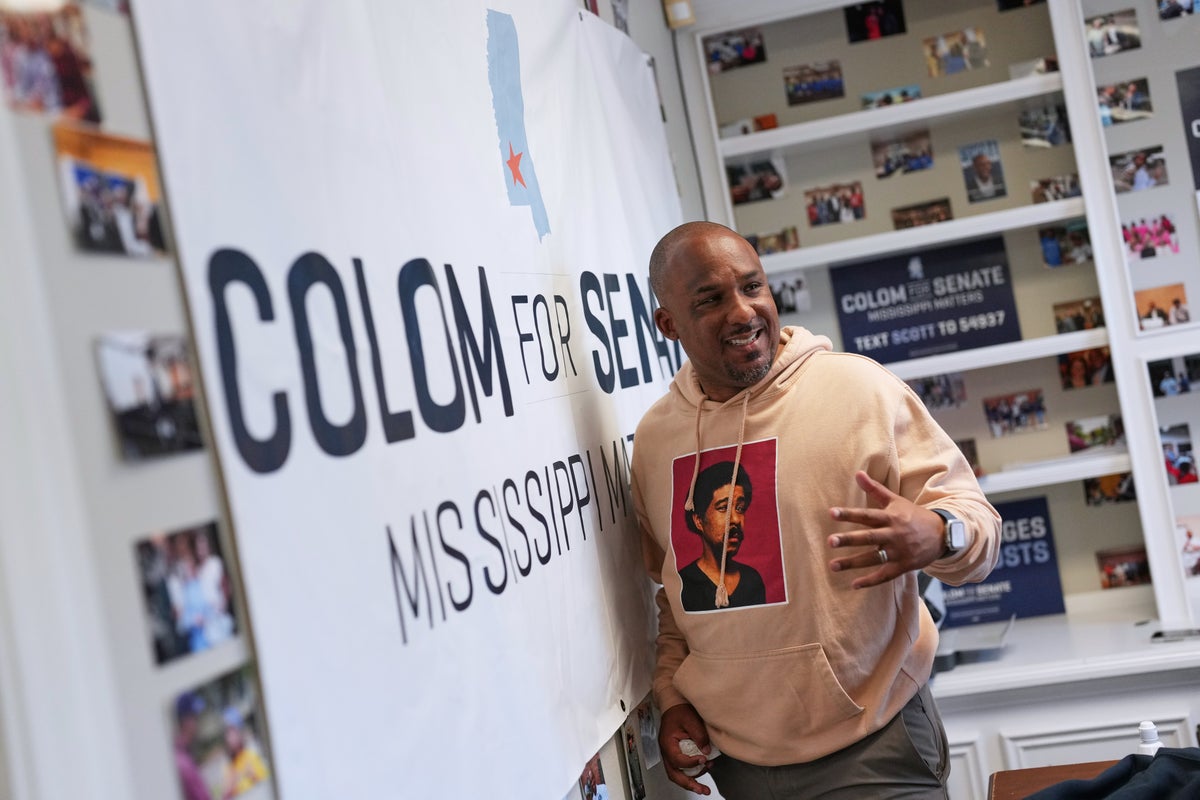
Blanche Bruce was born into slavery in 1841. He later served one term as a U.S. senator from Mississippi. He was the second — and the last — Black senator from a state at the violent heart of the nation’s civil rights struggle.Nearly 150 years later, Mississippi voters elected Scott Colom, who is poised to be the first Black candidate elected to the U.S. Senate from the Deep South state since the aftermath of the Civil War.Colom’s election will oust Republican incumbent Cindy Hyde-Smith and add to an explosive series of Democratic victories in midterm elections that have shifted the balance of power in Congress and are likely to derail the final two years of Donald Trump’s administration.Colom’s victory also is a seismic rebuke against threats to the ballot box and the relics of a bloody history that made Mississippi among the hardest places to vote in the country.Mississippi was one of two states alongside Alaska where Americans are still eagerly anticipating the results of Senate elections more than one week after Election Day. Democrats are projected to hold at least 55 seats in the Senate and more than 255 seats in the House of Representatives.(AP)This week, all eyes were on Hinds County, Mississippi’s most populous county and a Democratic stronghold that spans the state’s capital of Jackson, where election officials tallied remaining ballots on Wednesday.Most of the remaining ballots in the state are affidavit ballots, which voters cast if they did not bring identification with them to the polls or were listed as having an inactive voter registration.Voters cast 2,426 affidavit ballots in Hinds County. Election officials rejected 1,609 of them, and the vast majority of accepted ballots were cast for Colom.By Wednesday night, Colom’s lead in the state increased to more than 5,000 over Hyde-Smith, with 99 percent of ballots counted, according to unofficial results from the Associated Press. Colom’s campaign and election analysts determined outstanding ballots would not make up the difference.Mississippi law does not provide for a recount process for Senate races, opening the door for the Senate battle to play out in courtrooms.(AP)The state is also one of only three states that do not allow early in-person voting and among a dozen that do not allow universal mail-in voting. Republicans have also tried to throw out mail-in ballots that were postmarked before Election Day but arrived later, a challenge that the Supreme Court rejected earlier this year.Mississippi also has retained a Jim Crow-era law that imposes a lifetime ban from the ballot box against anyone convicted of certain felony crimes, a law that currently disenfranchises nearly 70,000 disproportionately-Black residents — or about 3 percent of the state’s eligible voting population.Roughly 40 percent of Mississippi residents are Black, but the state’s political makeup for decades has largely been made up of white officials at the state and federal level.According to the Movement Advancement Project’s ranking of voter access by state, Mississippi is dead last.A color lithograth J. Hoover from 1881 depicts abolitionist Frederick Douglas between Mississippi Senators Blanche Bruce, left, and Hiram Revels, right (Getty Images)In 1870, the Mississippi legislature Hiram Revels to fill one of the state’s two Senate seats left vacant after the Civil War. The country’s first Black senator filled the seat previously held by Confederate Albert Brown, a slaveholder who championed what he called the “blessings of slavery” beyond American borders.Several years later, Blanche Bruce was elected to the seat once held by Confederate President Jefferson Davis.But in the turbulent aftermath of the Civil War and emancipation, from white militia terror during Reconstruction through the decades-long Civil Rights movement, Mississippi never elected a Black senator again.The state’s last Democratic senator was among the Dixiecrats before a political realignment flipped the party platforms in the wake of civil rights progress and New Deal economic policies.John C. Stennis — the state’s last Democratic senator — opposed school integration, voted against the Civil Rights Act and the Voting Rights Act, and tried to block the creation of Martin Luther King Jr. Day as a federal holiday. He served for 41 years until his retirement in 1988.In 1934, as a trial prosecutor before his political career, Stennis was at the center of a murder case that led to a landmark Supreme Court ruling that determined confessions could not be coerced through violence and torture.Stennis had argued for a jury to convict three Black men accused of murdering a white man. One of the men on trial was nonfatally hanged twice and beaten while in custody. The others were also beaten until they confessed.They were each found guilty and sentenced to death before their convictions were overturned.Like Stennis, Colom worked as a prosecutor and a judge before launching his political career.Colom, a seventh-generation Mississippian, was nominated by then-President Joe Biden to serve as a federal judge for the Northern District of Mississippi in 2022.But his nomination was blocked by one of the state’s two Republican senators: Cindy Hyde-Smith.
Mississippi elects its first Black senator in 150 years giving Democrats a 55-seat majority
Full Article
Original Source
Read the full article at Independent →KhanList aggregates and links to publicly available news content. We do not host full articles from third-party sources. Always verify important information with original sources.