
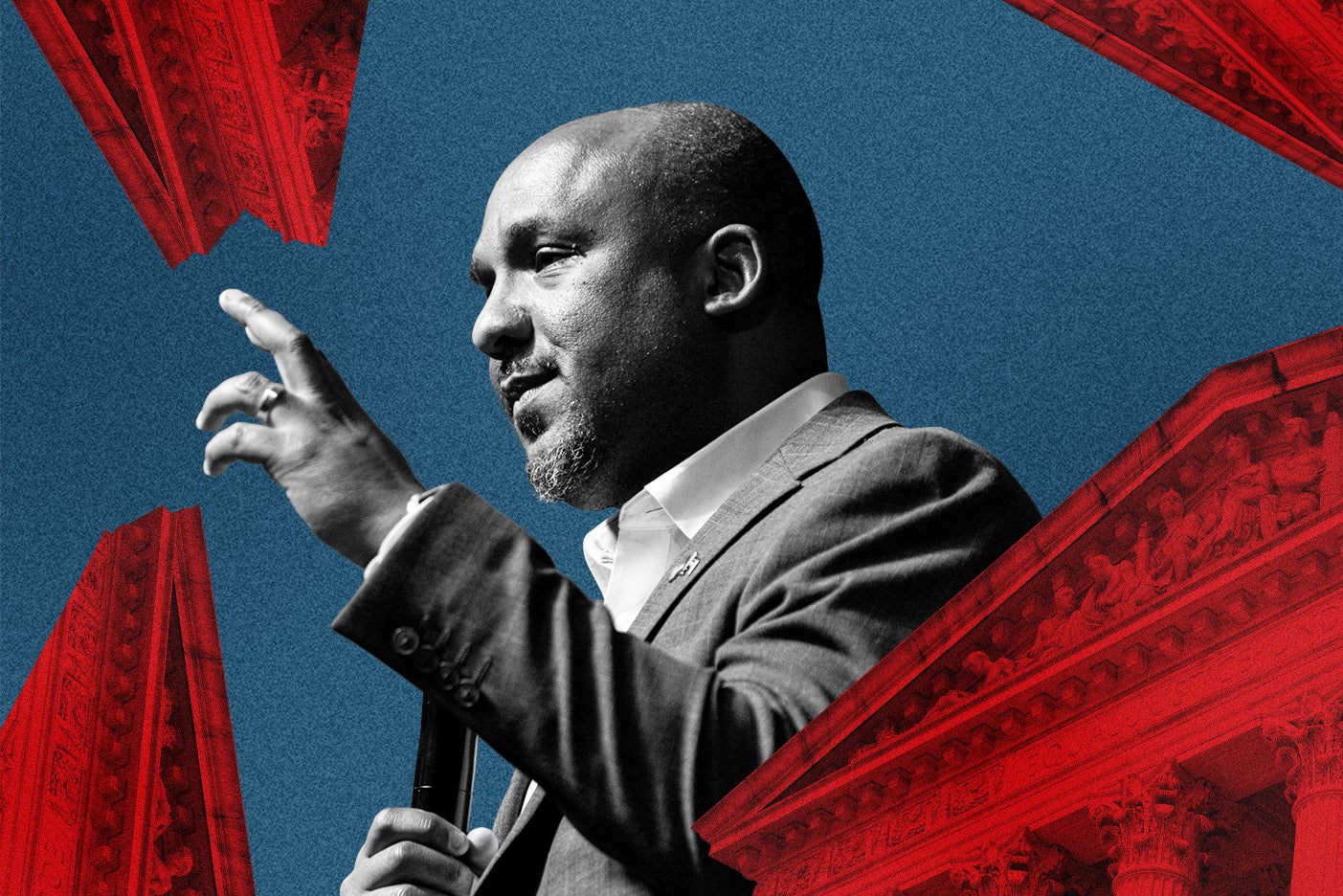
Jurisprudence By Enter your email to receive alerts for this author. Sign in or create an account to better manage your email preferences. Unsubscribe from email alerts Are you sure you want to unsubscribe from email alerts for Shirin Ali? Nov 12, 20265:50 AM Photo illustration by Slate. Photos by Brad Vest/Getty Images and Getty Images Plus. This is Executive Dysfunction, a newsletter that highlights one under-the-radar story about how Trump is changing the law—and how the law is pushing back—and keeps you posted on the latest from Slate’s Jurisprudence team. Click here to receive it in your inbox each week. The blue tsunami hit over a week ago, and it’s still making waves for Democrats. We’re looking at you Mississippi—one of the reddest states in the country was finally called for Democrat Scott Colom. He will be the first elected Black senator for the state in over 150 years, unseating Republican incumbent Sen. Cindy Hyde-Smith. Colom’s win came down to just a few thousand votes, and each side had lawyered up in anticipation of an ugly legal battle. The entire process has highlighted just how archaic Mississippi’s voting system is, even as—this time—democracy seems to have prevailed. On Wednesday evening, Mississippi’s senate race was called for Colom, who ended up carrying the state by about 4,600 votes over Hyde-Smith. Now, election officials will finalize remaining affidavit ballots, including ones for voters who had their registrations incorrectly marked inactive after a massive purge of Mississippi’s voter rolls ahead of this year’s midterm elections. Come Friday, county election commissioners for all of Mississippi’s 82 counties have to submit their certified election results to the secretary of state’s office. Then, on Dec. 3, Secretary of State Michael Watson is scheduled to declare the statewide general election results. The Colom and Hyde-Smith campaigns have indicated they are preparing for potential legal action, with both sides deploying small armies of attorneys and observers to monitor the ballot counting process. Challenging whether certain ballots should be counted is one of the only ways candidates can contest the outcome of a federal Senate race in Mississippi, as it is the only state in the country that does not have a law in place for automatic vote recounts in close races. The state also does not have a law in place mandating runoff elections. That means that Colom and Hyde-Smith must wait until final results of their election are announced before they can file a lawsuit (with the potential to result in a recount), which could happen any time after Friday’s deadline. Two days after Election Day, Hyde-Smith’s campaign sent a letter to each county election commissioner and circuit clerk for all 82 Mississippi counties demanding they separate all affidavit ballots from regular and absentee ballots. Affidavit ballots are generally used when a voter does not have their ID or was previously marked as inactive, as was the case for upward of 200,000 Mississippi voters after Watson partnered with credit agency Experian to purge the state’s voter rolls. In order to validate an affidavit ballot, voters have to physically go to their circuit clerk’s office and present their ID within five business days of filing that affidavit ballot in order for it to be counted. This is a move straight out of the Trump administration’s playbook, as the Justice Department in October similarly demanded California election officials separate mail ballots for about 20,000 voters it claimed it suspected were noncitizens trying to vote. A federal judge ruled against the DOJ, writing that separating ballots would “risk disenfranchising an untold number of voters” and “would wreak havoc and disrupt the election that is already underway” and “create a chilling effect on election workers and voters alike.” Nevertheless, Hyde-Smith’s team insisted that separating affidavit ballots is required by Mississippi law and federal law, so that each one “can be verified.” That very same day, Colom’s campaign fired off their own letter to Mississippi’s election officials acknowledging Hyde-Smith’s demands and warning that if they depart from ordinary election procedures, they “will violate Mississippi voters’ rights and Mississippi election law.” So, who’s right here? Well, the Mississippi Supreme Court ruled on this issue back in 1975 in Clark v. Rankin County Democratic Executive Com. and concluded that separating certain ballots is unlawful because it undermines “the secrecy of a voter’s ballot.” Colom’s campaign also noted that the U.S. Supreme Court’s decision in Bush v. Gore asserted that the “arbitrary and disparate treatment of voters in its different counties” amounts to “a constitutional violation” of the equal protection clause of the 14th Amendment. It’s also worth noting that in the event that Hyde-Smith or Colom is successful in forcing a recount through filing a lawsuit, these types of procedures “very rarely change the results of elections,” as Derek Muller, Notre Dame law professor, noted on the Election Law Blog. So far, the slow dribble of counting affidavit and mail ballots has favored Colom, something he predicted at the outset of Election Day. “The affidavit [ballots] always move in the Democrats favor in Mississippi. If you look at the ballots that are left, it’s going in our favor,” Colom told reporters. Mississippi was not on Democrats’ wish list heading into the midterm elections, relegated as a state that was impossible to flip from Republicans, something Colom argued hurts many Southern Democrats. But as his campaign catapulted to the national stage on Election Day and has since captivated the national news media, Mississippi’s Senate race also sheds light on how the state has gotten away with suppressing voting rights for decades. It’s one of three states that does not offer early voting, while it requires an excuse to vote by mail. The state also strips individuals convicted of certain felonies of their right to vote. In this race alone, 24 percent of affidavit ballots were rejected for issues such as having an incorrect county registration or the person voting at the incorrect precinct. The rejections appear to have been much more severe in deeply blue counties. Meanwhile, Mississippi is home to the highest share of Black voters, who account for nearly 40 percent of the state’s population, yet lawmakers have ensured there is only one Black-majority district in the entire state. Even that may go away soon, as state Republicans considered redistricting, now a perfectly legal endeavor thanks to the Supreme Court’s Louisiana v. Callais decision. However, on Nov. 3, Mississippi voters showed up and showed out in numbers that are proving to be insurmountable, in spite of all the barriers they face. We hope you learned a thing or two from this edition of Executive Dysfunction, and if you enjoyed reading it, please consider supporting our legal journalism by becoming a Slate Plus member! Elsewhere in Jurisprudence On this week’s episode of Amicus, Dahlia Lithwick talks about the midterm rebuke of Donald Trump with Ian Bassin, co-founder of Protect Democracy. Voters pushed back against authoritarianism, and now it’s up to Democrats to turn their victories into lasting change. That includes reforming the Supreme Court and repairing the Justice Department.While the blue wave washed over America, it was business as usual at the U.S. Supreme Court. The justices held oral arguments for a case designed to discriminate against LGBTQ+ families, and Dahlia discussed what went down with guest Madiba K. Dennie. The current House of Representatives failed to impeach Secretary of Defense Pete Hegseth, but they should keep trying once the new Congress is sworn in, Frank Bowman, law professor and former federal and state prosecutor, argues in Slate. A new slate of Democratic lawmakers is likely to try to impeach Hegseth next year, and at that point, Republicans may just go along with it, considering it a low-cost mode of distancing themselves from the Iran war and other deeply unpopular Trumpian military misadventures.The Supreme Court is considering a case that will determine whether anyone harmed by federal agents, whether in prison, in immigration detention, or on the street, can sue them for damage and hold them personally liable. Madiba K. Dennie breaks down how oral arguments went, including how SCOTUS has been invoking hypothetical congressional action as an excuse to ignore the very real harm federal agents inflict on people.There are plenty of lessons to take away from the midterm elections, but one that should top the list: Stop mass deportations. Voters the president convinced to trust him to overhaul our immigration system swung decisively to Democrats last week after spending nearly two years with targets on their backs. I argue that now is the moment for Congress to heed its mandate and rein in ICE. Thank you for reading Executive Dysfunction! We’re thrilled to be in your feeds and will be back with more dysfunction analysis next week. Donald Trump Elections Jurisprudence Voting Voting Rights Mississippi 2026 Midterms Executive Dysfunction
Mississippi Couldn’t Stop Scott Colom’s Victory—But It Wasn’t for a Lack of Trying
Full Article
Original Source
Read the full article at Slate →KhanList aggregates and links to publicly available news content. We do not host full articles from third-party sources. Always verify important information with original sources.