
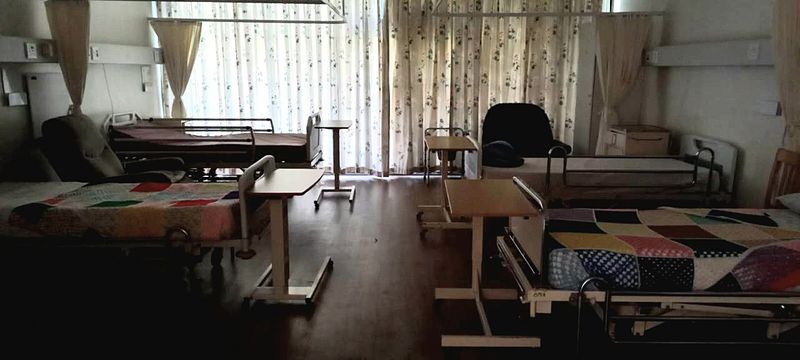
For more than 40 years, the answer was often “St Luke’s Inpatient Unit”. It was a place where symptoms could be brought under control, families could have some respite, and patients received compassionate, person-centred care from a team who understood the needs of people approaching the end of their lives.Almost two years after its closure, the unit still stands empty. Meanwhile, people with life-limiting illnesses continue to suffer, and families are left struggling to find a place where their loved one can die with grace and dignity. We are Put Patients First, a group of former St Luke’s staff and volunteers. We are raising these concerns once again because the people at the centre of this debate, patients and their families, cannot always speak for themselves. On 21 August 2026, GroundUp published Home or Hospice: the debate over the closure of St Luke’s inpatient unit. The responses from St Luke’s and the Department of Health have left us feeling that the real issue is being sidestepped.Former staff and volunteers say dying at home cannot be treated as a universal solution in an overstretched public health system, where hospitals are no substitute for hospice care. (Photo: iStock) The ‘people prefer to die at home’ conundrumWe all understand the wish to die at home, surrounded by family and familiar things. Sadly, St Lukes has treated this as a universal solution, and has not sufficiently accounted for the lived realities of its patients and the limits of our over-burdened public health system.The average family served by St Luke’s does not necessarily have the space, money, strength or skills to manage the final stages of a serious illness. Caring for someone who is dying is often both physically and emotionally exhausting. There may be no proper bed, basic utilities, and little or no opportunity for the family to rest, while caregiving needs intensify. Community home-based carers can provide valuable support, but visits are limited to twice a week for 90 minutes. When patients deteriorate after hours, families can find themselves with nowhere to turn. Panicked, they call an ambulance. If the patient survives the journey, there may be a long wait in an emergency department and another in a hospital passage until a bed is found.This is not a criticism of hospital staff. They work under immense pressure and do their best in very difficult circumstances. A general hospital bed, however, is not the same as a specialist hospice bed: a curtain hurriedly drawn around a bed does not provide the privacy, time and compassionate support that a dying patient and family need. It is the very antithesis of the total pain model of care, a defining feature of palliative care. Was the IPU underutilised? St Luke’s claimed that the Inpatient Unit cared for an average of three to five patients as compared to “600 on any given day” in the community. Hence the switch to offering only community-based services going forward. These figures should not be taken at face value. The low occupancy figures need to be considered in the context of St Luke’s financial difficulties. Staff recall that weekend and 24-hour nursing cover were discontinued in 2023 to cut costs. Consequently, medical aids started to refer paying patients elsewhere. Admission numbers were reduced to limit the number of carers required. Despite this there was always a waiting list, and patients sometimes died before they could be admitted.The quoted 600 in the context of St Luke’s staff capacity can only be referring to the number of registered patients with open files, not active, clinical interventions by staff. In our view, reputational damage following critical press coverage of St Luke’s management in the Sunday times 2019 has contributed to sustained financial difficulties. We have heard that a recent PWC audit raised concerns including governance failures, a culture of fear, lack of trust, staff shortages and high staff turnover. We feel that the St Luke’s Board has not adequately addressed those concerns and has instead removed a vital service. A weathered passage at the hospice in Kenilworth. (Photo: Supplied / GroundUp) Where are the equivalent facilities? In the GroundUp article, St Luke’s and the Department of Health referred to “a range of facilities and partnerships” as alternatives, mainly hospitals and transitional care facilities. Are these appropriate replacements?Transitional care facilities primarily help patients to recover and return to their lives. Their focus differs significantly from caring for someone needing end-of -life support and all the practical and existential issues that typically arise.Living Hope in Kommetjie is regularly cited as an alternative by St Luke’s. Living Hope is a private, explicitly evangelical Christian NGO. It has 22 beds, with one or two designated for palliative care. There is a long waiting list and patients who are actively dying are not admitted. In our experience, its overtly Christian character could be spiritually distressing for terminally ill patients of other faiths. Booth Memorial requires an upfront payment of R250 a day, putting it out of reach of many of our families.We know of a community nurse who spent a week trying to find placement for two patients. Nothing was available. One family was eventually advised to call an ambulance. The paramedics assessed that their relative was close to dying. The family then changed their minds to spare their relative a cold, lonely death in the emergency ward. We were told that numerous bedsores had developed after the person had been moved into the tiny home of a family member when their own home situation had become untenable.This is the reality behind the statistics. It is about real people, real families and suffering that could perhaps have been eased if appropriate care had been available.A basic human rightPalliative care is a basic human right. Despite this, no public hospitals to our knowledge have a palliative care ward or dedicated palliative care beds at this point. Terminally ill patients lie in overcrowded hospital wards with other patients with urgent and competing needs.The Department of Health has its own National Policy Framework and Strategy on Palliative Care. It recognises that person-centred, holistic palliative care is an essential part of healthcare and that access to services to relieve unnecessary pain and suffering is our right as human beings. We recognise the valiant efforts being made in public hospitals to provide basic palliative care wherever it is needed. This does not, however, remove the need for specialist care when a patient’s circumstances demand it. In our view, the Department of Health cannot simply count beds and say the need has been met. It must show that the care is appropriate, and available when people need it. St Luke’s has outsourced its responsibility to its patients to a public health system that cannot offer equivalent care. Beds from the now closed inpatient unit stand in the courtyard at St Luke’s. (Photo: Supplied / GroundUp) St Luke’s: prove that need exists In the article, the St Luke’s Board said it would reconsider opening the Inpatient Unit if there was clear, sustained evidence of clinical need together with long-term funding.Community nurses, volunteers and families see the problems every day. But there is no clear public picture of how many referrals fail, how long patients wait for a suitable placement, how many deteriorate while waiting, or how many die without ever receiving the care they need.We believe that the Department of Health should help establish this evidence. It should work with hospitals, community teams and families to assess the actual need for specialist inpatient palliative care. It should also create safe ways for staff, volunteers and families to speak about unmet needs without fear of reprisals. What now?Many people can and should be cared for at home. However, those who cannot, should not be abandoned simply because the system has decided that home care is the preferred model.If community care is the future, then fund it properly: provide adequate nursing cover, realistic visiting times and access to skilled help when families need it most. At the same time, retain a small specialist inpatient unit for patients with intractable pain, complex symptoms and families desperately needing respite. This relationship used to exist between Groote Schuur and the Inpatient Unit. If transitional facilities are the answer, ring-fence and staff beds for dying, not for just rehabilitation.The Inpatient Unit building remains vacant. Could the Department of Health lease or purchase it to fill the gap in its service? The public deserves to know why St Luke’s was denied funding that would have kept it operating. And does the possibility of funding still exist?Dignity is not a luxury for those who can afford it. Every person has intrinsic worth and the right to die with dignity. DMPut Patients First is an advocacy group of former St Luke’s Hospice staff and volunteers.
MISSING BEDS: St Luke’s hospice unit closure — Has dying without dignity become acceptable?
Full Article
Original Source
Read the full article at Dailymaverick →KhanList aggregates and links to publicly available news content. We do not host full articles from third-party sources. Always verify important information with original sources.