
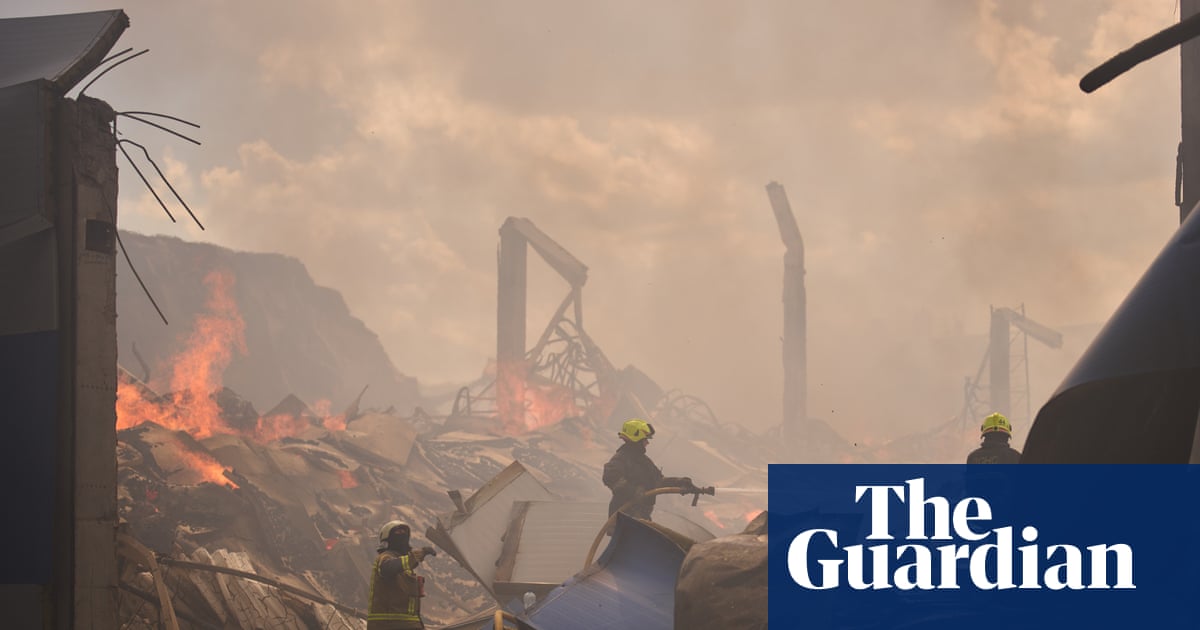
Stocking up on cured sausages from the half-empty shelves in her local supermarket, Valentyna Sveshnikova is worried about money. The 68-year-old grandmother lives off her small pension and has already noticed the cost of several goods increase, including sausages. Russia wants “to make our life miserable and impossible. And they’re actually succeeding in it,” she says.Russian strikes on food warehouses and logistics supply chains around several Ukrainian cities have left gaps on supermarket shelves and risk causing price increases.Kyiv has faced a particularly intense barrage of attacks. A temporary truce that was in place between Moscow and Kyiv to ensure the safe passage of US negotiators over the weekend ended abruptly on Monday night when jet-powered drones and ballistic missiles pounded Ukraine’s capital, killing two people.Dariya Malyukova shopping for groceries a Novus supermarket in Kyiv. Photograph: Amy HawkinsMany shelves at the Novus supermarket where Sveshnikova is shopping for groceries are empty. But customers, hardened by four years of war, are sanguine. “It’s scary, but I don’t plan to go anywhere,” says 40-year-old Dariya Malyukova.The agrarian policy and food minister, Taras Vysotsky, has warned that food prices could increase by 2.5% because of the attacks on warehouse infrastructure.But Dmytro Krymskiy, the co-founder of Bureau of Wine, which operates several high-end retail brands in Ukraine, including the supermarket chain Goodwine, says the impact could be as high as 15%.Many shelves lie empty at Novus supermarket due to the Russian attacks on food infrastructure. Photograph: Amy HawkinsOne of Krymskiy’s warehouses near Kyiv was hit on 1 September, wiping out €4m (£3.4m) of stock. The attacks “seriously hurt our business”, he says.Krymskiy says that prices will increase not because of a shortage of supplies, but because of the cost of reorganising supply chains to make them more resilient against strikes.He is exploring several options, including moving his warehouses to a neighbouring country such as Poland, using underground storage facilities and splitting his stock across several smaller sites. “We understand that we cannot have only one big warehouse,” he said. Krymskiy thinks his prices could rise by about 5%.The latest strike did not come as a complete surprise; it was the third time since the start of the full-scale invasion that his warehouses had been hit. The first, in 2022, destroyed €15m of supplies, while another attack in July this year annihilated €1.5m-worth of goods.The site of a Russian strike on a warehouse in the village of Myla, Kyiv oblast, in August. Photograph: Dan Bashakov/AP“It was really a matter of time,” he says. “The problem is, we had 3,000 pallets there, and you simply cannot move it,” he says. The recent onslaught of airborne attacks also meant that warehouse staff could only work for three to four hours per day, reducing the company’s ability to shift stock.The raids come at a difficult time for Ukraine. Kyiv has been hit by a torrent of daily drone and missile strikes since late August, killing dozens of people and destroying key infrastructure. As well as the food warehouses, Russia has targeted e-commerce logistics hubs and stockpiles of medical supplies.On Wednesday night, one of the World Health Organization’s main warehouses storing humanitarian aid on the outskirts of Kyiv was hit.At the warehouse of Biokon, a pharmaceutical company, the air was thick with the smell of burnt fuel on Friday as firefighters picked through the wreckage of the building. The company said in a statement that three months of medicines had been destroyed and that it had suspended all operations.Shopkeepers and customers say that most people are not panic-buying food in the way that they were in 2022.Ukraine’s food minister said Moscow was deliberately targeting ‘the internal civilian life support system’. Photograph: Libkos/Getty Images“What’s the point?” says Iryna Mesyanzhynova, a 54-year-old woman shopping for groceries at ATB, a low-cost supermarket in Brovary, near some of the burnt-out warehouses. “I have a bit of extra products, like porridge oats, but for the rest – vegetables, fruits – why would I buy them? They will just rot.“I’m trying to deal with today’s problem,” she says. “I try not to think about the future.”In a statement to the Guardian, Vysotsky, the agrarian policy and food minister, said that the logistics hubs of all of Ukraine’s leading supermarket chains, including Novus, ATB, Silpo and Fora had been destroyed or significantly damaged in the recent strikes.“This wave of strikes is the most massive since the beginning of the full-scale invasion,” Vysotsky said.“If in 2022 the enemy attacked mainly export-agricultural infrastructure, and in the following years destroyed the energy sector, then the attacks of August-September 2026 are a systemic attack on the internal civilian life support system. The enemy is purposefully trying to destroy the logistics that provide Ukrainian cities with food.”Aside from growing their own food, which many people already do, Ukrainians have few options other than trying to continue as normal. The attacks are “not our first of the war”, says Olena Zhuk, a 36-year-old travel manager shopping at a central Kyiv farmer’s market. “We will survive. We will not die from the hunger.”Additional reporting by Illia Dyadik
‘Miserable and impossible’: food scarce in Kyiv as Russia targets supply chains
Full Article
Original Source
Read the full article at Theguardian →KhanList aggregates and links to publicly available news content. We do not host full articles from third-party sources. Always verify important information with original sources.